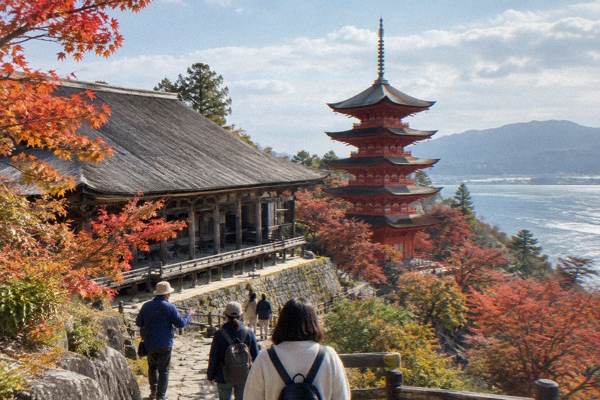
Mount Misen: Ropeway, Trails And The Summit View
Mount Misen is the 535-meter sacred peak on Miyajima, the island in Hiroshima Bay reached by a 10-minute JR ferry from Miyajimaguchi. The ropeway carries visitors most of the way up; three hiking trails climb from sea level; and the summit looks out over the islands of the Seto Inland Sea.
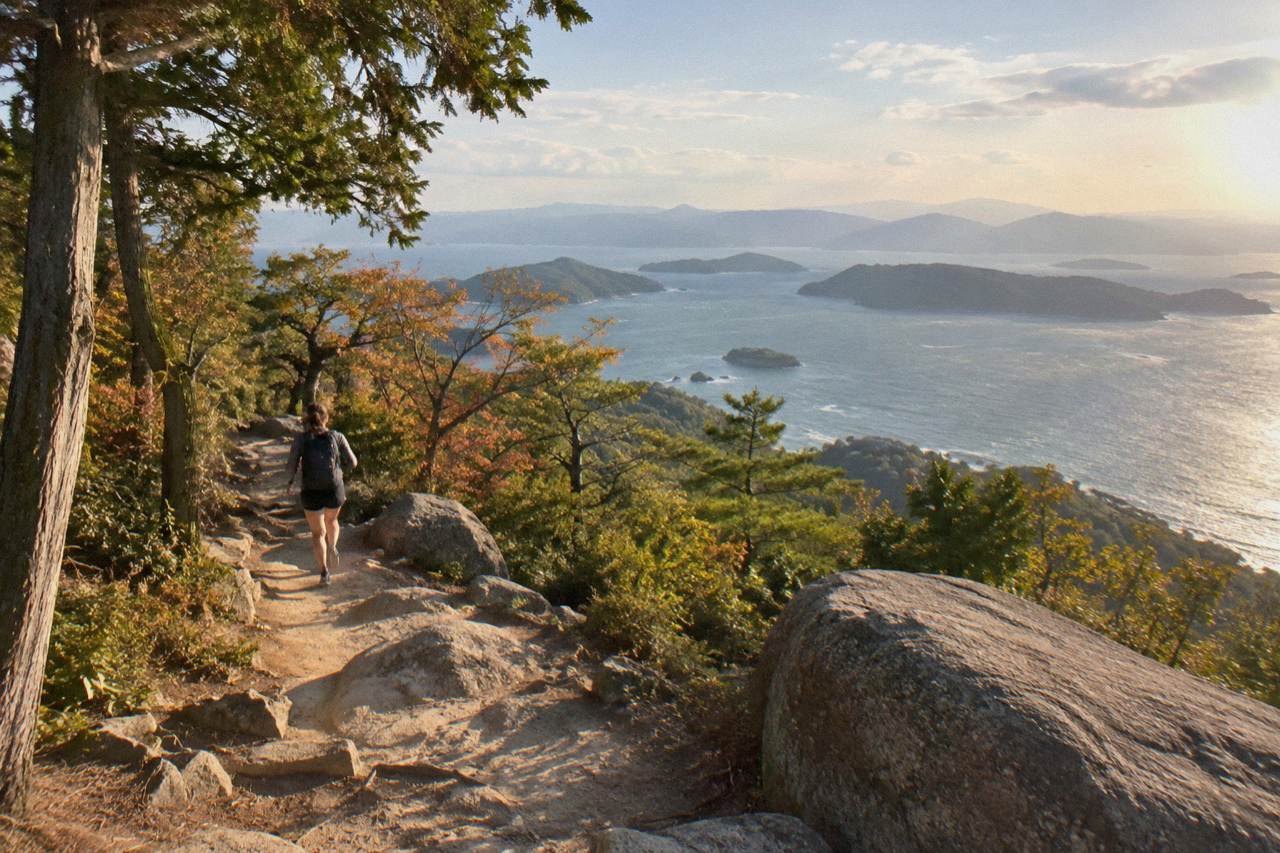
Mount Misen is Miyajima's highest point at 535 meters, a sacred mountain since Kukai founded a training site there in 806 and part of the 1996 World Heritage listing. The ropeway costs 2,000 yen return for adults, runs 9:00 to 16:00 with last descent at 16:30, and the summit is a further 30-minute walk from the top station.
Mount Misen rises 535 meters over the island of Miyajima in Hiroshima Bay, the same island that carries Itsukushima Shrine and its Great Torii in the water. Per the ropeway operator's English access page, the mountain has been a holy site since Kukai, also known as Kobo Daishi, built a training site on it in 806, and it was designated part of a World Cultural Heritage site together with the shrine in 1996. Official sources give the ropeway's two connected lines, its fares and hours, the three walking trails from sea level, the halls near the summit, and the numbers for getting to the island from Hiroshima.
How Much Does The Mount Misen Ropeway Cost?
The Miyajima Ropeway costs 2,000 yen for an adult round trip or 1,100 yen one way, while elementary school children pay 1,000 yen round trip or 550 yen one way. Fares are the same in either direction, so a one-way ticket paired with a walk down costs 1,100 yen. Groups of 25 or more get discounts, and Matsudai Kisen's Enjoy Ticket bundles the ferry round trip with the ropeway round trip at a discount.
Those are the full printed fares, and they are the same whichever direction the ticket covers, so a one-way ticket combined with a walk down one of the trails is a workable plan at 1,100 yen. Payment matters more than many visitors expect: credit cards, IC cards such as ICOCA and Suica, and PayPay are accepted at Momijidani Station at the base, but not at Shishiiwa Station at the top, so cash or a ticket bought below is what works at the upper end. The Information Center at Miyajima Pier, open 9:00 to 12:00 and 13:00 to 17:30, sells ropeway tickets alongside general tourism information.
A combined "Enjoy Ticket" from the Matsudai Kisen ferry operator bundles the ferry round trip with the ropeway round trip at a discount, which suits anyone arriving on that company's boats rather than the JR ferry.
| Ticket | Adult | Elementary school child |
|---|---|---|
| Ropeway round trip | 2,000 yen | 1,000 yen |
| Ropeway one way | 1,100 yen | 550 yen |
How Does The Mount Misen Ropeway Work?
The Miyajima Ropeway is two connected lines: the Momijidani Line, an 8-seater circulating gondola taking about 10 minutes, then the Shishiiwa Line, a 30-seater alternating aerial tram taking about 4 minutes, for roughly 14 minutes of riding in total. The base is Momijidani Station and the top is Shishiiwa Station, and the ride passes over the primeval forest that forms part of the 1996 World Heritage site.
The transfer between the two lines is part of the design, not a detour, and the gondola section is the longer leg. Strollers and wheelchairs cannot be taken into the ropeway cars and must be left at the base station office, and the stations have no elevators, so the ride plus the summit walk is a journey on foot at both ends. Pets are not allowed except guide and assistance dogs. The operator notes that service can be suspended for weather or maintenance, and the official site carries current status, so a morning check is sensible on windy or stormy days.
A free shuttle bus connects the Momijidani Park entrance with Momijidani Station roughly every 20 minutes starting at 9:50, with no service from 12:10 to 13:10, which shortens the flat walk from the ferry pier area to the base station.
| Ropeway detail | Figure |
|---|---|
| Base station | Momijidani Station |
| Top station | Shishiiwa Station |
| Momijidani Line | 8-seater circulating gondola, about 10 minutes |
| Shishiiwa Line | 30-seater alternating aerial tram, about 4 minutes |
| Upward service | 9:00 to 16:00 |
| Downward service | 9:20 to 16:30, last descent 16:30 |
| Regular closed days | None, weather suspensions excepted |
How Far Is The Walk From The Ropeway To The Mount Misen Summit?
From Shishiiwa Station it is about a 30-minute walk to the summit at 535 meters along a steep trail that passes Misen Hondo, per the Miyajima sightseeing association's ropeway course page. The operator's own map gives the standard summit walking course from Shishiiwa Station as about 1 hour round trip including the sights along the way, and a typical visit using the ropeway plus the summit walk runs about 3 hours when the temple halls are included.
The walking figures assume steady legs: the trail is steep, the operator advises layered clothing and sturdy shoes because mountain weather changes quickly, and the path can be slippery when wet. The halls sit on the way, so the round trip doubles as a temple visit rather than a pure climb, and the observatory at the top keeps its own shorter hours.
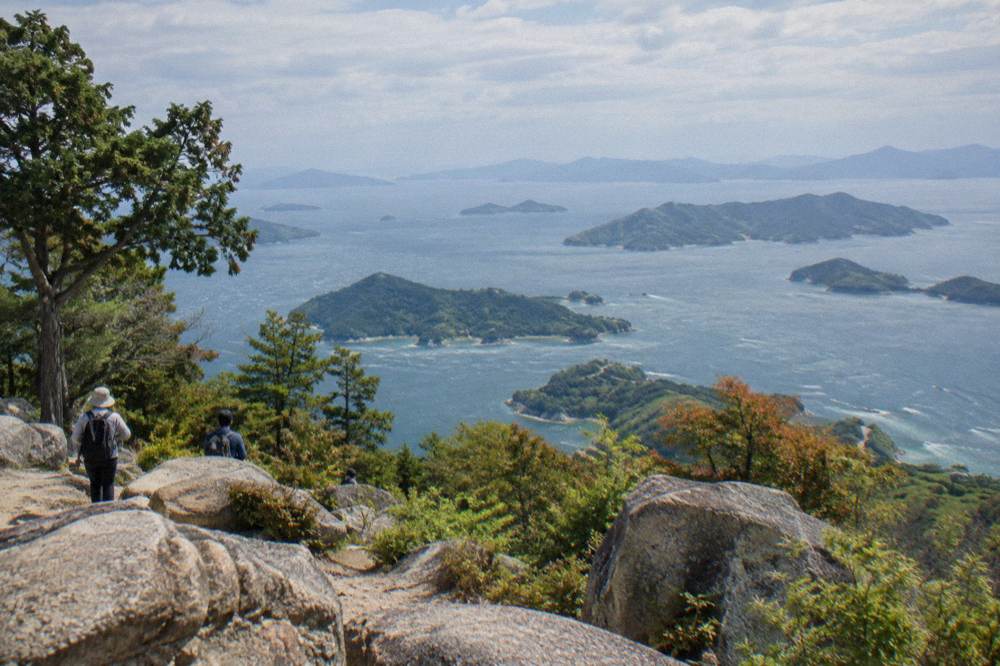
What the summit area itself holds is the reason to finish the walk: primeval forest that is part of the World Heritage designation, gigantic rocks, and, on clear days, panoramic views across the Seto Inland Sea toward Hiroshima. The sightseeing association's description names all three, and the view of the scattered islands is the one the mountain is known for.
| Summit facility | Hours |
|---|---|
| Mount Misen Observatory | 10:00 to 16:00 |
| Misen Hondo hall | 8:00 to 17:00 |
| Sankido hall | 8:00 to 17:00 |
| Typical ropeway-and-summit visit | About 2 hours |
| Same visit with the temple halls | Allow about 3 hours |
Can You Hike Mount Misen From Sea Level?
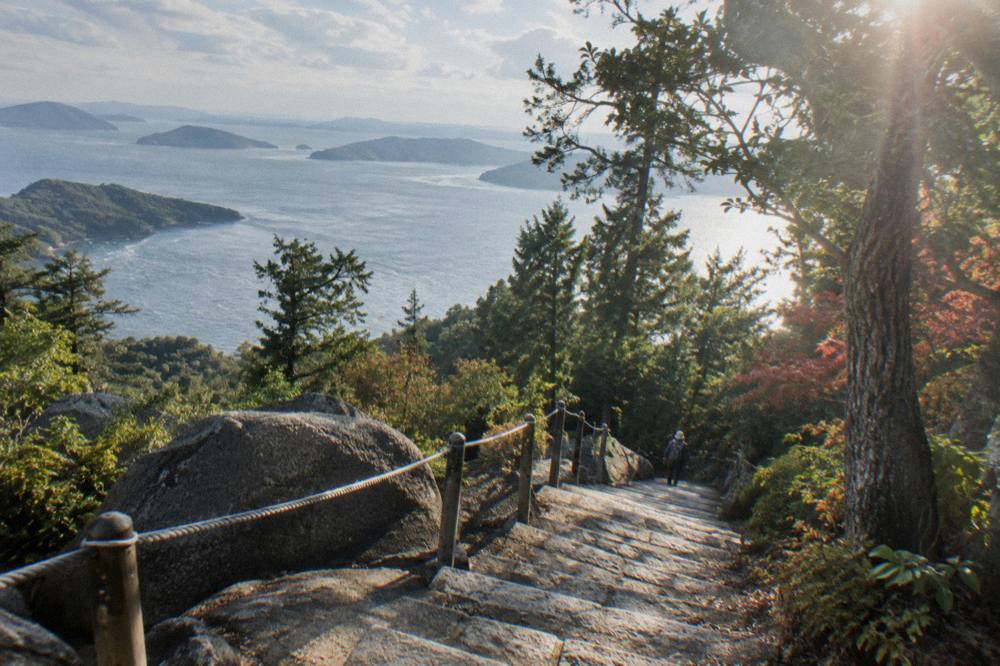
Yes: three main hiking trails climb from Miyajima's shoreline to the Mount Misen summit, the Daisho-in Course, the Momijidani Course, and the Omoto Course. All three reach the same 535-meter summit, and each is a walk through the primeval forest slopes rather than a ropeway shortcut.
The Momijidani Course climbs from the maple park at the ropeway base, the same Momijidani Park whose maples peak in mid to late November. None of the three needs the ropeway in either direction, though a one-way 1,100 yen ticket plus a trail descent is a common way to split the effort.
The same clothing advice from the operator applies more strongly to hikers: sturdy shoes and layers, because the mountain weather shifts fast and wet trails are slippery. Trails, like the ropeway, can close for weather or maintenance.
| Trail | Time to summit from sea level |
|---|---|
| Daisho-in Course | 1.5 to 2 hours |
| Momijidani Course | About 1.5 hours |
| Omoto Course | About 2 hours |
Why Is Mount Misen A Sacred Mountain?
Mount Misen has been a holy mountain since 806, when Kukai, the monk also known as Kobo Daishi, established a training site on it, per the ropeway operator's English access page. In 1996 the mountain and Itsukushima Shrine together were designated a World Cultural Heritage site, which is why the summit forest is protected primeval woodland rather than managed parkland.
The halls near the summit, Misen Hondo and Sankido, belong to that religious history and stay open 8:00 to 17:00, hours that run longer than the observatory's 10:00 to 16:00. Reikado Hall, which stood on the same trail, was destroyed by fire on 20 May 2026; the eternal flame was saved and kept elsewhere, and rebuilding is targeted for November 2027.
The sacred status reaches down the island to the shrine itself, whose admission details this site covers on the Itsukushima Shrine page. Reading the two together explains Miyajima's shape: the shrine at the waterline, the town behind it, and the mountain rising over everything.
How Do You Get To Mount Misen From Hiroshima?
From Hiroshima, the JR Sanyo Line runs to Miyajimaguchi in about 27 minutes for 420 yen, then the JR ferry crosses to Miyajima in about 10 minutes, and each visitor pays the 100 yen Miyajima Visitor Tax separately on entering the island. From Miyajima Pier the walk to the Momijidani Park entrance and the ropeway base is shortened by the free shuttle bus, which runs about every 20 minutes from 9:50.
The JR ferry runs roughly every 15 minutes from 8:00 into the evening, with the first departure about 6:25 and the last about 22:42, and Matsudai Kisen runs its own boats about every 15 minutes between 7:00 and about 20:00. The Japan Rail Pass and JR-West rail passes are valid on the JR ferry, and the group fare is 160 yen one way for parties of 8 or more. The crossing is short and sheltered, across the bay rather than open sea, since Miyajima sits in Hiroshima Bay on the Seto Inland Sea. The full index of guides sits on Hiroshima Travel Guide.
For the wider picture of the island, including the shrine approach and the shopping street near the pier, this site's Miyajima guide covers the full day plan.
| Leg | Figure |
|---|---|
| JR Sanyo Line, Hiroshima to Miyajimaguchi | About 27 minutes, 420 yen |
| JR ferry to Miyajima | About 10 minutes |
| JR ferry frequency | Roughly every 15 minutes, first about 6:25, last about 22:42 |
| Matsudai Kisen ferry | Roughly every 15 minutes, 7:00 to about 20:00 |
| Miyajima Visitor Tax | 100 yen, charged on entering the island |
| Shuttle bus, Momijidani Park entrance to Momijidani Station | Free, about every 20 minutes from 9:50 |
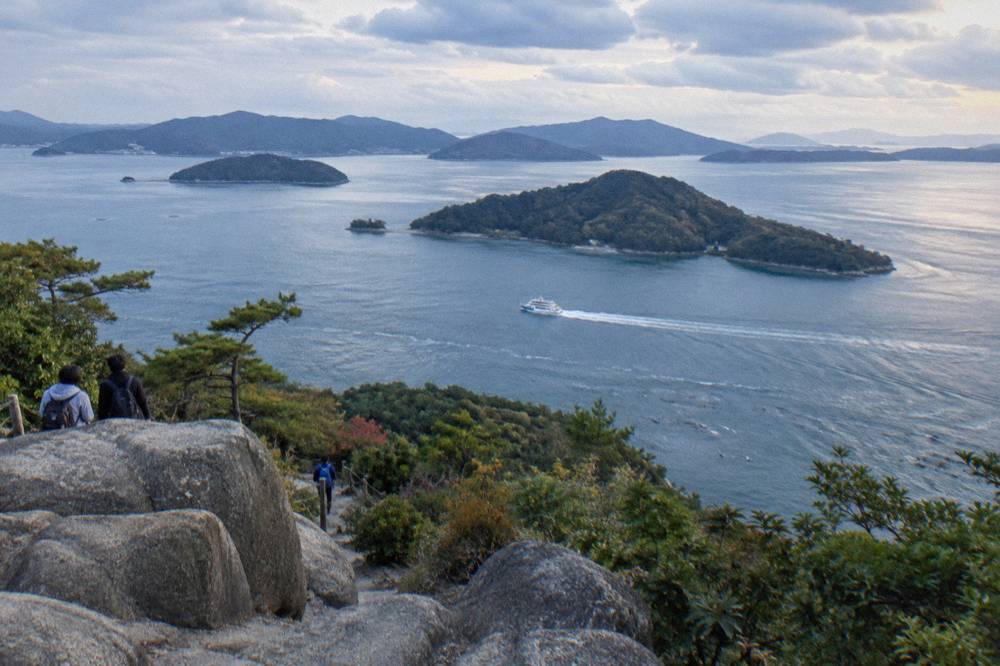
What Can You See From The Mount Misen Summit?
The summit area offers primeval forest, gigantic rocks, and panoramic views of the Seto Inland Sea and, on clear days, Hiroshima, as the Miyajima sightseeing association's ropeway course page describes. The observatory at the top operates 10:00 to 16:00, and the summit itself stands at 535 meters, the highest point on Miyajima.
The islands of the Seto Inland Sea are the signature sight: the water between Hiroshima and Shikoku is scattered with them, and from 535 meters the pattern reads as a map rather than a seascape. The forest on the slopes is part of the 1996 World Heritage designation, which protects it, and the rock formations along the summit trail are among the features the operator's map highlights on the standard one-hour course.
Visibility is the one variable no timetable fixes. The operator's own guidance on layered clothing exists because summit conditions rarely match the pier, and a hazy day still gives the forest and the halls even when the horizon softens.
Is Mount Misen Worth The Hike?
Yes, if the goal is the view and the temple halls: the summit sits at 535 meters with panoramas across the Seto Inland Sea, the ropeway covers the climb for anyone short on time or fitness at 2,000 yen return, and the three sea-level trails take 1.5 to 2 hours for walkers who want the forest. A typical ropeway visit with the summit walk runs about 2 hours, so the mountain fits inside a Miyajima day alongside the shrine.
The honest trade-off is the terrain. The last 30 minutes from Shishiiwa Station is steep, the sea-level trails are longer still, and the operator explicitly warns that weather changes quickly and trails get slippery when wet. Anyone with limited mobility faces a harder trip: no strollers or wheelchairs in the ropeway cars, no elevators at the stations, and a walking section at the top regardless.
For visitors pairing the mountain with the city, a guided day covering the Peace Memorial Park and the Miyajima crossing keeps the planning simple, and the ropeway's 16:30 last descent still sets the day's arithmetic.
What Should You Wear And Bring For Mount Misen?
The operator's guidance is specific: layered clothing and sturdy shoes, because mountain weather changes quickly and the trails can be slippery when wet. Cash or an IC card for Momijidani Station matters too, since Shishiiwa Station at the top accepts no cashless payment, and anyone planning the last ride down should be at the upper station before the 16:30 final descent.
The layering advice reflects the 535-meter climb: the summit runs cooler than the ferry pier, and wind on the exposed observatory adds to the difference.
Timing works backwards from the timetable. Upward service ends at 16:00 and the last descent is 16:30, so a ropeway day that includes the halls and the observatory wants a start soon after 9:00, and the free shuttle's lunch gap from 12:10 to 13:10 rewards arriving outside that window.
When Is The Best Season For Mount Misen?
No single month is the official answer, but the Japan Meteorological Agency (JMA) 1991-2020 station normals for Hiroshima show the pattern that matters for a mountain day: July is the wettest month at 279.8 mm of rain, January the driest at 46.2 mm, and August carries the highest average daily high at 32.8 degrees C against January's lowest average low of 2.0 degrees C. The operator suspends the ropeway in bad weather, so rain totals translate directly into closed days.
Momijidani Park at the ropeway base is a maple park whose colors peak in mid to late November, which pairs the mountain with the island's autumn draw. The trade-off in that season is shorter daylight against the 16:30 last descent. Summer visits face the heat and the June-to-July rain; winter visits are mild at the pier, averaging about 9.9 degrees C as a January daily high in Hiroshima, but colder at 535 meters.
The table below pulls the months that bracket those choices from the JMA normals.
| Month | Average daily high | Average daily low | Rainfall |
|---|---|---|---|
| January | 9.9 °C | 2.0 °C | 46.2 mm |
| April | 19.8 °C | 10.1 °C | 141.0 mm |
| July | 30.9 °C | 24.1 °C | 279.8 mm |
| August | 32.8 °C | 25.1 °C | 131.4 mm |
| October | 23.7 °C | 14.9 °C | 109.2 mm |
| November | 17.7 °C | 8.9 °C | 69.3 mm |
What Is Near The Mount Misen Ropeway Base?
The ropeway base sits at Momijidani Park, a maple park whose colors peak in mid to late November, and the walk back toward the ferry pier runs through Miyajima's Omotesando street, where grilled oysters and momiji manju are the standard food stops. The Information Center at Miyajima Pier, open 9:00 to 12:00 and 13:00 to 17:30, sells ropeway tickets and handles island questions.
Downhill from the mountain, the island's other sights stack within a short radius of the pier. Families weighing the day's balance can also check the Miyajima public aquarium page for the indoor alternative.
The practical chain for a full island day reads pier, shrine, Omotesando, Momijidani, ropeway, summit, and back, with the visitor tax already paid on arrival and the last ferry timetables, about 22:42 for the JR boats, closing the day.
Common Questions About Mount Misen
Is Mount Misen Worth The Hike?
Yes, for the 535-meter summit panorama over the Seto Inland Sea and the temple halls along the way. The ropeway covers the climb at 2,000 yen return for those who would rather not walk, and the three sea-level trails take 1.5 to 2 hours for hikers who would. A typical ropeway visit including the summit walk runs about 2 hours.
How Long Does The Mount Misen Ropeway Take?
The ride is two connected lines: about 10 minutes on the Momijidani gondola line and about 4 minutes on the Shishiiwa aerial tram, roughly 14 minutes in total. Add the 30-minute walk from Shishiiwa Station to the summit.
What Time Does The Mount Misen Ropeway Close?
Upward service runs 9:00 to 16:00 and downward service 9:20 to 16:30, with the last descent at 16:30. Service can be suspended for weather or maintenance.
Can Children Ride The Mount Misen Ropeway?
Yes, and elementary school children pay 1,000 yen round trip or 550 yen one way. Baby strollers and wheelchairs cannot be taken into the ropeway cars and must be left at the base station office.
Are Pets Allowed On The Mount Misen Ropeway?
No, pets are not allowed on the Miyajima Ropeway except guide and assistance dogs.
Do You Have To Hike To See The View From Mount Misen?
No, the ropeway reaches Shishiiwa Station, from which the summit is a 30-minute steep walk. The observatory at the summit is open 10:00 to 16:00 and looks out over the Seto Inland Sea and, on clear days, Hiroshima.
The mountain holds the island together: the shrine at the water, the forested slopes above it, and a 535-meter summit that explains why Kukai chose it in 806 and why the World Heritage listing covers both. Plan around the 16:30 last descent, pay the 100 yen island tax on arrival, and the rest of the day is arithmetic the timetables have already solved.