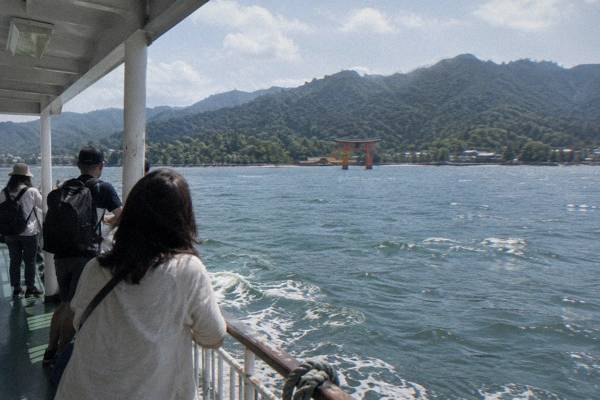
Itsukushima Shrine And The Floating Torii Gate
Itsukushima Shrine on the island of Miyajima in Hiroshima Bay is a UNESCO World Heritage Site whose vermilion Great Torii gate appears to float at high tide. This guide covers the admission fees, seasonal opening hours, ferry access from Hiroshima, the tide conditions that decide whether you can walk out to the gate, and the repair work currently under way.
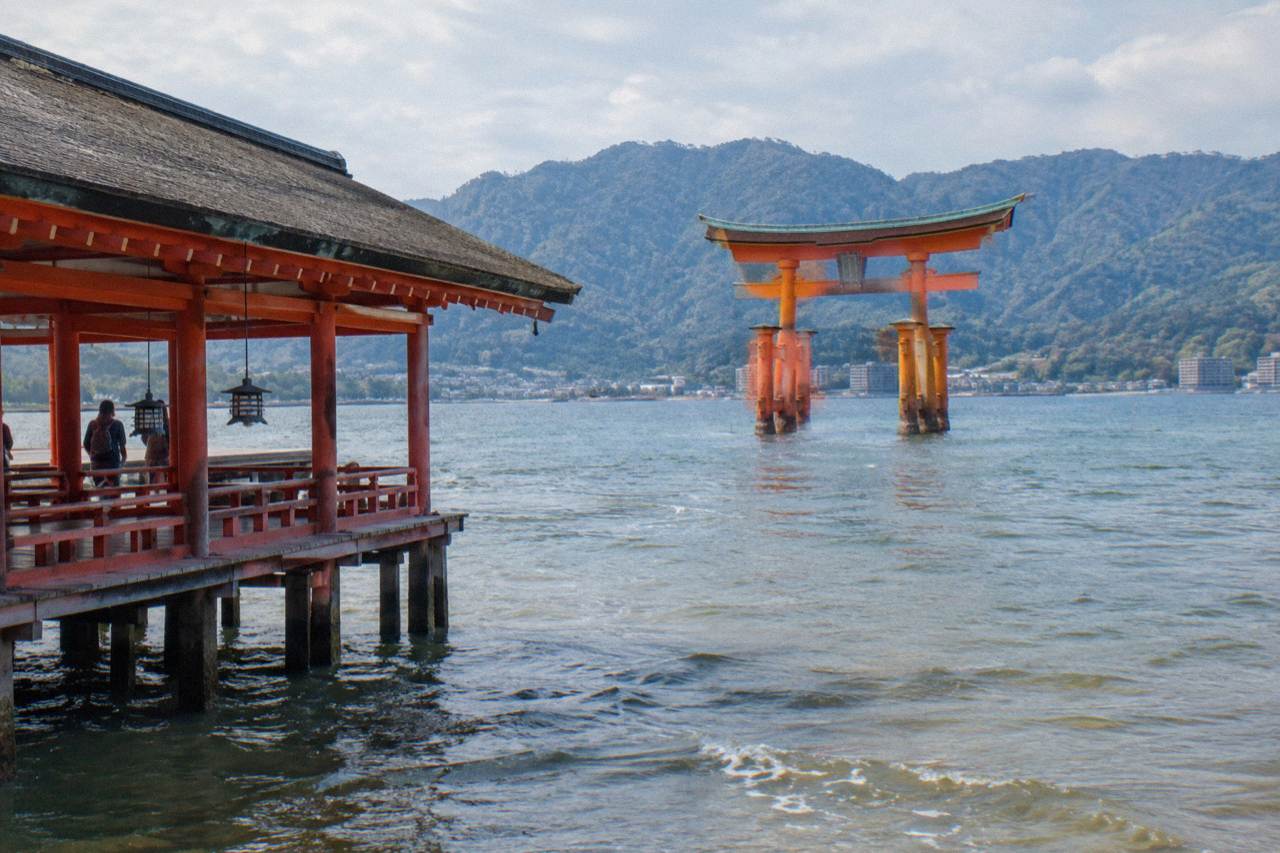
Itsukushima Shrine on Miyajima, reached by a 10-minute ferry from Miyajimaguchi near Hiroshima, costs 300 yen for adults and is open daily year-round, closing between 17:00 and 18:00 depending on the season. The Great Torii can be walked to at low tide and appears to float at high tide.
The shrine was established in 593, and its present form dates to 1168, when Taira no Kiyomori rebuilt it. This guide sets out what the shrine's own admission page and the ferry operators publish: the fees, the seasonal hours, the crossing from the mainland, the tide behaviour at the gate, and the repair work that is currently visible on the island.
What Is Itsukushima Shrine On Miyajima?
The buildings of Itsukushima Shrine are built over the water. The visitor route is one-way, running through the east and west corridors, the main hall, the Noh stage and the arched bridge. The shrine and the Great Torii were together inscribed as a UNESCO World Heritage Site in 1996.
The current torii is the ninth to stand on the site. It was erected in 1875, it stands about 16.6 meters tall, and it is made primarily of camphor wood, weighing about 60 tons. The main pillars are about 9.9 meters around, and the ridge beam is about 24.2 meters long. The gate holds itself in place by its own weight on a foundation of driven wooden piles, without deep burial in the seabed, and it uses a six-pillar Ryobu-torii style for stability. It has been designated a National Important Cultural Property since 29 March 1952.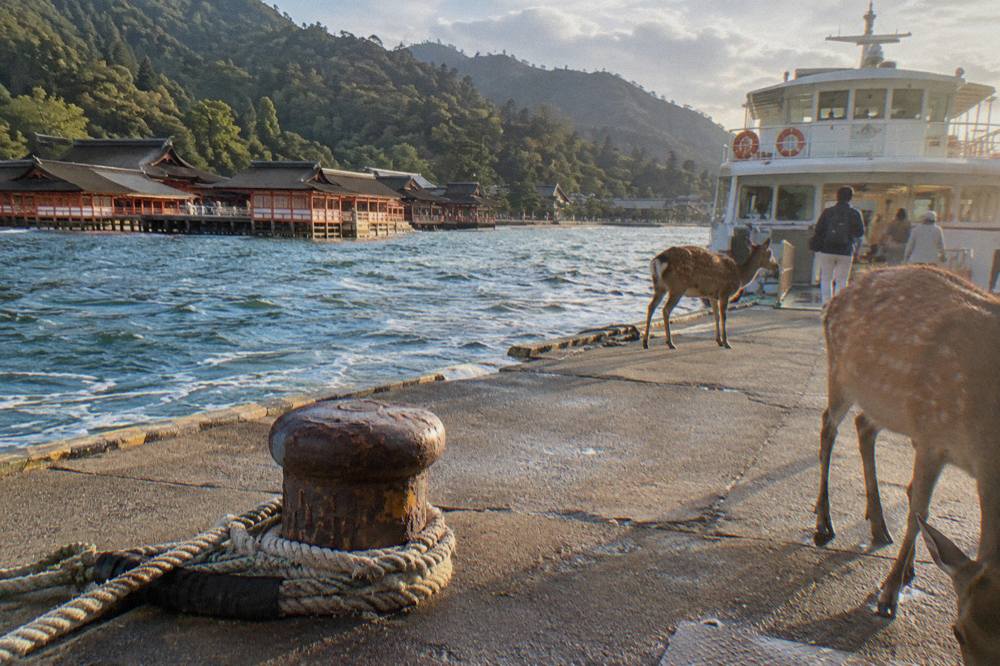
Nearby on the island stand two related buildings. Senjokaku, also known as Hokoku Shrine, is open year-round from 8:30 a.m. to 4:30 p.m. with 100 yen adult admission. The five-storied pagoda beside it is wrapped in scaffolding and sheeting for conservation repair work that runs to 20 November 2027. The five-storied pagoda and Senjokaku have their own page on this site, and the climb behind the shrine leads on to Daisho-in Temple and the paths up Mount Misen.
How Much Does Itsukushima Shrine Cost To Visit?
Admission to Itsukushima Shrine is 300 yen for adults, 200 yen for high school students and 100 yen for elementary and junior high students, per the shrine's own admission page. A combined ticket for the shrine plus the Treasure Hall is 500 yen for adults, and the Treasure Hall alone is 300 yen for adults. Senjokaku charges 100 yen for adults.
The Treasure Hall is open from 8:00 a.m. to 5:00 p.m. year-round. The combined ticket prices are 500 yen for adults, 300 yen for high school students and 150 yen for elementary and junior high students, so the combined adult ticket saves 100 yen against buying the two admissions separately.
| Admission | Adult | High School | Elementary / Junior High |
|---|---|---|---|
| Itsukushima Shrine | 300 yen | 200 yen | 100 yen |
| Treasure Hall | 300 yen | 200 yen | 100 yen |
| Combined shrine and Treasure Hall | 500 yen | 300 yen | 150 yen |
| Senjokaku (Hokoku Shrine) | 100 yen |
Beyond the shrine itself, the other fixed costs on the island are the Miyajima Visitor Tax and the Mount Misen ropeway. The visitor tax is 100 yen per person, charged separately on entering the island and collected with the inbound ferry ticket, with preschool children exempt. Japan Rail Pass holders ride the JR West Miyajima Ferry free of charge but still pay the 100 yen tax. The ropeway costs 2,000 yen return or 1,100 yen one way for adults, 1,000 yen return or 550 yen one way for children, running 9:00 to 16:00 with last descent at 16:30.
| Item | Adult | Child | Notes |
|---|---|---|---|
| Miyajima Visitor Tax | 100 yen | 100 yen, preschool free | Collected with the inbound ferry ticket |
| Mount Misen ropeway, return | 2,000 yen | 1,000 yen | 9:00 to 16:00, last descent 16:30 |
| Mount Misen ropeway, one way | 1,100 yen | 550 yen | Single ride either direction |
The Great Torii itself is viewable free from the shore at all times, and the illuminations after dark are also visible free from land. The paid admissions cover the shrine corridors and halls, the Treasure Hall and Senjokaku.
What Are The Itsukushima Shrine Opening Hours?
Itsukushima Shrine is open every day of the year, with no closure days. Doors open at 6:30 a.m. except on 1 January; closing time is 6:00 p.m. from 1 March to 14 October, 5:30 p.m. from 4 January to the end of February and from 15 October to 30 November, and 5:00 p.m. in December.
On 1 January hours are midnight to 6:30 p.m., and on 2 and 3 January, 6:30 a.m. to 6:30 p.m.
The seasonal closing times matter for planning an evening visit, because the shrine buildings close between 17:00 and 18:00 depending on the season while the illuminations run later. The Great Torii and the shrine are illuminated every evening from about 30 minutes after sunset until 11:00 p.m., and the illuminations can be watched from land, or from the sea by ship if the tide is high enough to approach the gate.
| Period | Opening Hours |
|---|---|
| 1 January | 0:00 to 18:30 |
| 2 to 3 January | 6:30 to 18:30 |
| 4 January to end of February | 6:30 to 17:30 |
| 1 March to 14 October | 6:30 to 18:00 |
| 15 October to 30 November | 6:30 to 17:30 |
| December | 6:30 to 17:00 |
| Treasure Hall, year-round | 8:00 to 17:00 |
| Senjokaku, year-round | 8:30 to 16:30 |
A typical visit through the shrine corridors and main halls leaves time for the Treasure Hall or Senjokaku in the same morning or afternoon. The corridor floorboards have gaps left for high-tide water pressure, and the shrine's admission page advises flat, comfortable shoes rather than high heels.
How Do You Get To Itsukushima Shrine From Hiroshima?
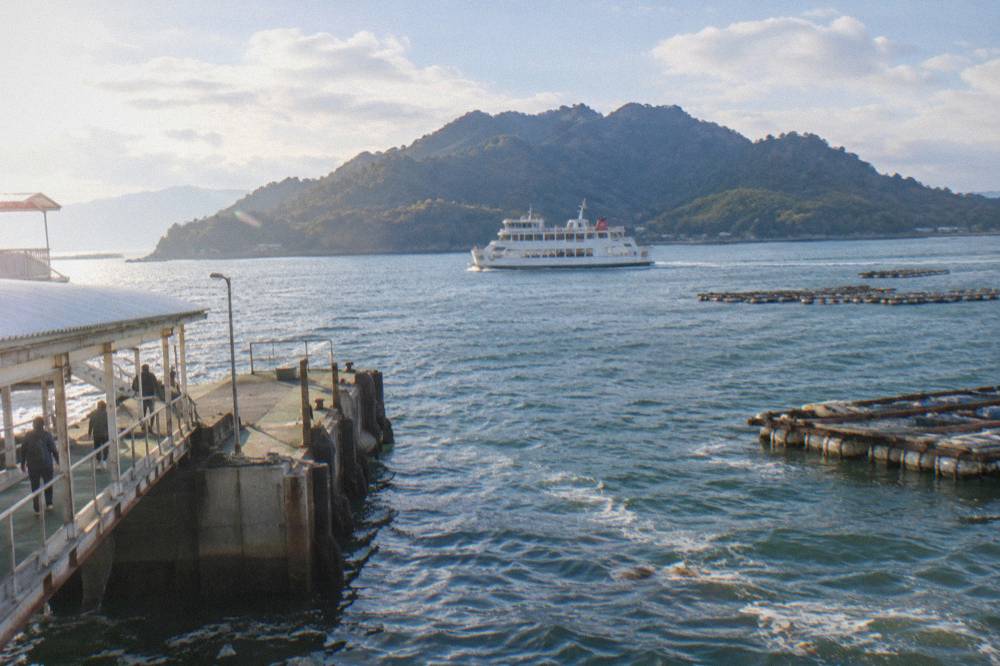
From JR Hiroshima Station, take the Sanyo Line to Miyajimaguchi Station, a ride of about 30 minutes, then a ferry across to Miyajima, a crossing of about 10 minutes, followed by a 10 to 15 minute walk along the shore from the ferry pier to the shrine entrance, as the shrine's own access page sets out.
Two ferry operators run the crossing. The JR West Miyajima Ferry departs Miyajimaguchi roughly every 15 minutes from 8:00 into the evening, with the first departure at 6:25 and the last at 22:42; the last ferry back from Miyajima departs at 22:14. Miyajima Matsudai Kisen runs its own timetable, also about every 15 minutes, from 7:00 into the evening. The Japan Rail Pass and JR-West rail passes are valid on the JR ferry, though the 100 yen Miyajima visitor tax still applies. The individual fare is 200 yen for adults and 100 yen for children one way. Other pages covering the same trip are gathered on Hiroshima Travel Guide.
| Leg | Details |
|---|---|
| JR Sanyo Line, Hiroshima to Miyajimaguchi | About 30 minutes |
| Ferry, Miyajimaguchi to Miyajima | About 10 minutes, roughly every 15 minutes |
| First JR ferry from Miyajimaguchi | 6:25 |
| Last JR ferry from Miyajima | 22:14 |
| Walk, Miyajima ferry pier to shrine entrance | 10 to 15 minutes along the shore |
From Hiroshima city, the Hiroden tram also serves Miyajimaguchi on the Miyajima line, and the Hiroden 1-Day Streetcar and Ferry Pass at 1,000 yen for adults includes the Miyajima Matsudai Kisen ferry plus the visitor tax. The Hiroden flat fare is 240 yen for adults and 120 yen for children on all lines, a fare in force since 1 February 2025. The tram now enters the Hiroshima Station building, reported since 3 August 2025.
A guided option covers the same logistics without the planning. The Hiroshima and Miyajima guided tour with Itsukushima Shrine and ferry pairs the city and the island in one day with the ferry crossing included: Check availability. Staying on the island instead changes the rhythm of a visit entirely, and the Miyajima overnight itinerary covers that option, while the broader Miyajima day trip guide and the Miyajimaguchi area page cover the mainland side of the crossing.
Why Does The Great Torii Gate Stand In The Water?
The Great Torii stands in the sea: the gate marks the boundary of the sacred area in the bay, standing about 212.7 meters in front of the main worshipping hall, and it holds its place purely by its own weight on driven wooden piles rather than being fixed into the seabed.
The current gate is the ninth generation, erected in 1875, and it uses a six-pillar Ryobu-torii style, a rare form chosen for stability. The structure is primarily camphor wood and weighs about 60 tons. Because the gate and the shrine buildings stand in the tidal shallows, the water level decides what the visitor sees, and the question of why the gate is in the water is answered in more depth on the page why is the Miyajima torii gate in the water.
When Can You Walk Out To The Great Torii?
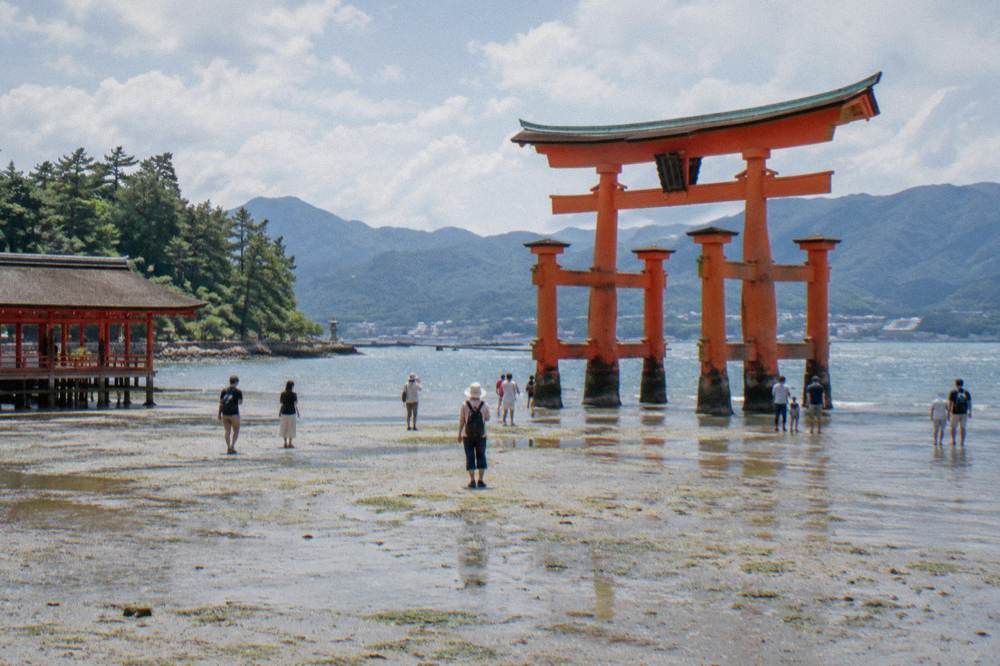
Visitors can walk out across the seabed to the base of the Great Torii when the tide level falls below about 100 cm referenced to Hiroshima Port, and the shrine buildings appear to float when the tide rises above about 250 cm, according to Miyajima guide figures, so the same gate gives two very different visits on the same day depending on the tide.
The tide at Miyajima runs a full daily cycle, and the live Hiroshima Bay tide block on this site, fed by Japan Meteorological Agency hourly predictions, is the place to check a specific date and time before planning a walk out to the gate.
| Tide Level, Hiroshima Port Reference | What You See At The Gate |
|---|---|
| Below about 100 cm | The seabed is exposed and visitors walk out to the torii base |
| About 100 to 250 cm | The gate stands in water of varying depth, viewed from shore or shrine |
| Above about 250 cm | The gate and shrine buildings appear to float |
At high tide the view changes character, and the illuminated gate after dark is also seen from the water: an Aqua Net night cruise from Miyajima Pier No. 3 runs departures at 17:55, 18:35, 19:15, 19:55, 20:35 and 21:15 for about 30 minutes at 2,000 yen for adults, when the tide is high enough to approach the gate. The full illumination schedule is covered on the page is the Miyajima torii gate lit up at night, and the tide-timing question has its own page at when is low tide at Miyajima.
Is Itsukushima Shrine Still Under Renovation?
The Great Torii's own restoration finished in December 2022, and the gate stands fully in view, but two other repair projects are under way on the island: structural reinforcement of the shrine's east corridor running from 10 April 2024 to December 2026, which does not block visitor passage, and conservation repair of the five-storied pagoda running from 20 January 2025 to 20 November 2027.
The shrine is open throughout the corridor work, and the reinforcement is visible along the paid visitor route without closing the corridor. The pagoda is wrapped in scaffolding and sheeting for the duration of its repair. Neither project affects the Great Torii or the view of the gate from the shore or the water. The renovation question is tracked on the page is the Miyajima torii gate still under renovation.
| Project | Period | Effect On Visitors |
|---|---|---|
| Great Torii restoration | Finished December 2022 | None, gate fully in view |
| East corridor reinforcement | 10 April 2024 to December 2026 | Corridor stays open, work visible along the route |
| Five-storied pagoda repair | 20 January 2025 to 20 November 2027 | Pagoda wrapped in scaffolding and sheeting |
How Old Is Itsukushima Shrine And Who Built It?
Itsukushima Shrine was established in 593, and its present form dates to 1168, when Taira no Kiyomori rebuilt it, per the shrine's own admission page, which carries the foundation date and the rebuild together. The shrine has stood on this shore through repeated reconstructions since, and the current Great Torii, the ninth, was erected in 1875.
The building history, including the foundation date and the rebuild year, is covered in full on the page when was Itsukushima Shrine built, which sets the dates in sequence with the torii generations.
How Does A Miyajima Visit Fit With Hiroshima Itself?
Miyajima pairs naturally with Hiroshima city because the ferry crossing is only about 10 minutes from Miyajimaguchi, roughly a 30-minute train ride from Hiroshima Station, so the island and the city's Peace Memorial Park are commonly combined into one long day or two relaxed days, and guided day products exist that cover both in a single outing.
The city side of that pairing centres on the Peace Memorial Park, the Peace Memorial Museum and the A-Bomb Dome, each with its own page on this site. The one day in Hiroshima and Miyajima itinerary works through the combination hour by hour.
What Should You Know Before You Go?
Bring flat shoes, carry 100 yen per person for the Miyajima visitor tax on top of the ferry, check the live Hiroshima Bay tide block before planning a walk out to the Great Torii, and time the illuminations for after sunset if an evening view matters, since the shrine closes between 17:00 and 18:00 while the lights run until 11:00 p.m.
The corridor floors have gaps between the boards, so the shrine's admission page advises comfortable flat shoes and against high heels. There is no parking at the shrine; drivers use the lots near the Miyajimaguchi ferry terminal and cross on foot. The last JR ferry back from the island departs at 22:14, which sets the latest possible end to an illumination evening viewed from the island.
Common Questions About Itsukushima Shrine
How Much Is Itsukushima Shrine Admission?
Adult admission is 300 yen, high school students pay 200 yen, and elementary and junior high students pay 100 yen. A combined ticket for the shrine plus the Treasure Hall is 500 yen for adults, 300 yen for high school students and 150 yen for younger students.
What Time Does Itsukushima Shrine Open?
The shrine is open every day of the year. It opens at 6:30 a.m. except on 1 January, and closes at 6:00 p.m. from 1 March to 14 October, 5:30 p.m. from 15 October to 30 November and from 4 January to the end of February, and 5:00 p.m. in December. On 1 January it opens at midnight and closes at 6:30 p.m.
Can You Walk To The Great Torii Gate?
Yes, when the tide level falls below about 100 cm referenced to Hiroshima Port, visitors walk across the exposed seabed to the base of the gate. Above about 250 cm the gate and shrine appear to float. Check the live Hiroshima Bay tide block for a specific date and time.
Is The Great Torii Under Renovation?
No. The torii's own restoration finished in December 2022. Separate work is under way elsewhere: east corridor reinforcement at the shrine to December 2026, which does not block the visitor route, and five-storied pagoda repair to November 2027.
How Do I Get To Itsukushima Shrine From Hiroshima?
Take the JR Sanyo Line from Hiroshima Station to Miyajimaguchi, about 30 minutes, then a ferry to Miyajima, about 10 minutes, then walk 10 to 15 minutes along the shore to the shrine entrance. Ferries run roughly every 15 minutes.
Is The Miyajima Torii Lit Up At Night?
Yes. The Great Torii, the main sanctuary, the five-storied pagoda, the Tahoto pagoda and the stone lanterns along Nishi-matsubara are illuminated every evening from about 30 minutes after sunset until 11:00 p.m., visible free from shore.