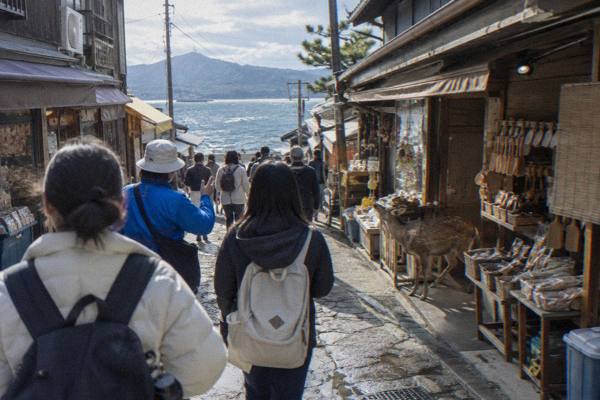
Senjokaku Hall And The Five-Storied Pagoda
Senjokaku Hall and the five-storied pagoda sit on a hill above Itsukushima Shrine on Miyajima, the island in Hiroshima Bay reached by a 10-minute ferry from Miyajimaguchi. The hall is open to visitors; the pagoda is under repair scaffolding until November 2027 and can never be entered.
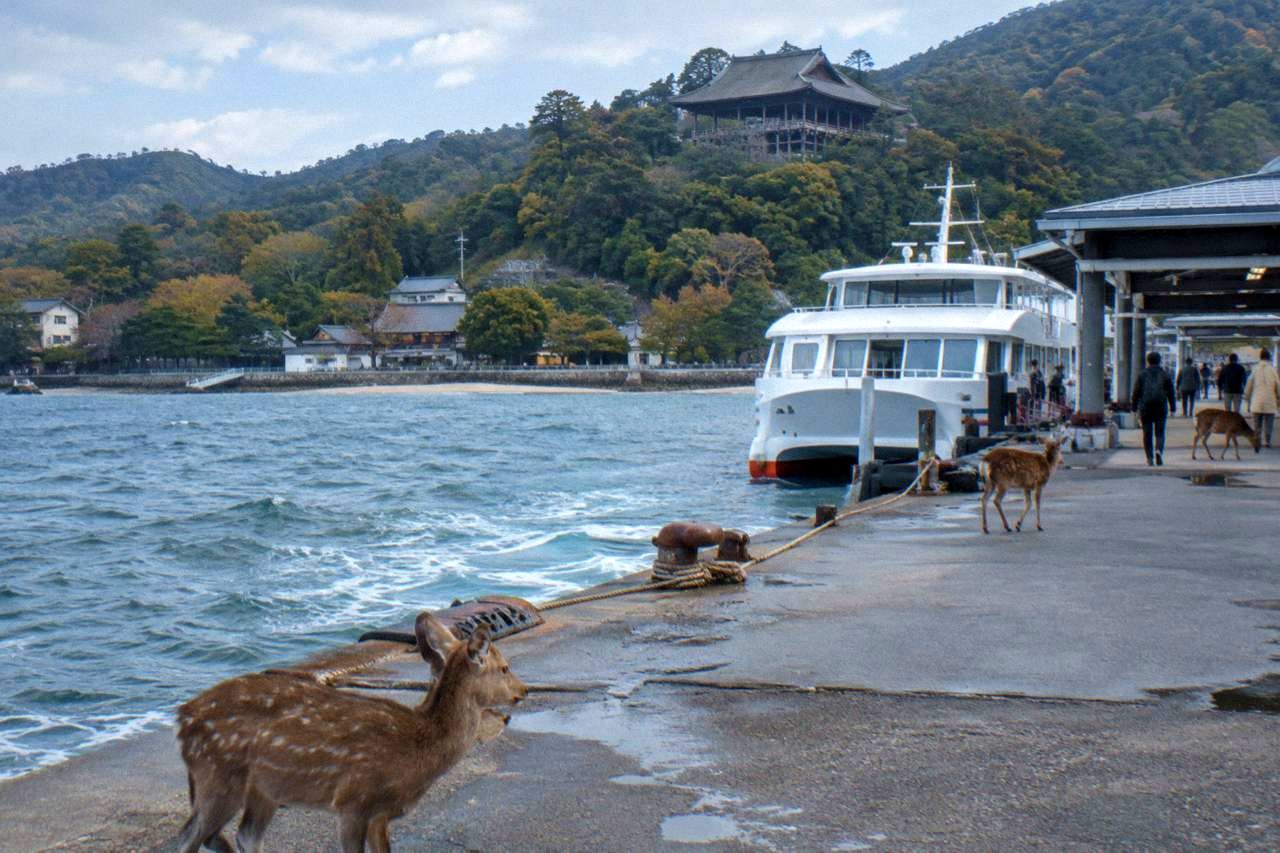
Senjokaku is an open-sided wooden hall on Tō-no-Oka, the hill above Itsukushima Shrine on Miyajima, about a 10 to 15 minute walk from the ferry pier. Visitors remove shoes at the entrance, carry them in plastic bags, and see votive paintings, ship models and a giant rice paddle inside, with views over the shrine, the Great Torii and the Seto Inland Sea. The five-storied pagoda next to it is wrapped in scaffolding for repairs until 20 November 2027 and cannot be entered at any time.
Senjokaku Hall and the five-storied pagoda stand together on a wooded hill above Itsukushima Shrine on Miyajima, the island in Hiroshima Bay reached by a roughly 10-minute JR ferry crossing from Miyajimaguchi. The hill, recorded in local history as Tō-no-Oka, served as a command post during the 1555 Battle of Itsukushima. A visit turns on what each one is, what the hall holds, what it costs to reach and see, and how the repairs running to 2027 change a visit.
What Is Senjokaku Hall On Miyajima In Hiroshima?
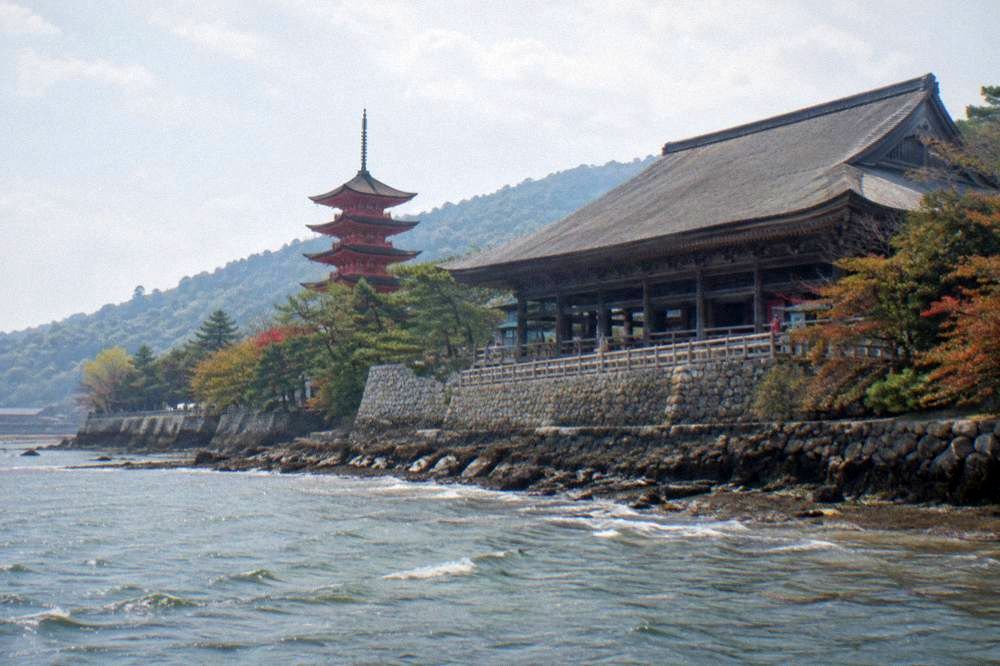
Senjokaku is a raised wooden hall on the hillside above Itsukushima Shrine on Miyajima, reached from the shrine entrance through trees and stone steps. Its open sides let the interior borrow light from the sea horizon, and its double-layer wooden floor, about 10 cm thick, withstands the salt winds off Hiroshima Bay. Roof tiles are stamped with the character for king, some finished with gold leaf. Admission is separate from the shrine, at 100 yen for adults.
The sides are open, so the interior borrows its light from the sea horizon, and the floor is a double-layer wooden construction about 10 cm thick, built to withstand the salt winds that come off Hiroshima Bay. The roof tiles carry a stamped character, "王" (king), and some of the outermost tiles are finished with gold leaf, details the island's English-language guides point out to visitors who look up before going in.
For context on the wider island, see the site's Miyajima island guide, which places Senjokaku among the shrine, Mount Misen and the waterfront streets.
What Can You See Inside Senjokaku Hall?
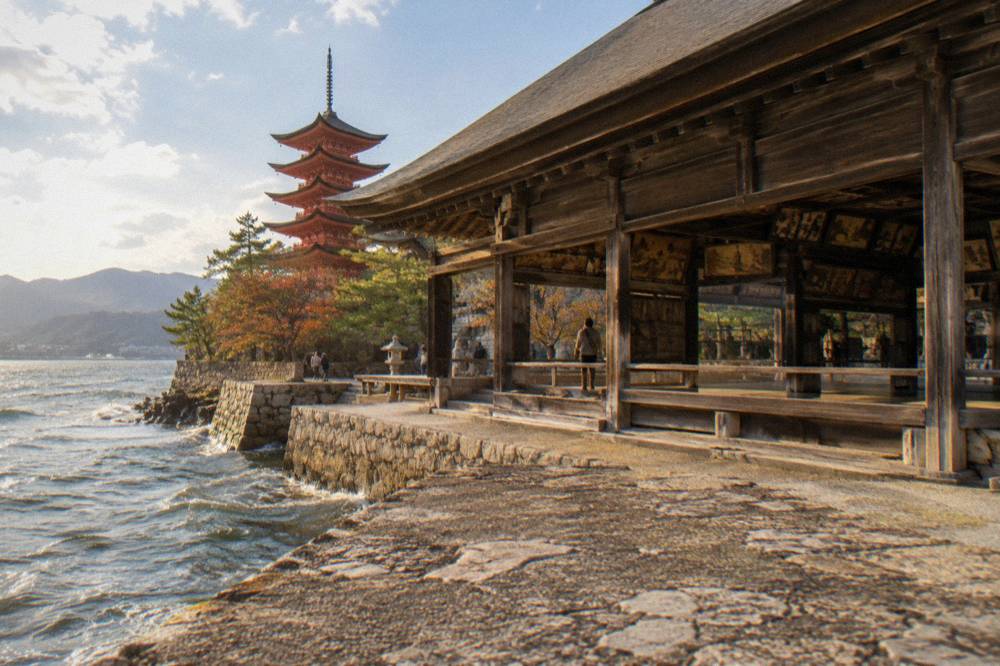
Inside Senjokaku, visitors walk the wooden floor in socks or bare feet, shoes removed and carried in provided plastic bags, and see large votive paintings called ema, a measuring staff known as a shakuzue that was used in a Great Torii reconstruction, ship models, and a large ceremonial rice paddle called a shamoji, all displayed in the open hall. Through the open sides, the hall frames panoramic views of Itsukushima Shrine, the Great Torii and the Seto Inland Sea.
The shoe rule is the first thing that shapes a visit. There is no way around it: footwear comes off at the entrance and travels with you in a plastic bag, which is the standard practice the hall's guide page states plainly. Socks without holes are the practical recommendation, and the wooden floor, that double-layer salt-wind construction, is the surface you walk on throughout.
The objects on display tie the hall to the island's shrine culture. The shakuzue measuring staff comes from work on the Great Torii, the great gate that stands in the shallows off the shrine and whose most recent full restoration finished in December 2022, as reported on the shrine's own construction page. The ship models connect the hall to the Seto Inland Sea's maritime traffic, and the oversized shamoji, the rice paddle Miyajima is famous for as a souvenir, sits as a ceremonial object rather than a kitchen tool.
Goshuin, the shrine seal stamps collectors accumulate in books, are available inside the hall until 4:00 p.m. during opening hours. A typical visit inside the hall plus time for the views pairs well with the shrine below on a single morning.
A guided half-day option such as the Miyajima Island Half-Day Tour with Guide covers the island's main sights with a local guide who handles the sequencing, which matters when the tide, the shrine hours and the ropeway timetable all pull a day in different directions. For the full picture of the island's main shrine, see the Itsukushima Shrine guide.
When Is Senjokaku Open And How Long Does A Visit Take?
Senjokaku is open from 8:30 to 16:30, year-round with no regular closure days, and a typical visit lasts 20 to 40 minutes inside the hall plus 10 to 20 minutes for the views from its open sides, so the hall fits comfortably into a half-day Miyajima circuit alongside Itsukushima Shrine. Goshuin seal stamps are issued inside until 4:00 p.m.
The 8:30 to 16:30 window, listed on the shrine's admission page alongside the Treasure Hall's longer 8:00 to 17:00 hours, makes Senjokaku one of the shorter-day sights on the island. That matters if you are building a day around the ferry timetable from Miyajimaguchi, which runs from the early morning until about 22:00 at night. An afternoon arrival still leaves time for the hall, though the last stamp is at 16:00 in practice for anyone collecting goshuin.
The absence of regular closures is stated plainly by the guide pages that track the hall, so there is no weekly closing day to plan around, unlike some museums in Hiroshima city. The one variable is weather: the open sides mean wind and rain reach part of the interior, and the stone steps up from the shrine entrance can be slick in wet conditions.
Here is how the island's main paid-entry sights compare on hours:
| Sight on Miyajima | Opening hours | Notes |
|---|---|---|
| Senjokaku Hall | 8:30 to 16:30 | Open year-round, no regular closures |
| Itsukushima Shrine | 6:30 to 18:00 (1 Mar to 14 Oct) | 6:30 to 17:30 from 15 Oct to 30 Nov; 6:30 to 17:00 in Dec |
| Itsukushima Treasure Hall | 8:00 to 17:00 | Same admission prices as the shrine |
| Mount Misen ropeway | 9:00 to 16:00 | Last descent 16:30 |
The shrine's seasonal hour shifts are worth watching in late autumn and winter, when the whole island's day compresses earlier.
Can You Enter The Five-Storied Pagoda On Miyajima?
No, the five-storied pagoda next to Senjokaku cannot be entered by the public at any time; visitors may only view it from outside, and as of the current repair programme it is wrapped in scaffolding until 20 November 2027, so even the exterior view is of a covered structure rather than the pagoda's red timbers. The shrine's own sightseeing page states the no-entry rule, and the repair end date appears on the island's English guide pages.
The shrine's construction page reports that the Great Torii restoration finished in December 2022, that East Corridor reinforcement at the shrine runs to December 2026, and that the pagoda repair runs to 2027, with the shrine itself open throughout.
A visitor in 2026 or early 2027 should set expectations accordingly: the hall delivers the interior experience on this hill, and the pagoda delivers a construction-site silhouette until the autumn of 2027.
The site's page on the shrine's renovation status tracks the wider repair programme in more detail.
How Do You Get To Senjokaku From Hiroshima?
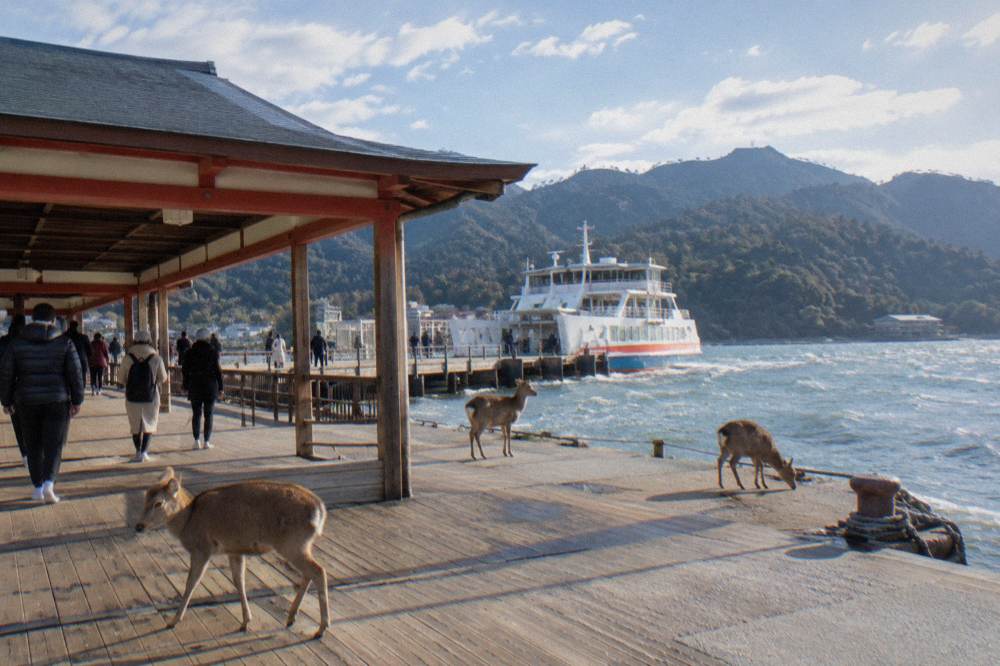
From Hiroshima, take the JR Sanyo Line about 25 minutes from Hiroshima Station to Miyajimaguchi, then the roughly 10-minute ferry to Miyajima pier, then walk about 10 to 15 minutes along the coast path to the Itsukushima Shrine entrance and up the stone steps to Senjokaku. A 100 yen Miyajima Visitor Tax is charged separately on entering the island, and preschool children are exempt.
The rail leg is the simplest part: JR Hiroshima Station to Miyajimaguchi on the Sanyo Line local takes about 25 to 27 minutes. Matsudai Kisen runs a parallel service on its own timetable, also about every 15 minutes across its operating day. The Japan Rail Pass and JR-West rail passes are valid on the JR ferry, which is worth knowing if you are touring the region on a pass. The wider set of guides lives on Hiroshima Travel Guide.
From Miyajima pier, the walk to the hall is documented at 10 to 15 minutes: along the coastline to the Itsukushima Shrine entrance, then up stone steps past the shrine. The paths are the island's main pedestrian routes, level along the waterfront and climbing only at the end.
If you would rather ride than walk the island, book a rickshaw tour here.
| Leg of the journey | Time | Detail |
|---|---|---|
| Hiroshima Station to Miyajimaguchi (JR Sanyo Line) | about 25 minutes | Local train |
| Miyajimaguchi to Miyajima pier (JR ferry) | about 10 minutes | Roughly every 15 minutes through the day |
| Matsudai Kisen ferry | about 10 minutes | Own timetable, roughly every 15 minutes from 7:00 |
| Miyajima pier to Senjokaku on foot | 10 to 15 minutes | Coast path to the shrine entrance, then stone steps |
The visitor tax is collected on the outbound crossing and is separate from any fare, a detail the ferry's own fare page sets out. For the island's deeper walking options, including the temple trails that climb toward Mount Misen, see the Daisho-in Temple guide.
How Much Does A Miyajima Day Cost Around Senjokaku?
Senjokaku Hall itself charges 100 yen for adults, the Mount Misen ropeway is 2,000 yen return for an adult, and the Miyajima Visitor Tax is a separate 100 yen on arrival, so the arithmetic of a full island day is a simple sum of those printed figures, with the rail fare to Miyajimaguchi on top.
Senjokaku Hall itself charges 100 yen for adults. The shrine's admission page sets the prices clearly: 300 yen adult, 200 yen for high school students, 100 yen for elementary and junior high students, with the Treasure Hall priced identically and a combined ticket at 500, 300 and 150 yen across those age bands. The ropeway page gives 2,000 yen adult return, 1,100 one way, with children at 1,000 and 550.
| Item | Adult | High school | Elementary and junior high |
|---|---|---|---|
| Itsukushima Shrine | 300 yen | 200 yen | 100 yen |
| Itsukushima Treasure Hall | 300 yen | 200 yen | 100 yen |
| Combined shrine and Treasure Hall ticket | 500 yen | 300 yen | 150 yen |
| Mount Misen ropeway, one way | 1,100 yen | 1,100 yen | 550 yen |
| Mount Misen ropeway, return | 2,000 yen | 2,000 yen | 1,000 yen |
| Miyajima Visitor Tax | 100 yen | 100 yen | 100 yen (preschool exempt) |
A guided island half-day, a ferry-inclusive Hiroshima day trip and a lunch-inclusive bus day are the three most common shapes for a Miyajima visit, and each is covered on its own page. Check availability for the half-day island tour if a guide-led structure appeals.
What Else Is Near Senjokaku On Miyajima?
Near Senjokaku on Miyajima, Itsukushima Shrine sits downhill at the shrine entrance, the Itsukushima Treasure Hall beside it, the five-storied pagoda steps from Senjokaku itself, and Daisho-in Temple along the path toward Mount Misen, with the Mount Misen ropeway on the upper hillside. The Miyajima Public Aquarium is the outlier in distance, about 25 minutes on foot from Miyajima pier.
The official English page gives about 25 minutes on foot from Miyajima pier, or 10 minutes by shared taxi, and lists daily hours of 9:00 to 17:00 with last admission at 16:00, though the aquarium is closed for facility repairs from 1 December 2026 to 31 March 2027. Its exhibits run from the mudflats of Miyajima to penguin, sea lion, otter and seal pools, with a live show pool for sea lion performances and feeding sessions. Children under 4 enter free.
The hill cluster around Senjokaku is far more compact.
| Sight | Position relative to Senjokaku | Hours |
|---|---|---|
| Itsukushima Shrine | Downhill at the shrine entrance | 6:30 to 18:00 in the main season |
| Itsukushima Treasure Hall | Beside the shrine | 8:00 to 17:00 |
| Five-storied pagoda | Steps from the hall, exterior view only | Scaffolding until 20 Nov 2027 |
| Daisho-in Temple | Along the path toward Mount Misen | See the temple's own page |
| Miyajima Public Aquarium | About 25 minutes on foot from the pier | 9:00 to 17:00, last entry 16:00; closed for facility repairs from 1 December 2026 to 31 March 2027 |
| Mount Misen ropeway | Upper hillside, reached via trails or shuttle | 9:00 to 16:00, last descent 16:30 |
For planning a multi-day stay that pairs Miyajima with the city, the one-week Setouchi itinerary sets out the wider loop.
Should You Visit Senjokaku With A Guide Or On Your Own?
The hall itself is a 30 to 60 minute stop with a single shoe rule and no complicated ticketing, while a guide adds the most value on the surrounding context, the 1555 battle history, and the shrine's tide-linked design, which a walker alone would miss; the island's half-day guided tour is the standard middle path.
Going alone is straightforward. What a solo visit gives up is interpretation: the objects inside the hall, the ema, the shakuzue, the ship models and the shamoji, each carry a story the hall's own displays compress, and the battle history of the hill is invisible without someone telling it.
A guided half-day tour of the island with a local guide covers the shrine, the hall and the island paths in one structured block, and the ferry-and-rail logistics, the 25-minute train, the 10-minute crossing and the visitor tax, are the same either way. For travellers combining Miyajima with Hiroshima city's Peace Memorial Park and Museum in a single day, a bus or train day trip that bundles both ends of the day is the less tiring structure.
The decision usually comes down to depth versus freedom, and both are defensible. The tide is the one force no plan fully controls: the torii can be walked to when the tide is below about 100 cm and appears to float above about 250 cm, per the guide figures, and the live tide block on this site's Miyajima pages carries the current Hiroshima Bay prediction.
What Should You Know Before Climbing To Senjokaku?
Wear socks you are happy to be seen in, since shoes come off and travel in a plastic bag for the whole visit; allow 30 to 60 minutes for the hall and its views; time your goshuin stamp before 4:00 p.m.; expect stone steps at the end of the walk up from the shrine entrance, which can be slippery in rain; and do not plan an interior visit to the pagoda, which is closed to the public and scaffolded to November 2027.
The shoe rule deserves repeating because it is the one hard requirement. The climb is short but real, stone steps rising from the shrine entrance to the hill, and the coast path from the pier is flat and easy before that.
Weather interacts with the building more than with most sights. The open sides that give the panorama also let the wind through, and rain reaches the outer floorboards. The island's climate follows the Hiroshima station pattern: the Japan Meteorological Agency 1991-2020 normals show July as the month with the highest rain total at about 279.8 mm and January the lowest at about 46.2 mm, with August the warmest at an average daily high of about 32.8 C. No single month is licensed here as the one to choose; the normals simply describe what falls and how warm it runs.
| Month | Average daily high | Average daily low | Rain |
|---|---|---|---|
| Jan | 9.9 °C | 2.0 °C | 46.2 mm |
| Apr | 19.8 °C | 10.1 °C | 141.0 mm |
| Jul | 30.9 °C | 24.1 °C | 279.8 mm |
| Oct | 23.7 °C | 14.9 °C | 109.2 mm |
Pairing the hall with the tide is the highest-value planning move. Since the hall looks straight down at the torii and the shrine roofs, arriving when the water is high shows the floating-gate view from above, while a low tide shows the walk-out crowd at the gate itself. The site's tide pages carry the current prediction for Hiroshima Bay, and the shrine's own hours shift with the seasons, so a morning shrine visit, a midday hall visit and an afternoon ropeway run is a sequence that respects all three timetables.
Common Questions About Senjokaku Hall And The Pagoda On Miyajima
What Is Senjokaku Hall On Miyajima?
Senjokaku Hall stands on Miyajima, the island in Hiroshima Bay reached by a roughly 10-minute ferry from Miyajimaguchi. Its interior holds votive paintings, a measuring staff from a Great Torii reconstruction, ship models and a ceremonial rice paddle.
Can You Go Inside The Five-Storied Pagoda?
No. The pagoda cannot be entered by the public at any time; it is viewed from outside only, and it is currently wrapped in scaffolding for repairs that run until 20 November 2027.
Do You Have To Take Your Shoes Off At Senjokaku?
Yes. Visitors remove shoes at the entrance and carry them in provided plastic bags for the whole time inside the hall, walking the wooden floor in socks or bare feet.
How Far Is Senjokaku From The Miyajima Ferry Pier?
About 10 to 15 minutes on foot: along the coast path to the Itsukushima Shrine entrance, then up stone steps to the hall.
What Are Senjokaku's Opening Hours?
8:30 to 16:30, year-round with no regular closure days. Goshuin shrine seal stamps are available inside until 4:00 p.m.
How Long Does A Visit To Senjokaku Take?
The island's guide pages give 20 to 40 minutes inside the hall plus 10 to 20 minutes for the views, so plan on roughly half an hour to an hour.
Senjokaku rewards a slow loop: the shrine at the water's edge, the steps up through the trees, the stockinged-foot wander across a floor built to shrug off salt wind, and the framed view of the Great Torii standing in Hiroshima Bay before you head back down to the ferry.