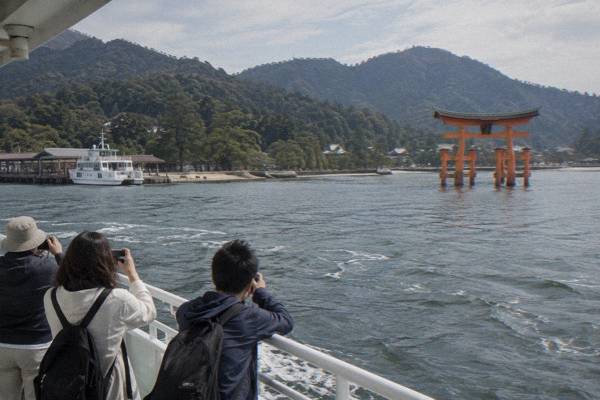
Staying Overnight On Miyajima: Evening Torii And A Ryokan Night
The ferries keep running late, the lanterns stay lit until 23:00, and the island in Hiroshima Bay goes quiet after the last day trip of the afternoon pulls out. Here is what an overnight on Miyajima actually involves, with fares, hours and admission figures from the operators themselves.
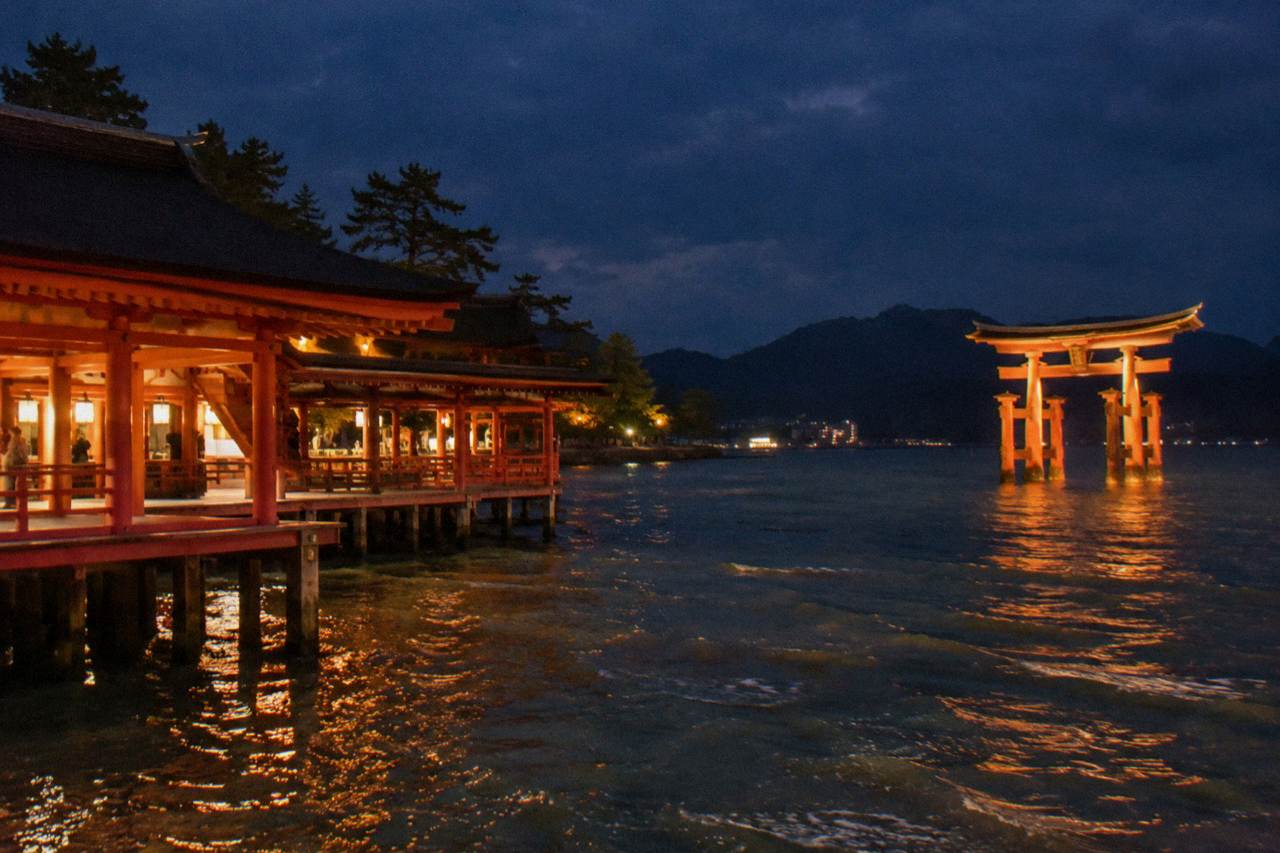
Yes, you can stay overnight on Miyajima: the JR ferry runs until about 22:00 from the island, the Great Torii and shrine are illuminated nightly until 23:00, and the Miyajima ryokan union lists member properties with typical check-in at 15:00 and check-out at 10:00 or 11:00.
The last afternoon ferries leave Miyajima for Miyajimaguchi on the Hiroshima mainland with the day-trip crowds aboard, and something specific happens then: the illumination switches on. The Miyajima Tourist Association's own light-up page states that the Great Torii, the main sanctuary of Itsukushima Shrine, the five-storied pagoda, the Tahoto pagoda and the stone lanterns along the approach are lit every night after sunset until 23:00. Staying overnight on Miyajima is the only simple way to see that, because the island's shops and restaurants mostly close by 17:00 or 18:00 and the evening is otherwise a shuttle back across Hiroshima Bay. The crossing, the evening, the night in a ryokan, the tide and the money all come in figures the operators publish themselves. Start with the wider picture on things to do in Hiroshima if the city itself is still on your list.
Why Stay Overnight On Miyajima At All?
Staying overnight on Miyajima buys you the two hours nobody on a day trip gets: the lit-up torii after sunset and the empty shoreline before the first ferry, because the JR ferry runs until about 22:00 from the island and the illumination stays on until 23:00, while the island's shops and restaurants mostly close by 17:00 to 18:00, which is exactly when day visitors are funneled back onto the boats.
The arithmetic is blunt. The illumination begins half an hour after the sun goes down. The island therefore holds a version of itself that a day trip structurally cannot see, and the Miyajima Tourist Association publishes the schedule for it: nightly, from after sunset to 23:00, viewable free from the shore, with the note that lights may stop temporarily for shrine events.
There is a second gain. The torii changes with the tide, and the times of high and low water vary with the date and the time of day. One night on the island gives an evening and a morning to catch different tide states. The Miyajima Tourist Association publishes tide tables, and the phenomenon page explains the thresholds: the shrine and torii appear to float when the tide is above about 250 cm, and the seabed is exposed enough to walk out to the gate when it falls below about 100 cm. Neither view is guaranteed to a fixed schedule, which is the argument for giving the island a night. The mechanics are explained in full on why the Miyajima torii gate is in the water.
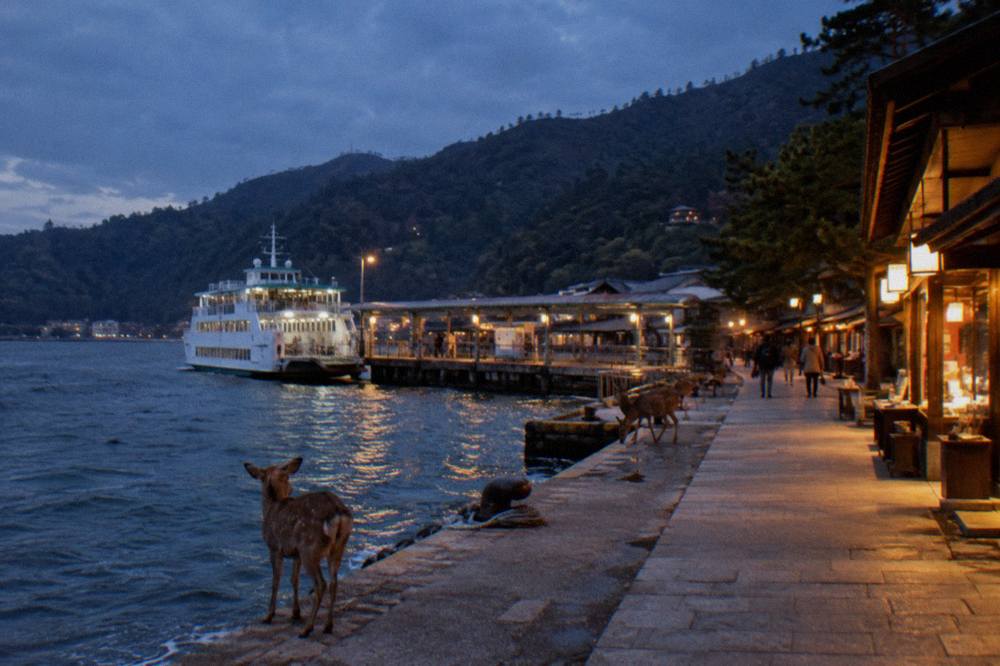
The morning case is just as strong. The JR ferry's first departure from Miyajimaguchi is at about 6:25, so day visitors start arriving early, but an overnight guest is already on the island and can walk the Omotesando approach to Itsukushima Shrine, a 10 to 15 minute walk from the ferry pier, before the boats disgorge. The shrine opens at 6:30 every day. That opening hour belongs to people who slept there.
How Do You Get To Miyajima And When Do The Ferries Stop?
You reach Miyajima by rail or tram to Miyajimaguchi on the Hiroshima mainland and then a roughly 10 minute ferry across Hiroshima Bay: the JR line from Hiroshima Station costs 420 yen, the Hiroden tram Line 2 takes about 66 to 70 minutes at a flat 240 yen, and the last JR ferry off the island departs at 22:14, with the first sailing from Miyajimaguchi at 6:25.
Two ferry companies work the crossing, and their late sailings differ, which matters enormously for an overnight plan. The JR West Miyajima Ferry runs the later service: its last departure from Miyajima is 22:14, and its first from Miyajimaguchi is 6:25. Matsudai Kisen, the other operator, finishes earlier: its last departure from Miyajima is 20:15 on weekdays, 20:35 from Miyajimaguchi. If your plan is dinner on the mainland and a late return to your ryokan, the JR boat is the one that matters. The Japan Rail Pass is valid on the JR ferry, though the 100 yen Miyajima visitor tax is charged separately either way.
| Crossing | Operator | First from Miyajimaguchi | Last from Miyajima | Notes |
|---|---|---|---|---|
| Miyajimaguchi to Miyajima | JR West Miyajima Ferry | 6:25 | 22:14 | About 10 minutes; Japan Rail Pass valid |
| Miyajimaguchi to Miyajima | Matsudai Kisen | 7:00 | 20:15 weekdays | About every 15 minutes |
| Miyajimaguchi to Miyajima | Aqua Net | reported schedule | reported evening sailings | About 5 minutes; 400 yen reported one way plus tax |
The visitor tax is a fixed part of the budget: 100 yen per person, collected with the ferry ticket on entry, preschool children exempt. It has applied since October 2023. For a full breakdown of both rail approaches, see the Hiroshima to Miyajima guide, and for the mainland end of the line, the Miyajimaguchi area page covers the terminal itself.
One combined ticket deserves a line of its own. The Hiroden 1-Day Streetcar and Ferry Pass costs 1,000 yen for adults and includes the Miyajima Matsudai Kisen ferry plus the visitor tax, so it covers the tram out, the crossing, the tax and the tram back in one figure. If you are building a bigger route around the island, the Miyajima day trip guide compares the options.
What Can You Do On Miyajima After The Day Trippers Leave?
After the afternoon boats leave, Miyajima offers the illuminated Great Torii and shrine buildings viewed free from the shore until 23:00, a night cruise from Miyajima Pier No. 3 at 2,000 yen for adults with sailings from 17:55 to 21:15, and a quiet walk along the Nishi-matsubara lantern line, since the island's shops and restaurants mostly close by 17:00 to 18:00.
The illumination is the headline. The Miyajima Tourist Association's light-up page lists exactly what is lit: the Grand Gate, the Main Sanctuary of Itsukushima Shrine, the five-storied pagoda, the Tahoto pagoda, the approach and the stone lanterns along Nishi-matsubara. It runs basically throughout the year, with the caveat that it may stop temporarily for shrine events. You do not pay to see it, and you do not enter the shrine to see it: the shrine's own closing times run from 17:00 in December to 18:00 in the March to mid-October season, so the lit complex is viewed from outside, from land, or from the sea. The details, including the nightly timing, are on the torii at night page.
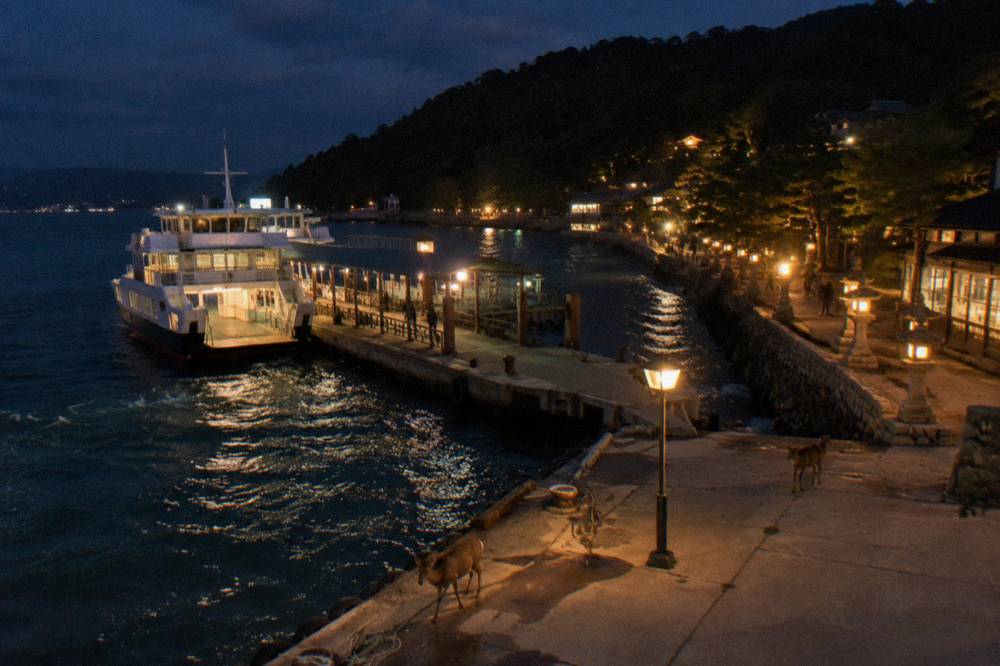
The sea option is specific and bookable in advance. The Aqua Net night cruise to the torii departs Miyajima Pier No. 3 at 17:55, 18:35, 19:15, 19:55, 20:35 and 21:15, runs about 30 minutes, costs 2,000 yen for an adult, and requires booking at least 2 hours ahead. The association notes the boat can approach the Grand Gate only if the tide is high enough, so the cruise and the tide table belong in the same planning step. The tide thresholds themselves are covered on when low tide hits Miyajima.
Plan dinner deliberately. With most island kitchens closing by 17:00 or 18:00, the realistic evening structure is an early dinner, the shoreline walk as the lights come on, and either the night cruise or a slow circuit of the lantern line.
Is It Better To Stay In Hiroshima Or Miyajima?
The last JR ferry off Miyajima is 22:14, while the illuminated torii, the 6:30 shrine opening and the quiet Omotesando morning outweigh late-night dining on Miyajima, because the island empties and dims by about 18:00 while Hiroshima keeps its nightlife.
The honest framing is that the two places fail in opposite directions. Hiroshima at night is a functioning city: the Hiroshima at night itinerary runs on izakaya districts and lit streets that do not close at 18:00. Miyajima at night is the torii, the lanterns and whatever your ryokan serves. Neither is wrong; they answer different questions.
| Decision factor | Overnight on Miyajima | Overnight in Hiroshima |
|---|---|---|
| Evening scene | Illumination until 23:00, quiet shore | Restaurants and bars open late |
| First shrine entry | 6:30 opening, before boats arrive | Requires the first ferry, about 6:25 from Miyajimaguchi |
| Last transport back | JR ferry 22:14 from the island | City transit runs later |
| Tide flexibility | Two tides across a stay | One tide window per visit |
| Day trip range | Ferry-dependent for everything | Tram, JR and Shinkansen on the doorstep |
For a first visit of two or three days, the cleanest split is one or two nights in the city and one night on the island. The Hiroshima in 2 days and Hiroshima in 3 days plans both build that way, and the combined Hiroshima and Miyajima in one day route is the compressed alternative when a night on the island does not fit. For city districts and hotel areas, the where to stay in Hiroshima guide does that job.
Where Should You Sleep On Miyajima?
Sleep in a ryokan on Miyajima itself, chosen from the Miyajima Tourist Association's ryokan union list, which publishes member properties with contact and capacity details, and where check-in is typically at 15:00 and check-out at 10:00 or 11:00, with Iwaso listed among the members at 38 rooms, so the booking decision is about location on the island and whether an evening meal is included rather than about ferry logistics.
The ryokan union page is the practical starting point: it lists member properties with the details you need to contact them directly, and it is the association's own roster rather than a booking platform's. The typical timing, 15:00 in and 10:00 or 11:00 out, shapes the day more than you might expect. A 15:00 check-in means the afternoon belongs to the shrine and the ropeway, and a 10:00 checkout means the morning walk happens with luggage either stored or already on your back. The rest of the planning pages sit on Hiroshima Travel Guide.
Location on the island is a short-axis decision. The ferry pier, the Omotesando shopping street and Itsukushima Shrine sit within a 10 to 15 minute walk of each other, so any property in that cluster puts the illuminated shoreline within an evening stroll. The Miyajima Omotesando area page covers the street itself, and the Itsukushima Shrine attraction page handles the sight in depth.
If a private guide adds value on your crossing day, the Miyajima Private Tour: A Journey to the Floating Torii is this site's featured island walk: Check availability. It pairs naturally with an overnight, since the guided hours fill the afternoon and the ryokan takes over from check-in.
What Does An Overnight Miyajima Itinerary Look Like Hour By Hour?
A workable overnight runs: arrive from Hiroshima by JR or tram to Miyajimaguchi in the early afternoon, ferry across in about 10 minutes, check in at 15:00, visit Itsukushima Shrine before its 17:00 to 18:00 close depending on season, eat early because most kitchens shut by 18:00, watch the illumination from the shore from 30 minutes after sunset, optionally take the 2,000 yen night cruise, sleep, and walk the torii shoreline before the 10:00 checkout.
The fixed hours come from the operators, so the skeleton is reliable even though the tide is not. Here is the frame as a table, using the published times.
| Point in the day | What the schedule gives you | Source figure |
|---|---|---|
| Early afternoon | JR from Hiroshima Station to Miyajimaguchi, about 30 min, 420 yen | JR timetable figure |
| Afternoon | Ferry crossing, about 10 min, plus 100 yen visitor tax | JR ferry page |
| 15:00 | Typical ryokan check-in | Ryokan union page |
| 17:00 to 18:00 | Shrine closes by season | Itsukushima Shrine admission page |
| Sunset plus 30 min | Illumination begins, runs to 23:00 | Tourist association light-up page |
| 17:55 to 21:15 | Night cruise sailings, about 30 min, 2,000 yen adult, book 2 h ahead | Miyajima at night listing |
| 6:25 | First ferry from Miyajimaguchi, first arrivals of the day | JR ferry timetable |
| 6:30 | Itsukushima Shrine opens | Shrine admission page |
| 10:00 or 11:00 | Typical checkout | Ryokan union page |
Seasonal note: the shrine's closing time moves through the year, so the pre-dinner visit window shifts with it. The table below is the full published set.
| Dates | Itsukushima Shrine hours |
|---|---|
| 1 Jan | 0:00 to 18:30 |
| 2 to 3 Jan | 6:30 to 18:30 |
| 4 Jan to end Feb | 6:30 to 17:30 |
| 1 Mar to 14 Oct | 6:30 to 18:00 |
| 15 Oct to 30 Nov | 6:30 to 17:30 |
| Dec | 6:30 to 17:00 |
| Treasure Hall, all year | 8:00 to 17:00 |
| Senjokaku, all year | 8:30 to 16:30 |
Two building works are visible on the island and worth expecting rather than discovering. East corridor reinforcement at Itsukushima Shrine runs to December 2026 and does not block visitor passage, and the five-storied pagoda is under conservation sheeting to November 2027, per the shrine's own construction page. The Great Torii itself finished restoration in December 2022 and stands clear. The current status is tracked on the renovation page.
How Does The Tide Change An Overnight Visit?
The tide decides which Miyajima you get: above about 250 cm the shrine and the Great Torii appear to float, below about 100 cm you can walk out across the seabed to the gate's camphor wood pillars, and with the water turning twice a day, an overnight stay gives you more chances to catch both states than a single afternoon, though not a guarantee, which is why the Miyajima Tourist Association publishes tide tables for planning.
The thresholds are the association's own guide figures, referenced to Hiroshima Port. The floating look needs the higher water; the walk needs the lower. The torii itself is a fixed structure: about 16.6 meters tall, the ninth gate on the site, erected in 1875, standing on driven wooden piles under its own weight rather than buried in the seabed, and designated a National Important Cultural Property since 1952. What changes is the water around it, twice a day, on a schedule you can read in advance.
Practical notes for the walk-out: it requires shoes tolerant of mud and seaweed, since the exposed seabed is wet ground, not a beach path. And the night cruise can only approach the Grand Gate when the tide is high enough, so the same table governs both halves of an evening. Never trust a remembered tide time from a forum post; the association's tables are the planning tool.
What Does A Miyajima Overnight Cost In Yen?
Budget for the basics: the JR ride from Hiroshima Station or a flat 240 yen Hiroden tram fare, 300 yen Itsukushima Shrine admission for adults or 500 yen combined with the Treasure Hall, 2,000 yen for the night cruise if you take it, and 2,000 yen return for the Mount Misen ropeway, with children at half the ropeway fare, while room rates are set by each property.
Hotel pricing is the one line left to the ryokan union: it lists its members and you price the night with them. Everything else in the plan carries a published figure.
| Item | Adult | Concessions |
|---|---|---|
| Miyajima visitor tax | 100 yen | Preschool free |
| JR, Hiroshima Station to Miyajimaguchi | 420 yen | Child fare per JR rules |
| Hiroden tram, flat fare, all lines | 240 yen | Child 120 yen |
| Hiroden 1-Day Streetcar and Ferry Pass | 1,000 yen | Includes Matsudai ferry and tax |
| Itsukushima Shrine | 300 yen | High school 200, elementary and junior high 100 |
| Shrine plus Treasure Hall combined | 500 yen | 300 and 150 |
| Mount Misen ropeway return | 2,000 yen | Child 1,000; one way 1,100 and 550 |
| Aqua Net night cruise | 2,000 yen | Booking at least 2 hours ahead |
The ropeway runs 9:00 to 16:00 with last descent at 16:30, so it is strictly a daytime item on the day you arrive, not an evening one. If your overnight slots into a longer spring or autumn route, the Miyajima autumn leaves guide and the Hiroshima cherry blossom guide pick the seasonal weeks.
What Should You Pack For A Night On The Island?
Pack for mud, tide and early light: shoes that tolerate wet seabed and seaweed for the low-tide walk to the torii, comfortable flat footwear for the shrine corridor boards, which the shrine's own page notes have deliberate gaps for high-tide water pressure, a layer for the shoreline after dark, and whatever your ryokan asks you to bring, since check-in is typically 15:00 and checkout 10:00 or 11:00, which means luggage moves with your morning.
The shoe point is official, not folklore: the shrine's admission page specifically warns that the corridor floorboards have gaps that let high-tide water pass through, and recommends comfortable shoes. The low-tide walk adds the mud and seaweed condition. Neither needs specialist gear, just nothing you would grieve over.
And if a summer overnight tempts you toward a swim, check can you swim at Miyajima first.
Common Questions About Staying Overnight On Miyajima
Is It Better To Stay In Hiroshima Or Miyajima?
It depends on what your evening is for. Hiroshima keeps its restaurants, bars and late transport, while Miyajima offers the illuminated torii until 23:00, the 6:30 shrine opening and a quiet shoreline morning, at the cost of an island that largely closes by 18:00 and a last JR ferry off at 22:14. A split of nights, one or two in the city and one on the island, answers both sets of priorities.
Can You See The Torii Lit Up Without Staying Overnight?
Yes. The torii and shrine are illuminated every night from 30 minutes after sunset until 23:00, viewable free from shore, and JR ferries run about every 15 minutes until the 22:14 last departure from Miyajima, so a day trip that stays into the evening can watch the light-up without rushing. The overnight instead buys a relaxed, crowd-free evening and the quiet shoreline morning. To see the lit torii from the water, the 2,000 yen night cruise from Miyajima Pier No. 3 sails from 17:55 to 21:15.
Do You Have To Pay The Miyajima Visitor Tax Twice?
No. The tax is 100 yen per person, collected with the ferry ticket on entry to the island, and preschool children are exempt. It is charged once per entry, so an overnight with one arrival and one departure pays it once. Japan Rail Pass holders ride the JR ferry covered but still pay the separate 100 yen.
What Time Do You Have To Leave Miyajima The Next Morning?
You do not have to leave early at all. Typical ryokan checkout is 10:00 or 11:00, and ferries run about every 15 minutes through the day, so a late-morning departure is normal. The advantage of being up early instead is the 6:30 shrine opening and the shoreline before the first ferry from Miyajimaguchi departs at 6:25.
Is Anything On Miyajima Closed For Repairs Right Now?
The Great Torii itself finished restoration in December 2022 and stands clear. Per the shrine's construction page, east corridor reinforcement runs to December 2026 but does not block visitor passage, and the five-storied pagoda is under conservation sheeting to November 2027. The shrine, its corridors and the shoreline remain open throughout.
Can You Walk To The Torii During An Overnight Stay?
When the tide is below about 100 cm, yes: the seabed is exposed and you can walk out to the base of the gate, in shoes that tolerate mud and seaweed. Above about 250 cm the gate and shrine appear to float instead. Check the Miyajima Tourist Association's tide table for your dates.
The overnight on Miyajima is a small logistics problem with a large payoff: one ferry timetable, one tide table, one ryokan booking, and in exchange the island in the two states almost nobody waits around to see, lantern-lit at night and shoreline-quiet at dawn.