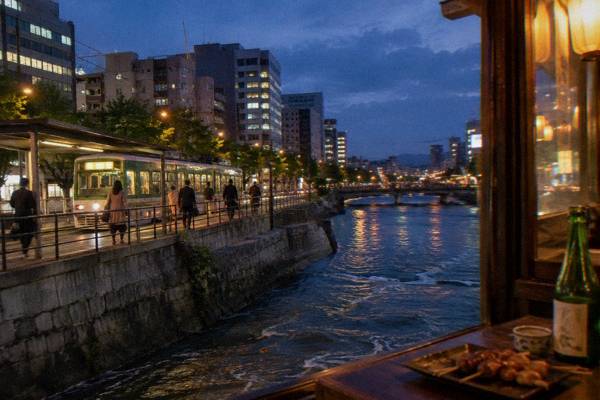
Hiroshima At Night: Lit Dome, Riverside Walks And Late Okonomiyaki
Hiroshima changes character after sunset: the Atomic Bomb Dome is lit, the Motoyasu promenades glow, Miyajima's Great Torii is illuminated until 11 p.m., and Okonomimura grills until 22:00.
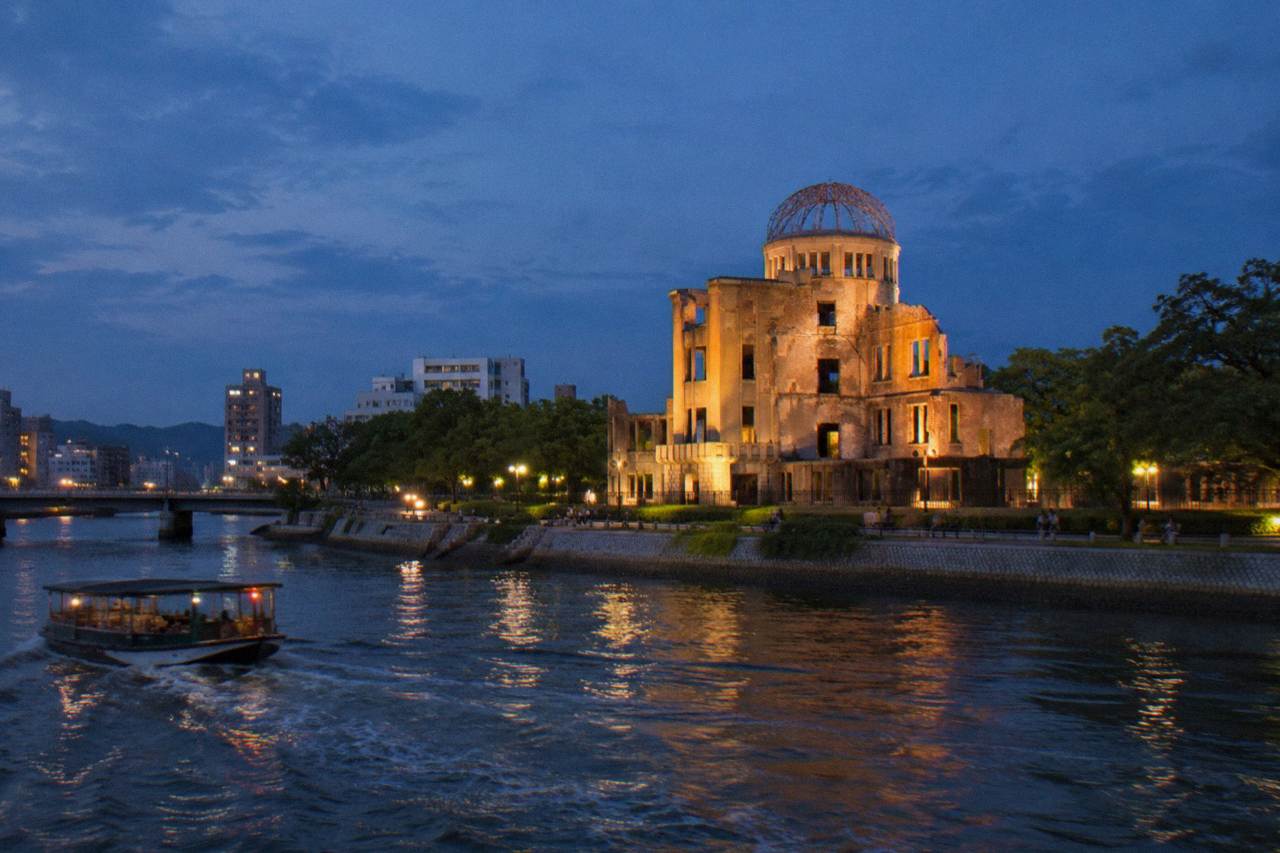
The Atomic Bomb Dome is lit nightly from sunset to around midnight and can be viewed free from outside the fence, Miyajima's illuminations run from 30 minutes after sunset to 23:00, and Okonomimura serves okonomiyaki until 22:00 with last orders around 21:30.
Hiroshima after dark is a quieter city than the daytime version, but not an empty one. The Atomic Bomb Dome is illuminated from sunset until around midnight, the riverside promenades along the Motoyasu carry LED lighting for safe walking, and a 10-minute ferry away, the Great Torii at Miyajima is lit every evening until 11 p.m. Add a food building in Shintenchi that grills okonomiyaki until 22:00, and the evening fills itself. This itinerary walks through what stays open, what it costs in yen, and how the last trams and ferries shape the night.
What Can You See In Hiroshima At Night?
The after-dark highlights of Hiroshima are the illuminated Atomic Bomb Dome viewed from outside its fence, the LED-lit promenades along the Motoyasu River, the lantern-lit shrine and torii at Miyajima until 23:00, and okonomiyaki counters across the Shintenchi district that serve until 22:00. All of these are reachable on the flat 240-yen Hiroden tram fare.
The evening splits naturally into two halves. In the city, the core loop between the Atomic Bomb Dome-mae tram stop and the Motoyasu riverside takes in the dome, the park and the promenades, and the whole stretch is free to walk. On the island, the illuminations around Itsukushima Shrine begin 30 minutes after sunset and run to 23:00, with the last JR ferry back from Miyajima at 22:14.
Timing is the one thing to plan properly. Okonomimura takes last orders around 21:30, the last tram on Hiroden Line 1 toward Hiroshima Port leaves central stops around 22:01, and the island and the city cannot both be done comfortably after dinner. Pick one anchor for the evening, either the dome and the river, or the ferry and the torii, and let the tables further down this page set the schedule.
The Atomic Bomb Dome After Dark: Hours, Lighting And Access
The Atomic Bomb Dome in Hiroshima is viewable 24 hours a day, 365 days a year, from outside its perimeter fence, with no admission fee and no entry permitted inside the structure. The exterior is illuminated nightly from sunset until around midnight, and the Motoyasu River directly beside it carries the reflection of the lit ruin.
The dome stands at 1-10 Otemachi, Naka-ku, inside the Peace Memorial Park area, which is reported to be open at all times with no entry fee. The building was constructed in 1915 as the Hiroshima Prefectural Product Exhibition Hall, designed by Czech architect Jan Letzel, and the city decided to preserve it in 1966, with five rounds of preservation work carried out since. The city's light-down campaigns for energy conservation can affect the lighting, typically from 8:00 p.m., so the illumination is not guaranteed at a constant level all night.
Access is simple. From JR Hiroshima Station South Exit, Hiroden streetcar Line 2 (toward Miyajimaguchi or Nishi-Hiroshima) or Line 6 (toward Eba) reaches the Genbaku Dome-mae stop in about 20 minutes, and the stop is directly beside the site, about a 1-minute walk to the viewing area. The flat fare is 240 yen for adults and 120 yen for children on every Hiroden line. Walking from Hiroshima Station is also possible, at roughly 2 km or 30 minutes on foot. A focused visit to the exterior takes about 20 to 30 minutes, which leaves the rest of the evening for the river.
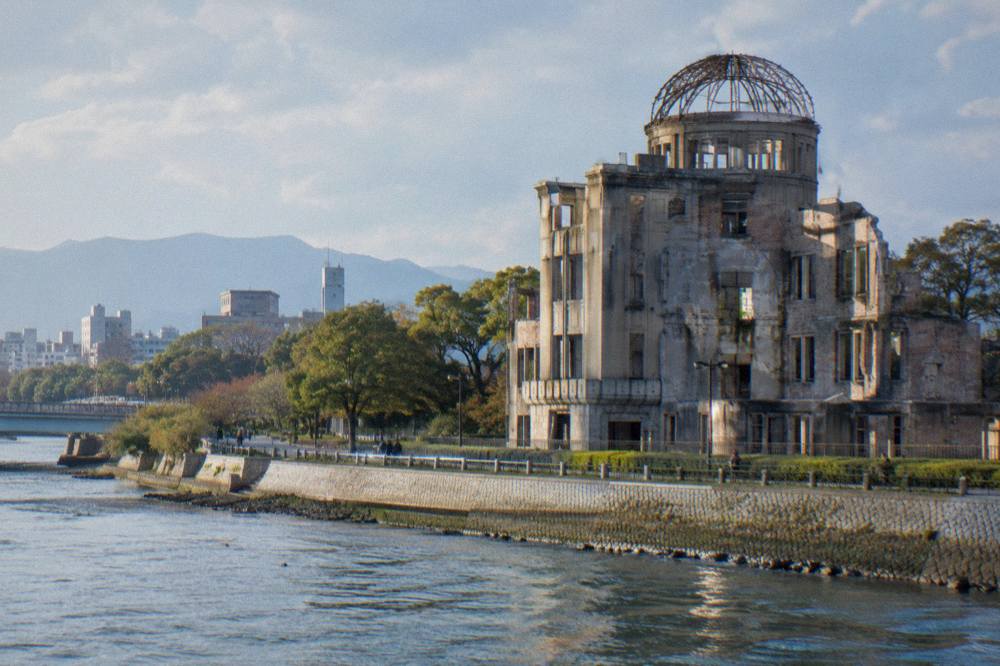
For the full history of the building and its preservation, see the Atomic Bomb Dome attraction guide. The deeper background of the Peace Park around it is covered on a guided peace memorial walk that runs before dark, and the 2.5-hour historical walk below pairs well with an evening dome visit.
To hear that history from a guide while it is still daylight, book a peace and history walking tour here.
A guided history walk earlier in the day gives the evening dome its context: Check availability
Riverside Walks Along The Motoyasu In Hiroshima
The Motoyasu River flows directly past the Atomic Bomb Dome, and the riverside promenades along Hiroshima's rivers, including the Motoyasu, feature LED illumination for safe nighttime walking. This is the quiet centrepiece of a Hiroshima evening. The Peace Memorial Park itself spans a reported 122,100 square metres with 35 monuments, so the walk can be extended through the park as far as legs allow.
One dated note belongs to the calendar rather than the itinerary: lantern floating ceremonies take place annually on 6 August along the Motoyasu River near the dome, and the Peace Memorial Ceremony is held that morning from 8:00 to 8:50 in the Peace Memorial Park. The evening river scene on that one night is different from every other night of the year. Behaviour on the riverbank follows the park's rules. Photography is normal practice on the promenades; loud behaviour around the dome and the memorials is not.
Miyajima After Dark: Is The Great Torii Lit Up At Night?
Yes. The illuminations around Itsukushima Shrine, including the Grand Gate, run every day from 30 minutes after sunset until 11:00 p.m., covering the Great Torii, the Main Sanctuary, the Five-storied Pagoda, the Tahoto pagoda, the approach and the stone lanterns along Nishi-matsubara. The island is reached by a 10-minute JR ferry from Miyajimaguchi.
The current Great Torii, the ninth on the site, was erected in 1875 and stands about 16.6 metres tall, roughly 212.7 metres from the Haiden, the main worshipping hall. Its main pillars measure about 13.4 metres with a circumference of about 9.9 metres, and the crossbeam runs about 24.2 metres. It has been a National Important Cultural Property since 29 March 1952. Its restoration finished in December 2022, and repair work on a corridor and the five-storey pagoda is reported to be under way, with the shrine open throughout.
The tide decides what the lit torii looks like. The shrine appears to float when the tide level is above about 250 cm, and visitors can walk out to the gate when the tide drops below about 100 cm. Between those levels it stands in shallow water. Check the live tide prediction for Hiroshima Bay before choosing a night for this, because a high-tide evening shows a floating gate and a low-tide evening shows a walkable one, and both are lit.
Timing matters on the clock as well. The last JR West Miyajima ferry departs Miyajima at 22:14, so the 21:15 night cruise and one last look at the shore are the practical end of an island evening. The shrine itself closes between 17:00 and 18:30 depending on the season, so the illumination is viewed from outside. For the full question-and-answer treatment, see Is The Miyajima Torii Gate Lit Up At Night?, and for staying over instead of racing the ferry, read the Miyajima overnight itinerary.
| Illuminated element at Miyajima | Lit every day | Notes |
|---|---|---|
| Grand Gate (O-torii) | 30 min after sunset to 23:00 | About 16.6 m tall, erected 1875 |
| Main Sanctuary of Itsukushima Shrine | 30 min after sunset to 23:00 | Shrine interior closes 17:00 to 18:30 by season |
| Five-storied pagoda | 30 min after sunset to 23:00 | Repair reported under way to 2027 |
| Tahoto pagoda | 30 min after sunset to 23:00 | Lit as part of the shrine illuminations |
| Approach and Nishi-matsubara stone lanterns | 30 min after sunset to 23:00 | Stone lantern line along the shore |
The Night Cruise To The Lit Torii From Miyajima
Aqua Net's Hiroshima night cruise to view the lit torii and shrine departs Miyajima Pier No. 3 at 17:55, 18:35, 19:15, 19:55, 20:35 and 21:15, lasts about 30 minutes and costs 2,000 yen for an adult. The illuminations can be watched from land or from the sea, if the tide is high enough for the boat to approach the Grand Gate.
That is the whole decision in one paragraph. From the shore, the lit gate, the pagodas and the lantern line cost nothing beyond the 100-yen Miyajima Visitor Tax charged on entering the island. From the water, the 2,000-yen sailing adds the floating view, and the operator's departures line up with the 30-minutes-after-sunset start of the illuminations through the 21:15 sailing, which still lands passengers before the 22:14 last JR ferry. More of these guides are collected on Hiroshima Travel Guide.
| Night cruise departure | Duration | Adult fare | Fits before last ferry (22:14) |
|---|---|---|---|
| 17:55 | About 30 minutes | 2,000 yen | Yes |
| 18:35 | About 30 minutes | 2,000 yen | Yes |
| 19:15 | About 30 minutes | 2,000 yen | Yes |
| 19:55 | About 30 minutes | 2,000 yen | Yes |
| 20:35 | About 30 minutes | 2,000 yen | Yes |
| 21:15 | About 30 minutes | 2,000 yen | Yes, tight |
Late Okonomiyaki In Hiroshima: Okonomimura And Station Counters
Okonomimura in Hiroshima's Shintenchi district operates daily from 11:00 to 22:00 with last orders around 21:30, across 24 okonomiyaki stalls on four floors. A standard Hiroshima-style okonomiyaki there runs 800 to 1,500 yen, with toppings pushing plates to 1,500 to 2,200 yen.
Hiroshima-style okonomiyaki is built in layers: a thin crepe-like batter base first, then a large amount of cabbage, pork, yakisoba or udon noodles, and often a fried egg on top, unlike the Osaka style that mixes everything into the batter. Noodles are a standard layer in the Hiroshima version and typically absent in the Osaka one. The city reportedly has more okonomiyaki restaurants than Osaka, and Okonomimura is the concentrated version of that fact.
The building sits at 5-13 Shintenchi, Naka-ku, a 3-minute walk from the Hacchobori tram stop on the Hiroden network, reachable on the flat 240-yen fare, or freely all day on the 700-yen 1 Day Streetcar Pass valid on all lines. Many stalls provide English menus.
For a later seat, the station area's ekie counters run past Okonomimura's last orders. Mitchan Sohonten's ekie branch at Hiroshima Station is open 11:00 to 22:00, Reichan on ekie 1F serves until 21:30, and Denko Sekka's ekie store keeps going until 23:00 with its stacked 3D okonomiyaki. The background on the dish, its districts and its etiquette is in the Hiroshima okonomiyaki guide, the building itself is covered on the Okonomimura page, and the wider bar-and-district scene, including Nagarekawa and Yagenbori, sits in the Hiroshima nightlife guide.
| Late okonomiyaki counter | Location | Hours | Notes |
|---|---|---|---|
| Okonomimura (24 stalls, 4 floors) | 5-13 Shintenchi, Naka-ku | 11:00 to 22:00, last orders about 21:30 | 3 minutes from Hacchobori tram stop |
| Mitchan Sohonten ekie branch | 1-2 Matsubara-cho, Minami-ku | 11:00 to 22:00 | Hiroshima Station |
| Reichan | ekie 1F, Hiroshima Station | 11:00 to 21:30 | Soba-based okonomiyaki |
| Denko Sekka | ekie, Hiroshima Station | 11:00 to 23:00 | 3D okonomiyaki |
Trams, Ferries And Last Departures In Hiroshima At Night
The last Hiroden Line 1 tram toward Hiroshima Port leaves central stops around 22:01, Line 2 trams from the Hiroshima Station area run until around 22:50 on many routes, and the last JR ferry from Miyajima departs at 22:14. Every Hiroden ride costs a flat 240 yen for adults and 120 yen for children, on all lines including the Miyajima line.
The Hiroden flat fare has applied since 1 February 2025, and the 1 Day Streetcar Pass at 700 yen for adults covers all lines, which suits a day that hops between Hacchobori, the dome and Miyajimaguchi. The tram now enters the Hiroshima Station building's 2nd floor, reported since August 2025, which makes a late station-counter dinner an easy ending: eat upstairs, board upstairs.
On the island side, JR ferry departures from Miyajimaguchi run roughly every 15 minutes from 8:00 into the evening, with the first sailing about 6:25 and the last from Miyajima at 22:14. Matsudai Kisen runs its own competing ferry on a roughly 15-minute headway over a shorter day. Great Torii sailings, the route that passes in front of the gate, run 9:10 to 16:10, so the lit-gate sea view at night belongs to the night cruise, not the commuter ferry.
| Service | Last or latest departure | Fare |
|---|---|---|
| Hiroden Line 1 toward Hiroshima Port | About 22:01 from central stops | 240 yen adult, 120 yen child |
| Hiroden Line 2 from Hiroshima Station area | About 22:50 on many routes | 240 yen adult, 120 yen child |
| JR Miyajima Ferry from Miyajima | 22:14 | 200 yen one way per adult |
| Matsudai Kisen ferry | Evening service ends earlier than the JR ferry | Separate operator timetable |
One more night-owl fact: the Hiroshima Station Tourist Information Center operates until midnight year-round, and the Peace Memorial Park Rest House information center extends to 8:00 p.m. in August. If the evening plan needs rescuing, the station desk is open late.
Peace Park At Night: Rules And Quiet Hours
Peace Memorial Park in Hiroshima is reported to be open at all times, with no closing hours and no entry fee, and covers 122,100 square metres containing 35 monuments. The practical etiquette layer is thin and clear. Keep voices down around the memorials. Treat the fence around the dome as the boundary it is, since access beyond it is not permitted and the structure's interior is closed to entry.
Photography from the promenades and riverbank is unremarkable; the same camera pointed into a night ceremony crowd on 6 August is a different matter, and restraint is the better reading of the site's request for respect. The one dated overlay is the Peace Memorial Ceremony on 6 August, 8:00 to 8:50, with about 7,000 seats in the park plus about 2,200 indoor seats at the International Conference Center. On that evening the riverside lantern floating takes place along the Motoyasu near the dome, and the whole river scene is given over to it.
An Evening Route Through Hiroshima In Order
A workable evening in Hiroshima runs: the Peace Park and lit Atomic Bomb Dome after sunset, the Motoyasu promenade walk, dinner at Okonomimura or a station counter, and either the last Line 2 tram around 22:50 in the city, or, on an island night, the 21:15 cruise and the 22:14 ferry from Miyajima.
Two full routes, then, depending on which side of the water the evening ends.
| Time | City evening | Island evening |
|---|---|---|
| Sunset | Arrive Genbaku Dome-mae by tram (240 yen) | JR ferry from Miyajimaguchi to Miyajima |
| Sunset + 30 min | Lit dome and Motoyasu reflection | Miyajima illuminations begin |
| Evening | Promenade walk through Peace Memorial Park | Great Torii and lantern line from shore |
| 19:00 to 20:30 | Okonomimura, last orders about 21:30 | Night cruise from Pier No. 3, 2,000 yen |
| Last move | Line 2 tram about 22:50 from station area | 21:15 cruise, 22:14 last JR ferry |
The choice between the two is really a choice of tide. A high-tide island night shows a floating, lit torii from the water; a low-tide night allows a walk to the gate's pillars on the sand. The city evening is tide-proof and needs nothing but a tram card. Visitors building a longer stay can chain this evening onto the Hiroshima in one day itinerary or the fuller Hiroshima and Miyajima in one day plan, and first-timers get the wider framing in first time in Hiroshima.
Common Questions About Hiroshima At Night
Is The Atomic Bomb Dome Lit At Night?
Yes. The exterior is illuminated nightly from sunset until around midnight, and it is viewable 24 hours a day, 365 days a year, from outside the perimeter fence with no admission fee. City light-down campaigns for energy conservation, typically from 8:00 p.m., can affect the lighting.
Is Peace Memorial Park Open At Night?
The park is reported by the city to be open at all times, with no closing hours and no entry fee. The site asks for quiet, respectful behaviour.
How Late Can You Eat Okonomiyaki In Hiroshima?
Okonomimura operates 11:00 to 22:00 with last orders around 21:30. At Hiroshima Station, Mitchan Sohonten's ekie branch serves to 22:00, Reichan to 21:30 and Denko Sekka to 23:00.
What Time Is The Last Tram In Hiroshima?
The last Hiroden Line 1 tram toward Hiroshima Port departs central stops around 22:01, and Line 2 trams from the Hiroshima Station area run until around 22:50 on many routes. The flat fare is 240 yen adult, 120 yen child.
Can You See The Miyajima Torii Lit Up At Night?
Yes. Illuminations around Itsukushima Shrine, including the Grand Gate, run every day from 30 minutes after sunset to 11:00 p.m., viewable from land or from the sea when the tide is high enough. The last JR ferry back from Miyajima departs at 22:14.
Is The Hiroshima Night Cruise Worth It?
The Aqua Net night cruise from Miyajima Pier No. 3 runs about 30 minutes at 2,000 yen adult, with departures to 21:15. The shore view of the lit gate is free, so the sailing is bought for the water-level perspective of the illuminated torii and shrine.
However the evening is assembled, the two hard edges are the 22:14 ferry on the island side and the 22:01 to 22:50 spread of last trams in the city, and everything else in a Hiroshima night bends around them.