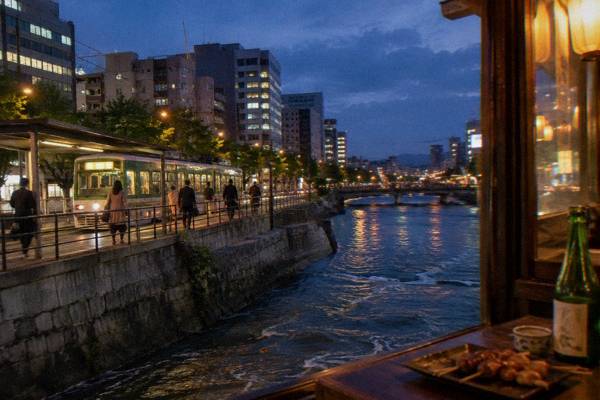
Hiroshima Okonomiyaki: How It Differs And Where To Eat It
Hiroshima okonomiyaki is a layered savoury pancake built on a thin crepe-like base with cabbage, pork, noodles and egg, and the city of Hiroshima has more okonomiyaki restaurants than Osaka.
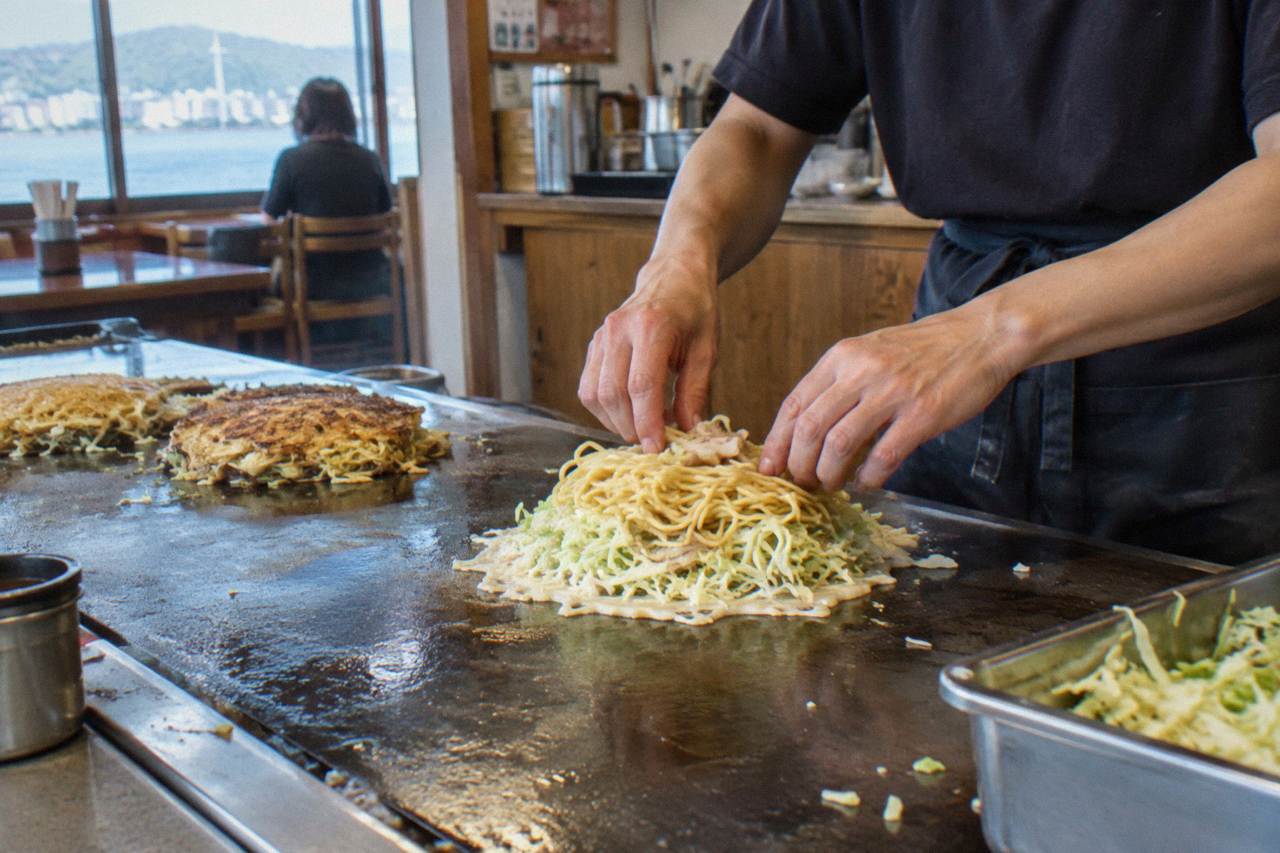
Hiroshima okonomiyaki is layered rather than mixed: a thin batter base first, then cabbage, pork, yakisoba or udon noodles, and often a fried egg, cooked on a teppan. Okonomimura in central Hiroshima holds 23 restaurants on floors 2 to 4, and standard portions there run from about 800 to 1,500 yen.
Hiroshima okonomiyaki is the city's signature dish, and it is built nothing like the version most guidebooks describe first. A very thin crepe-like batter base goes on the teppan griddle first, then a large amount of cabbage, then pork, then a layer of yakisoba or udon noodles, and often a fried egg on top, each element cooked separately and stacked rather than stirred together. This page explains the difference between the two styles, where to eat the Hiroshima version from the Okonomimura stall complex to the station branches, what a plate costs, and how to learn to cook one yourself.
What Is Hiroshima Okonomiyaki And Why Does The City Own It?
Hiroshima okonomiyaki is a layered savoury pancake: a thin batter base cooked first on a hot griddle, then a large heap of cabbage, pork, yakisoba or udon noodles, and usually a fried egg, all stacked in stages and finished with sauce. The style is reported to be called Hiroshimayaki locally, and Hiroshima has more okonomiyaki restaurants than Osaka.
As any Hiroshima Travel Guide will tell you, the layering is the whole point. Where Osaka-style mixes everything into one batter before it touches the griddle, the Hiroshima cook builds the dish in distinct strata, and the contrast between crispy noodles and steamed cabbage inside a soft stack is what the style is built to deliver. The batter base is thin, closer to a crepe than a pancake, so it carries the pile rather than dominating it.
The noodle layer is standard in Hiroshima rather than an optional extra, which alone makes it a different meal from the Osaka version.
What Is The Difference Between Hiroshima And Osaka Okonomiyaki?
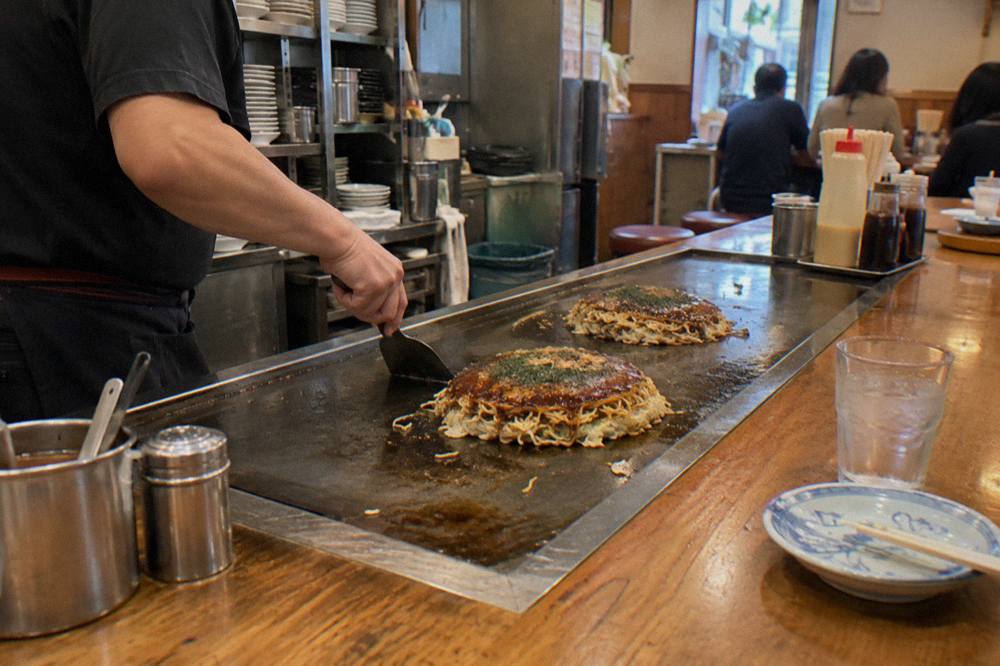
The difference is construction: Hiroshima-style layers a thin crepe-like batter base, cabbage, pork, noodles and often a fried egg as separate strata, while Osaka-style mixes all the ingredients into a thicker batter before cooking. Noodles are standard in the Hiroshima version and typically absent from Osaka-style except in modan-yaki variations, so the two plates look and eat differently.
Both are cooked on a teppan and both finish with the same dark, sweet-savoury sauce, but the method divides them. In Osaka the cabbage, egg and flour become one batter, poured as a single thick disc. In Hiroshima the base stays separate and thin, the cabbage goes on as a mound that steams down, and the noodles fry beside it before the whole stack is flipped and assembled with sauce brushed over the top.
| Aspect | Hiroshima Style | Osaka Style |
|---|---|---|
| Batter | Very thin crepe-like base, cooked first | Thicker batter with ingredients mixed in |
| Method | Layered in stages on the griddle | Mixed, then poured as one disc |
| Noodles | Yakisoba or udon as a standard layer | Typically none, except modan-yaki variations |
| Egg | Often a fried egg on top | Usually mixed into the batter |
| Texture | Crispy noodles against steamed cabbage | Uniform, softer crumb |
The two cities treat the dish as a rivalry, and Hiroshima's argument is the noodle layer plus the sheer number of places serving it. Regional variations push the idea further inside the prefecture: Fuchu-yaki uses minced meat, and Shobara-yaki swaps the noodles for rice, so the layered principle survives even where the filling changes.
A guided day is one way to pair the food with everything else the city holds. The Hiroshima & Miyajima in 1 Day: Private Tour, Licensed Guide pairs the Peace Memorial Park with the island in a single structured day, and food stops can be part of how a private day is shaped. Solo touring works too, and the question of whether Hiroshima is walkable has its own answer elsewhere on this site.
Where To Eat Hiroshima Okonomiyaki In The City?
The headline address is Okonomimura at 5-13 Shintenchi, Naka-ku: 23 okonomiyaki restaurants on floors 2 to 4, a 3-minute walk from the Hacchobori tram stop on the Hiroden network, with most stalls operating 11:00 to 22:00 daily and last orders around 21:30. Around Hiroshima Station, the ekie building holds branches including Mitchan Sohonten, Reichan and Denko Sekka.
Okonomimura is the dedicated complex, and its scale is the draw: two dozen independent stalls, each with its own griddle and its own house style, stacked vertically in the Shintenchi entertainment district. Many stalls provide English menus, most take cash only, and none take reservations, so the visit is deliberately informal. The full Okonomimura attraction page covers the building in more detail.
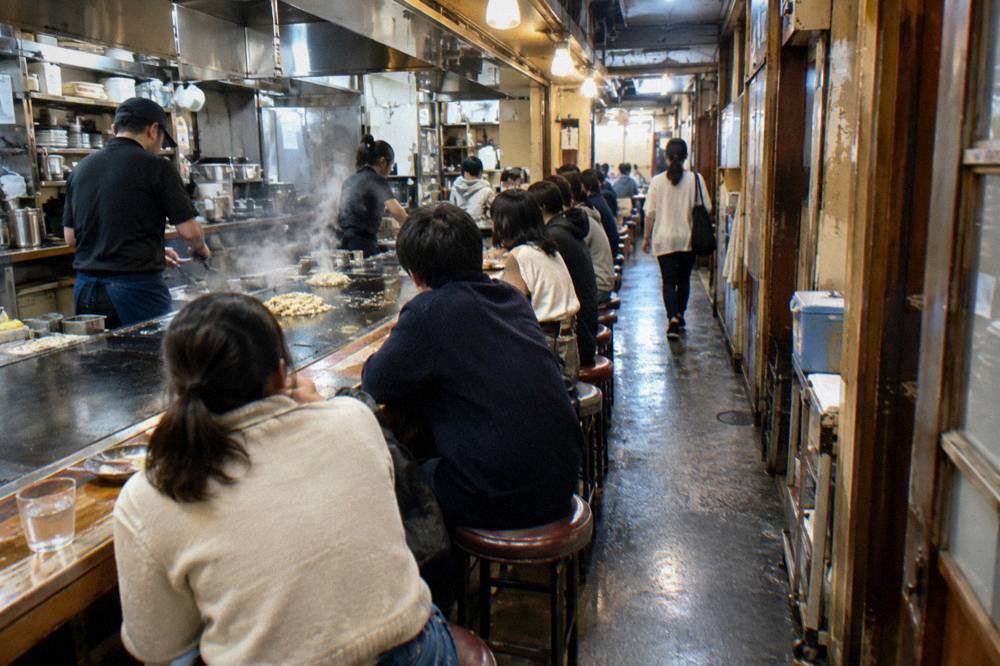
The station end of the city is the other cluster. Three named branches sit at 1-2 Matsubara-cho, Minami-ku, inside or beside the ekie complex at Hiroshima Station, which makes a plate possible between trains. The station-area eating guide goes deeper on that district.
| Branch | Location | Hours | Note |
|---|---|---|---|
| Mitchan Sohonten ekie | 1-2 Matsubara-cho, Minami-ku | 11:00 to 22:00 | Hiroshima-style okonomiyaki |
| Reichan | ekie 1F, Hiroshima Station | 11:00 to 21:30 | Soba-based okonomiyaki |
| Denko Sekka ekie | 1-2 Matsubara-cho | 11:00 to 23:00 | 3D okonomiyaki |
The dish travels with the city rather than being pinned to one street.
How Much Does Hiroshima Okonomiyaki Cost At Okonomimura?
A standard okonomiyaki at Okonomimura costs roughly 800 to 1,500 yen, and toppings push plates to around 1,500 to 2,200 yen. Most stalls take cash only, so the practical budget is a couple of notes per person rather than a card, and there are no reservations to secure a griddle seat in advance.
The price spread reflects what goes on the plate. A plain standard portion sits at the lower end of the range, and the upper band arrives with extra pork, seafood or egg. Against other local costs, the plate sits below the 2,500-yen OKOSTA cooking experience, which is to say it is ordinary city eating, not a splurge.
| Plate | Typical Range |
|---|---|
| Standard okonomiyaki | 800 to 1,500 yen |
| With toppings | 1,500 to 2,200 yen |
| OKOSTA cook-it-yourself experience | 2,500 yen, tax included |
Budget or not, the meal anchors the evening in the centre. A Hiroshima night itinerary naturally ends near a griddle, and the question of okonomiyaki restaurant etiquette has its own page for anyone unsure how the counter seating works.
Can You Cook Hiroshima Okonomiyaki Yourself In Hiroshima?
Yes, and the dedicated venue is OKOSTA, the okonomiyaki workshop run by Otafuku inside ekie at 1-2 Matsubara-cho, a 2-minute walk from the north exit of Hiroshima Station. Sessions last 1.5 hours, run three times daily at 10:30, 13:00 and 18:30, cost 2,500 yen tax included with one topping, and require advance reservation at least three days ahead.
The experience is built around the layering, not just the eating. Standard, Muslim-friendly, vegetarian and gluten-free versions all cost the same 2,500 yen: the halal option uses sauce from the company's Malaysia factory with squid and shrimp instead of pork, the vegetarian version substitutes corn and vegetarian sauce, and the gluten-free version uses rice-flour noodles and gluten-free sauce. Participants keep the paper apron and hat. Evening party plans at the 18:30 session run 3,300 yen with one drink or 5,500 yen with a two-hour all-you-can-drink option.
| Session | Time | Price |
|---|---|---|
| Morning | 10:30 to 12:00 | 2,500 yen tax included |
| Afternoon | 13:00 to 14:30 | 2,500 yen tax included |
| Evening party plan (one drink) | 18:30 to 20:00 | 3,300 yen tax included |
| Evening party plan (all-you-can-drink) | 18:30 to 20:00 | 5,500 yen tax included |
Capacity is capped at 20 participants per session with 40 total across the venue, groups of 30 or more can book the whole space, and grades 1 to 4 need one guardian per child. Same-day bookings are accepted by phone only. The OKOSTA museum page carries the full detail, and a longer okonomiyaki cooking class is listed separately on this site for anyone who wants a booked class rather than a direct reservation.
Because the workshop sits inside the station complex, reaching Hiroshima is effectively reaching the class. The airport limousine bus covers the run from Hiroshima Airport to the Shinkansen exit of the station in about 50 minutes, costs 1,500 yen per adult and 750 yen per child, leaves from Bus Stop 2, and accepts IC cards. From Shin-Osaka the Nozomi shinkansen needs roughly 80 to 85 minutes, and the journey from Tokyo takes about four hours. City streetcars charge a flat fare of 240 yen for adults and 120 yen for children on every line, including the Miyajima line, and the trams now serve the station building itself, stopping on its second floor inside the complex.
A morning class frees the rest of the day for the city's other sights. The Peace Memorial Museum keeps long hours: 7:30 to 19:00 from March to July and from September to November, 7:30 to 20:00 in August, and 7:30 to 18:00 from December to February, with closures on 30 and 31 December and in mid-February for an exhibit change. Admission is 200 yen for college students and older, 100 yen for high school students, free for junior high school pupils and younger, and 100 yen for visitors 65 and over who show a passport. Shukkeien garden asks 350 yen for adults and 150 yen for university students, admits school students free, and opens at 9:00 every day, closing at 18:00 from 16 March to 15 September and at 17:00 the rest of the year, with last entry 30 minutes before closing. One caveat: the Hiroshima Castle keep closed to visitors permanently on 22 March 2026, so the castle is an exterior-only sight now, though a history museum in the Sannomaru section of the grounds is slated for 2027.
An afternoon slot still leaves time for Miyajima. JR ferries make the 10-minute crossing from Miyajimaguchi roughly every 15 minutes during the day, from a first departure near 6:25 to a last around 22:00; the Japan Rail Pass and JR-West rail passes are valid on board, and sailings that pass the Great Torii run from 9:10 to 16:10. A 100 yen visitor tax is collected separately on entering the island, with preschool children exempt. Itsukushima Shrine charges 300 yen for adults, 200 yen for high school students and 100 yen for elementary and junior high students, and a combined ticket with the Treasure Hall costs 500, 300 and 150 yen at those same tiers. The shrine opens at 6:30 and closes between 17:00 and 18:30; the Treasure Hall runs 8:00 to 17:00 and Senjokaku 8:30 to 16:30. The corridor floorboards are set with gaps that relieve the pressure of high tides, and comfortable shoes make the walk easier. Tide also governs the famous gate: at around 250 cm the Great Torii seems to float, and once the water drops below roughly 100 cm you can walk out to its base. If energy remains, the Mount Misen ropeway costs 2,000 yen round trip or 1,100 yen one way for adults, half that for children, runs 9:00 to 16:00 with a last descent at 16:30, and needs about an hour for the round trip, plus another hour if you walk the summit trails.
Is Okonomiyaki Healthy?
As a single meal, okonomiyaki is a mixed picture rather than a verdict: it delivers a large amount of cabbage, a protein layer and eggs, but it also carries noodles, a sweet-savoury sauce and griddle oil, so the balance depends on the toppings chosen. The gluten-free and vegetarian versions at OKOSTA show how the plate can be adjusted without changing the dish's structure.
The honest framing is portion and frequency. A standard plate is a full meal in itself, noodles included, and the topping range moves the calorie total more than the base does.
The dietary adjustments matter more than they might sound. The halal sauce supply from the company's Malaysia factory means the Muslim-friendly version is not an improvised substitution but a built product line, and the gluten-free version swaps the wheat noodles for rice-flour ones while keeping the layered build intact. A vegetarian plate substitutes corn for pork rather than removing the layer, so the structure of the dish survives every version on the menu.
Where Did Okonomiyaki Originate?
The Hiroshima and Osaka versions of okonomiyaki each grew into distinct regional forms, with the layered Hiroshima style now inseparable from the city's food identity. The name is reported locally as Hiroshimayaki, and the prefecture's own variants, Fuchu-yaki and Shobara-yaki, show the form spreading and adapting inside Hiroshima Prefecture itself.
Hiroshima's version is reported locally as Hiroshimayaki, the prefecture has its own regional variants in Fuchu-yaki and Shobara-yaki, and the city has more okonomiyaki restaurants than Osaka. The strict history of the dish is not settled on this page; it is laid out on the dedicated where did okonomiyaki originate page. A plate in Shintenchi is not an antique, it is a working food.
How Do You Get To The Okonomiyaki Districts?
Okonomimura is a 3-minute walk from the Hacchobori tram stop on the Hiroden network, where the flat fare is 240 yen for adults and 120 yen for children, and a 1-Day Streetcar Pass valid on all lines costs 700 yen for adults. The station branches sit inside the ekie complex at Hiroshima Station itself, so no tram is needed to reach them.
The Hiroden network ties the two food clusters together. The pass pays for itself after a handful of rides and covers all lines, including the Miyajima line for anyone heading onward toward the ferry to Miyajima.
| Journey | Cost |
|---|---|
| Hiroden single ride, adult | 240 yen |
| Hiroden single ride, child | 120 yen |
| Hiroden 1-Day Streetcar Pass, adult | 700 yen |
The tram system now enters the Hiroshima Station building itself, reported since August 2025, which shortens the walk from platform to griddle at the ekie branches. The getting around Hiroshima guide covers the full network, and the Hiroshima Station guide covers the building.
Can You Pair Okonomiyaki With A Full Hiroshima Day?
Yes, and the pairing is natural: the Peace Memorial Park, museum and castle fill the day, and an okonomiyaki dinner in Shintenchi or at the station closes it, which is exactly the shape of the site's one-day itinerary. A private guided day with a licensed guide can sequence the food stops alongside the memorials so nothing is left to improvise on the day.
Want that sights and dinner pairing arranged for you? Book a food and culture walking tour here.
The practical advantage of a guide is sequencing rather than access: the stalls take walk-ins, so the question is when and where, not whether. A private guide day with a licensed local can be arranged around a dinner finish, and Check availability covers the current dates and terms on the operator's live listing. For the independent version, the first-time visitor guide and the things to do in Hiroshima page hold the full sequence.
Common Questions About Hiroshima Okonomiyaki
What Is The Difference Between Hiroshima And Osaka Okonomiyaki?
Hiroshima-style layers a thin crepe-like batter base, cabbage, pork, noodles and often a fried egg in separate stages, while Osaka-style mixes all the ingredients into a thicker batter before cooking. Noodles are a standard layer in the Hiroshima version and typically absent from Osaka-style, except in modan-yaki variations. The result is a different texture as well as a different look: crispy noodles against steamed cabbage in Hiroshima, a uniform softer disc in Osaka.
Do You Need A Reservation At Okonomimura?
No. Okonomimura does not take reservations, and most stalls take cash only. Stalls operate roughly 11:00 to 22:00 with last orders around 21:30, and many provide English menus.
How Much Is A Plate At Okonomimura?
A standard okonomiyaki at Okonomimura costs about 800 to 1,500 yen, and toppings push plates to around 1,500 to 2,200 yen. Cash is the safe assumption at most stalls.
Can Vegetarians Eat Hiroshima Okonomiyaki?
Yes. The OKOSTA workshop runs a vegetarian version with corn instead of pork and vegetarian sauce, a Muslim-friendly version using halal sauce with squid and shrimp, and a gluten-free version with rice-flour noodles and gluten-free sauce, all at the same standard session price.
Can You Learn To Cook It In Hiroshima?
Yes. OKOSTA, inside ekie at Hiroshima Station, runs 1.5-hour sessions three times daily at 2,500 yen tax included, with reservations required at least three days ahead and same-day bookings by phone only. A longer booked okonomiyaki cooking class is also listed on this site.
Hiroshima okonomiyaki rewards exactly the attention this page has given it: know the layering, know the two clusters where it is served, carry cash for the stalls, and book ahead only for the cooking experience. The dish is the city's most edible argument for itself, and the griddles are running from late morning to close.