Okonomimura: Four Floors Of Okonomiyaki Counters
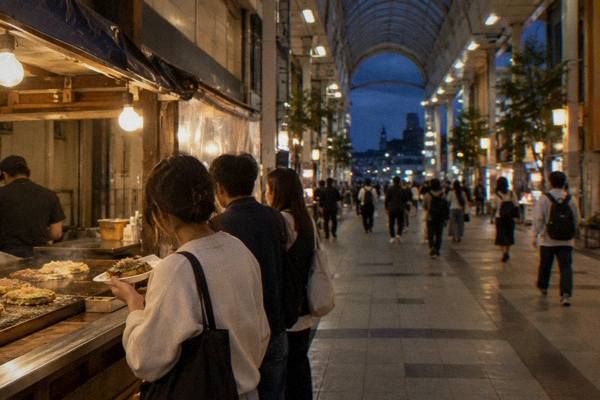
Okonomimura in central Hiroshima packs 24 okonomiyaki counters into four floors of one building in Shintenchi, a three-minute walk from the Hacchobori tram stop.
Okonomimura is a dedicated okonomiyaki building at 5-13 Shintenchi, Naka-ku, Hiroshima, with 24 stalls over four floors, most open 11:00 to 22:00, entry free and standard servings around 800 to 1,500 yen.
Okonomimura in Hiroshima is a single building devoted to one dish: 24 okonomiyaki counters spread across four floors at 5-13 Shintenchi, Naka-ku, in the heart of the city's dining and shopping district. Entry costs nothing, you pay only for what you eat at the counter, and most stalls cook from late morning until 22:00. The essentials are the building itself, the tram ride there, the cost of a meal, the difference between the layered Hiroshima style and the Osaka version, and the counter etiquette that keeps the narrow counters moving.
What Is Okonomimura In Hiroshima?
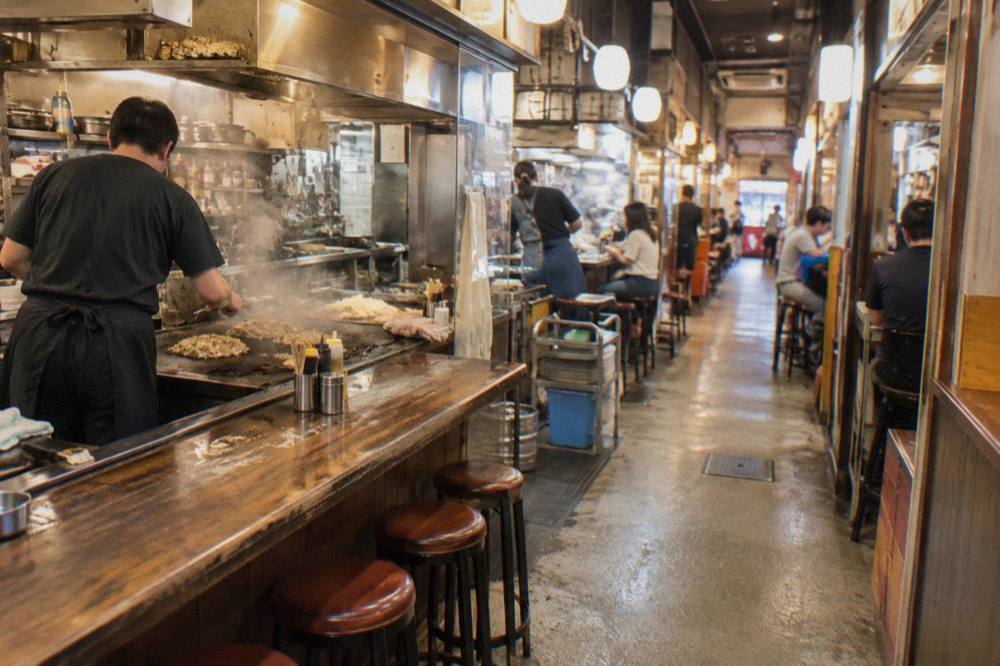
Okonomimura is a purpose-built food building in Hiroshima's Shintenchi district that houses 24 okonomiyaki restaurants across four floors, where every stall cooks the layered Hiroshima style of the dish on a teppan griddle in front of seated customers. Entry to the building is free, and diners pay only for the food and drinks they order at their chosen counter.
The building at 5-13 Shintenchi, Naka-ku, opened in its current form in 1992, but the idea is far older. It grew out of the postwar food stalls that gathered in Shintenchi Square after 1945, serving grilled food to a rebuilding city. When Shintenchi Square became a park in 1963, the stalls relocated into a two-story building, and that cluster became known nationwide. The writer Minoru Kida is credited with coining the name Okonomimura for the stall cluster in the mid-1960s. Many of today's stalls are family-run, passed down through generations since the stall era.
The building is much larger than a single restaurant, and that is the point. A visit is less about finding one famous counter and more about choosing a floor, choosing a stall, and taking a seat at the griddle. A visit can take between 45 minutes and two hours, with time for a meal and a look around the floors.
The building operates year-round with no general closures noted for 2025 to 2026, though individual stall hours vary, so a late-evening arrival is safer before 21:30, when last orders are taken at most counters. Many stalls provide English menus for international visitors, which removes the main friction of ordering at a griddle counter in a foreign language. The building's own general inquiry line, 082-241-2210, handles questions about stalls and access.
For the wider picture on the dish itself, from layering technique to sauce, the site's Hiroshima okonomiyaki guide covers the style in depth, and where okonomiyaki originated traces the history of the word and the food.
| Fact | Figure |
|---|---|
| Address | 5-13 Shintenchi, Naka-ku, Hiroshima 730-0034 |
| Stalls | 24 across four floors |
| Current building completed | 1992 |
| Typical stall hours | 11:00 to 22:00, last orders around 21:30 |
| Entry fee | Free, pay per dish at the stall |
| General inquiries | 082-241-2210 |
Where Is Okonomimura And How Do You Get There?
Okonomimura stands in Shintenchi, central Hiroshima, a three-minute walk from the Hacchobori stop on the Hiroden tram network, about 10 to 15 minutes from Hiroshima Station on the flat 240 yen adult fare, and about a 10 to 15 minute walk from Peace Memorial Park via the Hondori shopping arcade.
The Hiroden tram is the simplest approach. From Hiroshima Station, take the tram to Hacchobori, where the adult flat fare is 240 yen and the child fare 120 yen, the same on every line including the Miyajima line. The building is a three-minute walk from the stop. From the station area it is roughly 10 to 15 minutes on the tram. Alternatives: a 12-minute walk from Hiroshima Bus Center, or a 3 to 5 minute walk from the Shintenchi or Hacchobori bus stops. Anyone planning several tram trips in a day can use the Hiroden 1 Day Streetcar Pass at 700 yen for adults, valid on all lines, which covers the central okonomiyaki spots and more besides.
It slots naturally into a day built around Hiroshima in one day, and it is a standard stop on an evening in the city, which the Hiroshima at night itinerary covers alongside Nagarekawa and Yagenbori.
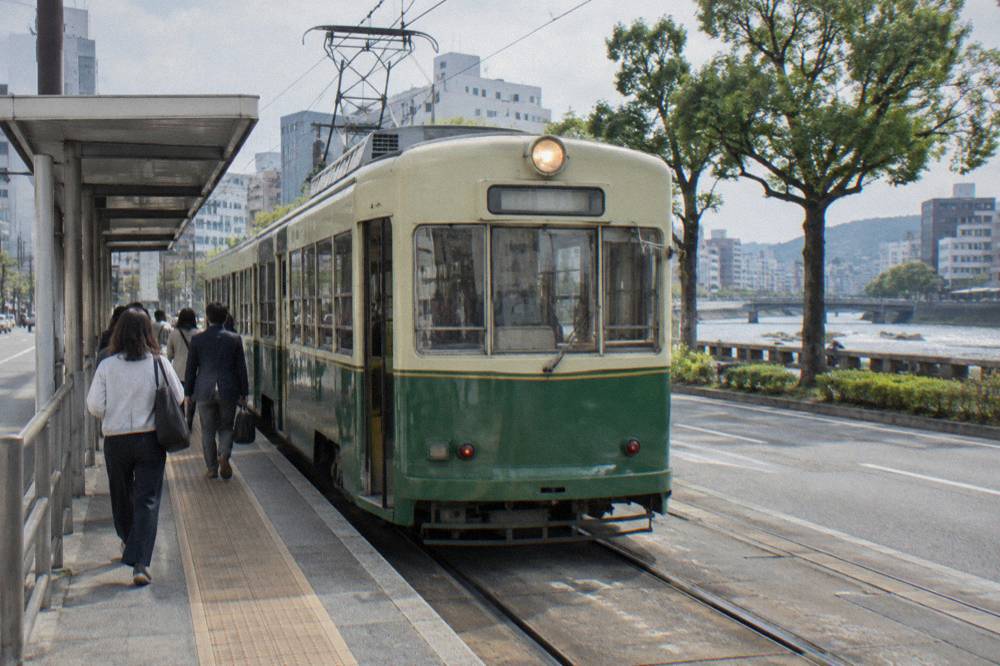
The flat fare structure makes the tram decision easy: there is no zone calculation and no surcharge for the Miyajima line, so the 240 yen figure holds whether the trip is two stops or the full length of the network. For a day that mixes counters, museums and the station area, the 700 yen day pass pays for itself on the third ride, and the tram network reaches all of the central districts this page mentions.
| Route | Figure |
|---|---|
| Hiroshima Station to Hacchobori by Hiroden | About 10 to 15 minutes, 240 yen adult, 120 yen child |
| Hacchobori stop to Okonomimura on foot | 3 minutes |
| Hiroshima Bus Center to Okonomimura on foot | 12 minutes |
| Shintenchi or Hacchobori bus stops on foot | 3 to 5 minutes |
| Peace Memorial Park to Okonomimura on foot via Hondori | About 10 to 15 minutes |
| Hiroden 1 Day Streetcar Pass | 700 yen adult, all lines |
A custom private tour is another way to anchor a food evening to the rest of the city, with a local guide shaping the route between the Peace Park, Hondori and the counter districts.
How Much Does Eating At Okonomimura Cost?
A standard okonomiyaki at Okonomimura costs about 800 to 1,500 yen per serving, toppings push the bill to roughly 1,500 to 2,200 yen, drinks run 300 to 1,000 yen, and a realistic all-in budget is 1,500 to 2,500 yen per person including drinks, since entry to the building itself is free.
The price structure is simple. There is no cover charge and no building entry fee: the cost is the dish plus whatever you drink. The 800 to 1,500 yen band covers the basic layered servings, and oyster or seafood toppings are among the additions that move a serving into the higher band. Preparation at the counter takes 15 to 20 minutes, because the layered build, batter, cabbage, pork, noodles, egg, is cooked stage by stage in front of you rather than assembled at once.
Payment method matters more than price. Around 70 percent of restaurants in Hiroshima city accept IC cards such as Suica or QR payment apps, but many tiny stalls require cash, so carrying yen notes is the safe play for a counter visit. Peak dinner hours run 18:00 to 20:00, and arriving at 17:00 or after 21:00 is the standard advice for avoiding lines, since seats at small counters are limited and many stalls enforce a one-dish-per-person rule for that reason.
| Item | Typical figure |
|---|---|
| Standard okonomiyaki serving | 800 to 1,500 yen |
| Serving with toppings | 1,500 to 2,200 yen |
| Drinks | 300 to 1,000 yen |
| Budget per person with drinks | 1,500 to 2,500 yen |
| Entry to the building | Free |
How Does Hiroshima Okonomiyaki Differ From Osaka Style?
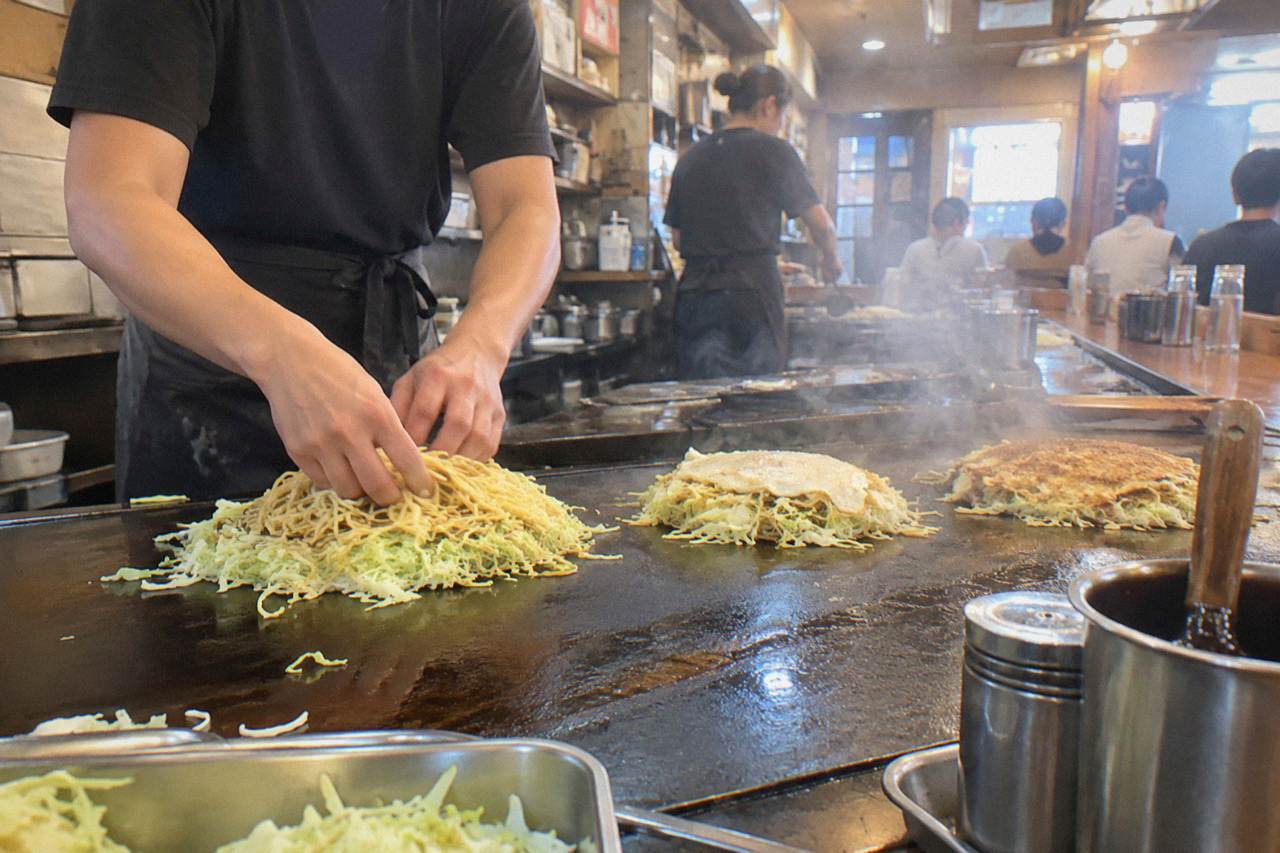
Hiroshima-style okonomiyaki is built in layers, a thin crepe-like batter base first, then a large amount of shredded cabbage, pork, yakisoba or udon noodles and often a fried egg on top, while Osaka-style mixes all ingredients into a thicker batter, and noodles are a standard layer in Hiroshima but not in Osaka outside modan-yaki variations.
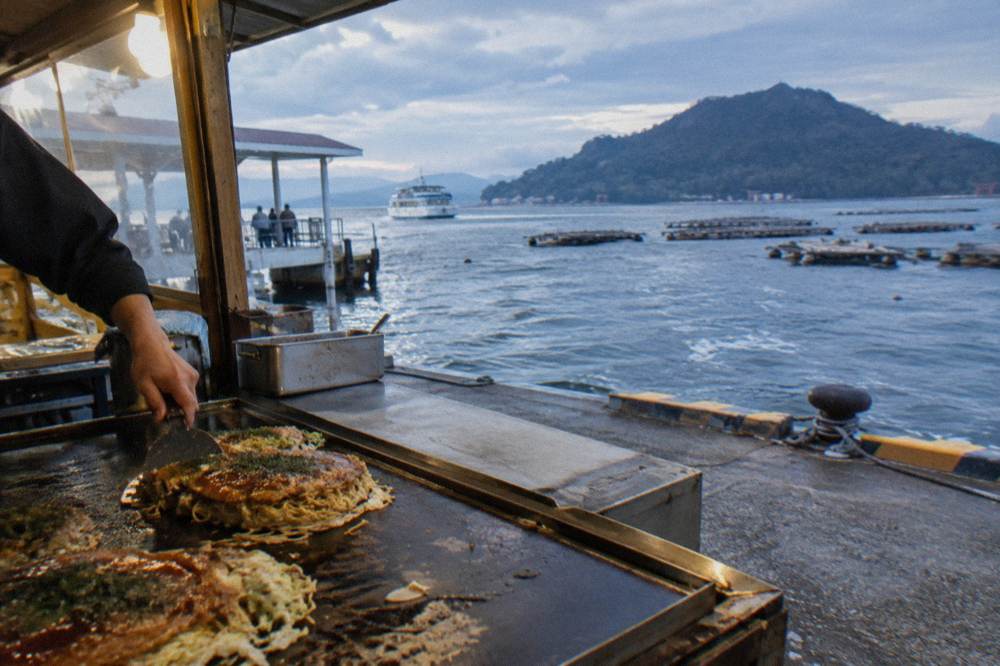
The difference is construction. In Hiroshima the cook lays down a very thin batter base and cooks it first, then stacks the other elements on top in sequence, so each layer keeps its own texture. In Osaka the batter and the fillings are combined before cooking, producing a single dense pancake. The noodle layer is the clearest visible tell: a Hiroshima serving has yakisoba or udon inside it as a matter of course, a standard Osaka serving does not. A Hiroshima serving carries around 150 g of shredded cabbage, and the basic order at many Hiroshima shops is niku-tama-soba, pork, egg and soba noodles. More of these guides are collected on Hiroshima Travel Guide.
The scale of the scene reflects the local attachment to the dish. Hiroshima has more okonomiyaki restaurants than Osaka, a counter-intuitive fact for a city a fraction of the size, and over 2,000 okonomiyaki restaurants operate in Hiroshima city. Okonomimura's 24 counters are the most concentrated expression of that, but the style is cooked everywhere from station buildings to neighbourhood shacks.
For the health angle on the dish, cabbage volume and cooking method included, see is okonomiyaki healthy.
What Are The Etiquette Rules At Okonomiyaki Counters?
Eat Hiroshima okonomiyaki directly from the hot teppan griddle using the small metal spatula called a hera or kote, without moving it to a plate, sit at the teppan counter rather than a table, order one okonomiyaki per person where the stall requires it, and call the dish okonomiyaki rather than Hiroshimayaki, since the layered version is considered the local standard.
The rules exist because the stalls are small and the griddle is the table. Counter seats are where the dish is meant to be eaten, cut and lifted straight from the iron with the spatula provided. Sauce and mayonnaise are self-serve on the table, applied to taste rather than requested. The one-per-person rule at many small stalls is a seating constraint, not an upsell: a counter that seats eight cannot absorb a party of eight sharing three servings. Ordering "Hiroshimayaki" reads as redundant to Hiroshima cooks, the layered style being simply what okonomiyaki means in the city. The full set of table manners, including payment habits, is gathered in the site's okonomiyaki restaurant etiquette page.
None of this is complicated, and the stall's own cook sets the pace. The spatula is used to press, portion and lift, English menus cover the ordering at many stalls, and the main obligation on the diner is the one-dish minimum and a calm seat at the counter while the 15 to 20 minute build runs its course.
| Situation | The working rule |
|---|---|
| How to eat | Directly from the griddle with the hera or kote spatula |
| Where to sit | Teppan counter seats rather than table seats |
| Ordering | One okonomiyaki per person where the stall requires it |
| What to call it | Okonomiyaki, not Hiroshimayaki |
| Sauce and mayonnaise | Self-serve on the table |
| Payment | Many tiny stalls take cash only, carry yen |
What Else Can Okonomiyaki Fans Do In Hiroshima?
The main alternatives inside Hiroshima are the okonomiyaki branches clustered in the ekie mall at Hiroshima Station, including Mitchan Sohonten, Reichan and Denko Sekka, and the OKOSTA okonomiyaki museum workshop 2 minutes from the station's north exit, where visitors cook their own under instruction for 2,500 yen tax included per 1.5-hour session.
OKOSTA, run by the Otafuku sauce company, turns the dish into a taught experience. Sessions run three times daily, at 10:30 to 12:00, 13:00 to 14:30 and 18:30 to 20:00, each lasting 1.5 hours, and reservation is required at least three days ahead by phone or form, with same-day booking by phone only. The standard, Muslim-friendly, vegetarian and gluten-free experiences all cost 2,500 yen tax included with one topping choice, evening party plans run 3,300 yen with one drink or 5,500 yen with a 2-hour all-you-can-drink option, and participants keep the paper apron and hat. Capacity is 20 per session, up to 40 total, and children in grades 1 to 4 need one guardian each. The site's Okosta okonomiyaki museum page has the full detail.
The Muslim-friendly version uses halal okonomi sauce from the company's Malaysia factory with squid and shrimp instead of pork, the vegetarian version swaps in corn and vegetarian sauce, and the gluten-free version is built on rice flour noodles with gluten-free sauce, each at the same 2,500 yen price.
For eating rather than cooking, the station-side counters give a second hub beyond Shintenchi, and a hands-on class is the third route into the dish, covered on the okonomiyaki cooking class page.
| Place | Location | Hours | Note |
|---|---|---|---|
| Mitchan Sohonten ekie branch | ekie, 1-2 Matsubara-cho, Minami-ku | 11:00 to 22:00 | Hiroshima-style servings |
| Reichan | ekie 1F, Hiroshima Station | 11:00 to 21:30 | Soba-based okonomiyaki |
| Denko Sekka ekie store | ekie, 1-2 Matsubara-cho | 11:00 to 23:00 | Serves 3D okonomiyaki |
| OKOSTA workshop | ekie 1F, 2 minutes from the north exit | 10:00 to 20:30 | 2,500 yen tax included, reservation required |
| OKOSTA session | Time | Price, tax included |
|---|---|---|
| Standard experience | 10:30 to 12:00 | 2,500 yen, one topping |
| Standard experience | 13:00 to 14:30 | 2,500 yen, one topping |
| Evening session | 18:30 to 20:00 | 2,500 yen, or party plans |
| Evening party plan, one drink | 18:30 session only | 3,300 yen |
| Party plan, 2-hour drinks | 18:30 session only | 5,500 yen |
How Does Okonomimura Fit Into A Hiroshima Day?
Okonomimura is open from 11:00 into the late evening, and it pairs naturally with the Shintenchi and Hondori shopping streets, the Nagarekawa and Yagenbori bar districts, and a first afternoon at the Peace Park, the museum and the A-Bomb Dome.
A common day shape runs west to east. The morning goes to the Peace Memorial Park and the Peace Memorial Museum, whose adult admission is 200 yen, with the A-Bomb Dome viewable from outside its fence at no fee. The afternoon can run east along the Hondori arcade toward Shintenchi, and the evening ends at a counter in Okonomimura before the bars of Nagarekawa and Yagenbori. Rainy-day planning barely changes, since the tram drops you three minutes away and the building is indoors; the Hiroshima rainy day itinerary handles the rest.
The timing also works in reverse for early risers. Stalls open at 11:00, so a morning at the museum followed by a late lunch at a counter lands before the 18:00 dinner peak, and a serving cooked at midday costs exactly what the same serving costs at 19:00. The one-dish rule makes lunch the easier slot for groups, since counters turn over faster and the queue pressure of the evening hours is absent.
For the broad picture of the city's sights beyond food, the things to do in Hiroshima round-up is the site's main index. And for anyone pairing the city with the island, a guided day that includes the Miyajima ferry crossing covers both without needing to plan the connections alone, as does the private custom option with a local guide.
Common Questions About Okonomimura
What Is Okonomimura?
It is a dedicated okonomiyaki building at 5-13 Shintenchi, Naka-ku, Hiroshima, housing 24 okonomiyaki restaurants across four floors. Entry is free and diners pay only at their chosen stall.
How Do I Get To Okonomimura From Hiroshima Station?
Take the Hiroden tram to Hacchobori, about 10 to 15 minutes at the flat fare of 240 yen for adults and 120 yen for children, then walk 3 minutes. The building is also a 12-minute walk from Hiroshima Bus Center.
How Much Does Okonomiyaki Cost At Okonomimura?
Standard servings run about 800 to 1,500 yen, toppings push the figure to roughly 1,500 to 2,200 yen, drinks cost 300 to 1,000 yen, and a typical per-person budget with drinks is 1,500 to 2,500 yen.
What Are Okonomimura's Opening Hours?
Most stalls operate from 11:00 to 22:00 daily, with last orders around 21:30. Hours vary by stall, and no general closures are noted for 2025 to 2026.
Do I Need A Reservation At Okonomimura?
No. Stalls seat walk-in customers at the counter, though seats are limited, many stalls require one okonomiyaki per person, and arriving before 18:00 or after 21:00 avoids the 18:00 to 20:00 peak.
Can I Pay By Card At Okonomimura?
About 70 percent of Hiroshima city restaurants accept IC cards or QR payment, but many tiny stalls require cash, so carry yen for a counter visit.
Okonomimura serves the dish Hiroshima cooks better than anywhere else and sits three minutes from a tram stop that costs 240 yen to reach.