Where Did Okonomiyaki Originate?
Okonomiyaki in this city on the Seto Inland Sea evolved from a prewar snack called issen yoshoku rebuilt on iron plates after 1945. Here is the documented history.
The Japan Ministry of Agriculture, Forestry and Fisheries regional-dish page traces the Hiroshima style to a prewar snack called issen yoshoku, and the Hiroshima okonomiyaki industry association traces its rebirth to iron plates and flour aid in the burnt ruins of August 1945. That documented history runs, step by step, from the prewar streets to the multi-storey food buildings of today.
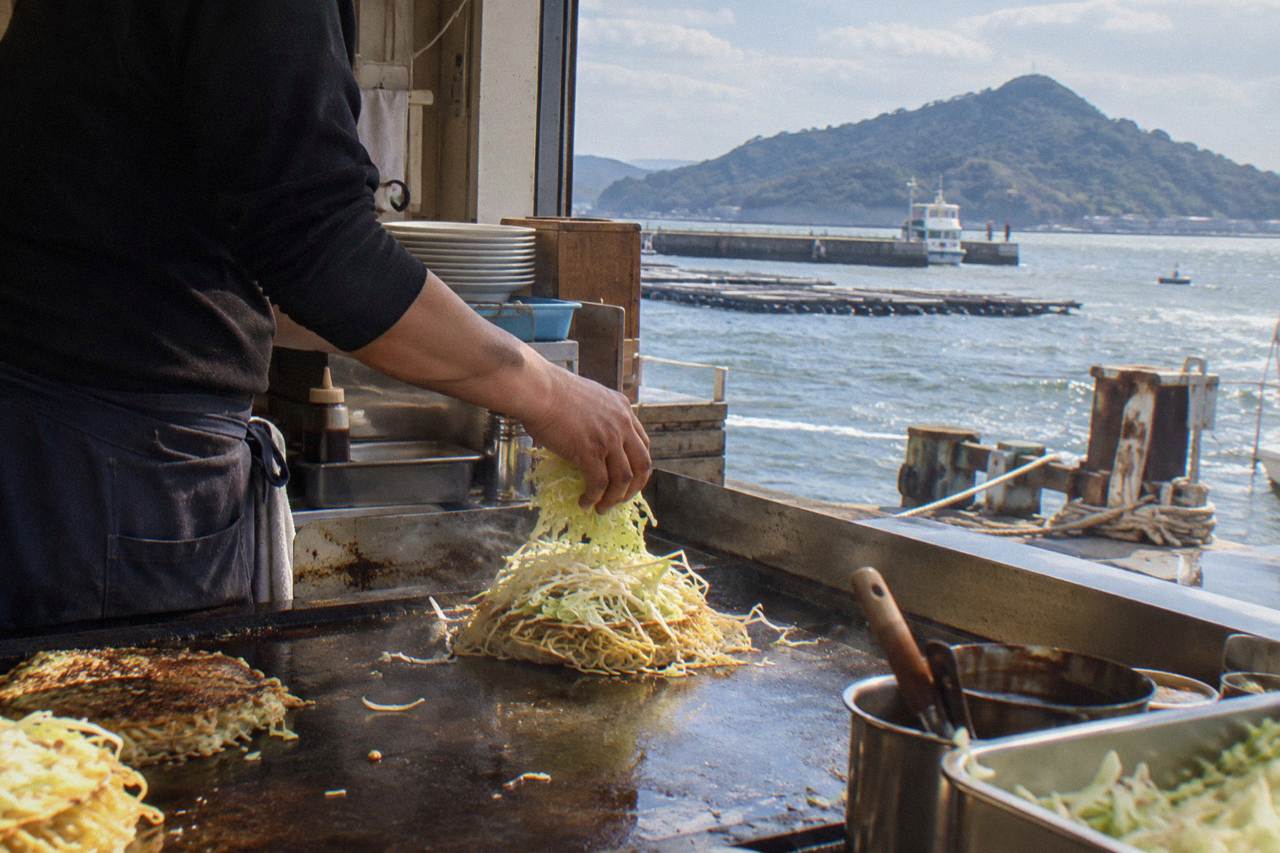
Okonomiyaki in its Hiroshima form originated in Hiroshima, evolving from a prewar dish called issen yoshoku, meaning a one-cent western meal, that was sold to children from stalls before the Second World War, then rebuilt after the August 1945 atomic bombing, when cooks used iron plates from burnt ruins and United States flour aid to revive the dish, adding cabbage, eggs, pork and soba noodles during postwar reconstruction.
That is the account given by two Japanese sources with direct standing: the okonomiyaki page maintained under the Ministry of Agriculture, Forestry and Fisheries regional-dish programme, and the English history page of the Hiroshima okonomiyaki industry association. Neither claims the dish was invented in a single shop on a single day. What the records show instead is a street snack that survived a catastrophe and grew layers, literally, as the city rebuilt around it.
The prewar dish was modest. It was a thin pancake topped with green onions and dried fish flakes or shrimp, cheap enough for children to buy with pocket coins. In that form it was closer to a grilled crepe than to what a Hiroshima counter serves now. The war interrupted the story, and the bombing of 6 August 1945 reset it.
After the bombing, the association's history page records, people cooked issen yoshoku again on iron plates taken from burnt ruins, using flour from United States aid. From those stalls, the dish evolved by addition: cabbage, egg, pork and soba noodles, one layer at a time, until it became the Hiroshima-style okonomiyaki served today. The association calls it the soul food of postwar reconstruction, born in the ruins of the city.
Who Cooked The First Hiroshima-Style Okonomiyaki?
The early Hiroshima okonomiyaki stalls of the postwar years were run largely by war widows, according to a Los Angeles Times report on the dish's history, and one documented stall, Rei-chan, opened around 1955 in Higashi-Shintenchi Square, while the chain Micchan Souhonten was founded in 1950 by Inune Mitsuo, who is credited with key inventions in the Hiroshima style.
No single name is recorded as the inventor, and the sources are careful about that. What is documented is the social shape of the recovery. The Los Angeles Times reporting describes many of the early stalls as remodelled homes or street stands run by women widowed by the war, cooking on teppan griddles for a city rebuilding itself. The Hiroshima Peace Media reporting carries the same thread, with the Rei-chan stall of Nobuto and Toshie Yamashiro standing as one named example in Higashi-Shintenchi Square.
Micchan Souhonten, founded in 1950, is the other documented early name. A Japanese food-culture article credits its founder, Inune Mitsuo, with key inventions for the layered Hiroshima style. The detail matters because it dates the technical birth of the modern dish to a narrow window: between the 1950 founding and the late 1950s, when, per BBC Travel's account, okonomiyaki had spread across social classes in Hiroshima as a symbol of resilience.
One more company belongs in this origin story even though it cooked nothing: Otafuku, the sauce maker. The Los Angeles Times reporting records that Otafuku launched its special thick okonomiyaki sauce in 1952 after feedback from Hiroshima cooks, and that it now produces 210,000 bottles of okonomiyaki sauce per day in Japan. The sauce and the city grew up together.
How Did Hiroshima Okonomiyaki Become Famous Across Japan?
Hiroshima okonomiyaki became known nationwide after the Hiroshima Toyo Carp baseball team's championship victory in Showa 50, 1975, when the dish was featured in guidebooks, according to the Ministry of Agriculture, Forestry and Fisheries page, which also credits a 1955 wave of Hiroshima shops remodelling to add soba noodles and pork to the recipe.
The timeline is worth reading in order, because it shows a local recovery food becoming a national name in three distinct moves.
| Year | Documented step in the Hiroshima okonomiyaki story |
|---|---|
| Before 1945 | Issen yoshoku, a thin pancake with green onions and dried fish flakes or shrimp, sold to children from stalls in Hiroshima |
| August 1945 | Iron plates from burnt ruins and United States flour aid used to cook issen yoshoku again after the atomic bombing |
| 1950 | Micchan Souhonten founded by Inune Mitsuo, credited with key inventions in the Hiroshima style |
| 1952 | Otafuku launches its special thick okonomiyaki sauce after feedback from Hiroshima cooks |
| 1955 | A wave of Hiroshima shops remodel to offer soba noodles and pork in okonomiyaki; Rei-chan stall reported in Higashi-Shintenchi Square |
| 1975 | The Carp's championship year; okonomiyaki features in guidebooks and becomes known nationwide |
| 2008 | Otafuku opens the Wood Egg Okonomiyaki Museum |
| 2018 | The OKOSTA cooking studio next to Hiroshima Station opens for okonomiyaki experiences |
The Ministry page calls okonomiyaki the soul food of Hiroshima and notes it is eaten year-round as a last meal after drinking parties. The Carp connection is the hinge for the national story: a baseball title put the city in the sports pages, and the guidebook coverage that followed carried its food with it.
How Does Hiroshima Okonomiyaki Differ From The Kansai Style?
Hiroshima-style okonomiyaki is built by layering, with ingredients piled on a thin base of batter and noodles added, whereas the Kansai style mixes everything into the batter before cooking, and the Ministry page describes the Hiroshima version as thinly spread batter cooked in a pan and piled with heaps of cabbage, pork, yakisoba and a fried egg.
The difference is construction, not just geography. In the Kansai version the cabbage, egg and flour form one mixed batter. In the Hiroshima version each element keeps its own layer: batter first, cabbage heaped on top, pork, then noodles, then a thin fried egg, then sauce. A calorie-database breakdown of a standard Hiroshima serving lists 55 g wheat flour, 75 g steamed Chinese noodles, 40 g pork, 95 g cabbage, 35 g bean sprouts and 15 g salad oil as typical component weights, which shows how much of the dish sits above the batter. Other pages covering the same trip are gathered on Hiroshima Travel Guide.
The Hiroshima region also varies the template, and the Ministry page records two named local versions in the prefecture.
| Regional version | Documented difference |
|---|---|
| Shobara City | Uses locally produced rice instead of noodles, eaten with ponzu sauce |
| Kure City | Uses thin udon noodles and is served folded in half |
| Hiroshima city standard | Thin batter, layered cabbage, pork, yakisoba and a fried egg |
Hiroshima's claim to the dish also has a statistical footing: the prefecture ranked first in Japan for okonomiyaki shops per 100,000 population in the 2014 Economic Census, and reported counts put more than 2,000 okonomiyaki restaurants in Hiroshima city alone. For the eating side of the story rather than the history, the Hiroshima okonomiyaki guide covers the dish across the city, and the question of whether okonomiyaki is healthy has its own answer page with the calorie figures.
Where To Eat Okonomiyaki In Hiroshima Today?
Okonomimura, a four-storey building in Hiroshima's Shintenchi area reported to house 24 stalls across 4 floors, stands on the ground where many postwar okonomiyaki stalls were concentrated, and the OKOSTA cooking studio by Otafuku, a reported 2-minute walk from Hiroshima Station, offers okonomiyaki-making experiences for visitors who want to cook their own.
The geography is the payoff of the origin story. The Japan National Tourism Organization pamphlet describes it as a four-storey building full of okonomiyaki restaurants popular with tourists. The Okonomimura page covers the building in detail, and the etiquette rules for eating okonomiyaki at a restaurant explain the counter customs, from the small metal spatula called a hera to the one-per-person rule at many small stalls.
For a hands-on version of the history, the OKOSTA okonomiyaki museum page covers the Otafuku-run cooking studio, which the BBC account dates to 2018, next to Hiroshima Station. Otafuku's Wood Egg Okonomiyaki Museum, opened in 2008, adds factory tours and cooking experiences on the sauce-maker's own site. Frozen okonomiyaki from Hiroshima is sold in supermarkets, train stations, airports and souvenir shops, per the Ministry page, so the dish travels home in a suitcase as easily as it is eaten at a counter.
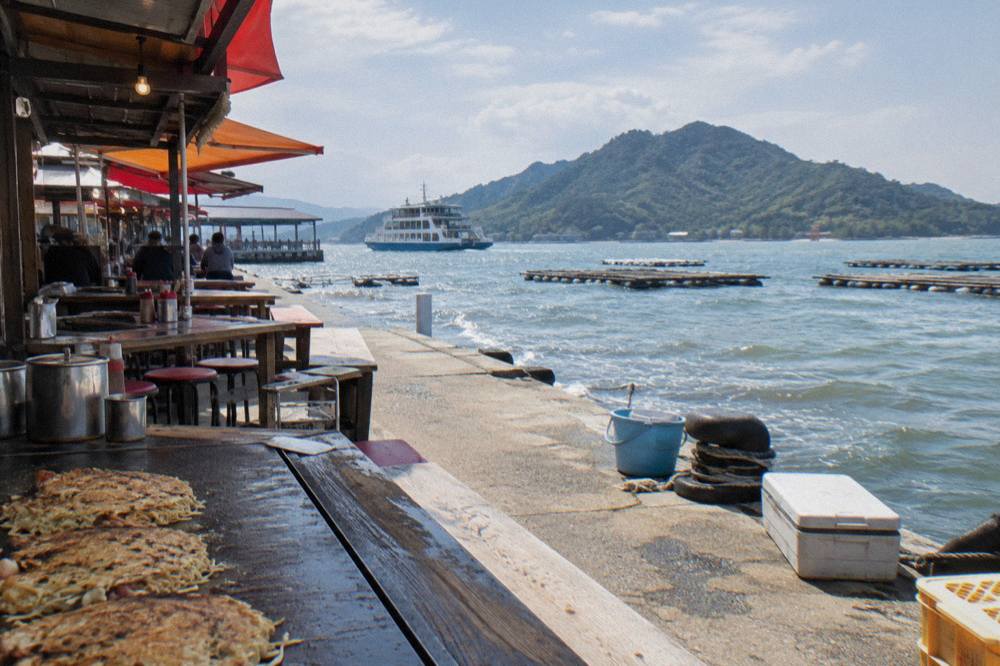
Visitors fitting the dish into a wider plan will find the one day in Hiroshima itinerary makes room for both the Peace Memorial Park and a griddle dinner, and the Hiroshima at night itinerary treats the evening food run as its own event. Getting between the station, the park and the food districts is easiest on the city trams, and the Check availability link beside this article covers the day pass for those tram lines, including the Miyajima line.
Is Okonomiyaki Originally From Osaka Or Hiroshima?
The layered, noodle-bearing version documented by the Ministry of Agriculture, Forestry and Fisheries and by the Hiroshima okonomiyaki industry association is the Hiroshima style, developed in this city from issen yoshoku and rebuilt after 1945, while the mixed Kansai style is a different construction with its own history that the Hiroshima sources describe only as a contrast, not as a rival claim.
The honest answer is that the two dishes share a name and a griddle but not a build. The Ministry page and the JNTO pamphlet both frame the Hiroshima style as layered on thin dough with noodles, unlike the mixed Kansai style. The Hiroshima claim rests on a documented paper trail: the prewar issen yoshoku, the 1945 revival on salvaged iron plates, the 1955 remodelling wave, the 1952 Otafuku sauce, the 1975 guidebook moment.
Common Questions About Okonomiyaki Origins In Hiroshima
Where Did Okonomiyaki Originate?
Okonomiyaki in its Hiroshima form originated in Hiroshima, from the prewar snack issen yoshoku that was revived on iron plates from the ruins in August 1945 and then layered with cabbage, pork, egg and soba noodles during reconstruction, per the okonomiyaki industry association and the Ministry of Agriculture, Forestry and Fisheries.
What Does Issen Yoshoku Mean?
Issen yoshoku translates as a one-cent western meal. It was a thin pancake topped with green onions and dried fish flakes or shrimp, sold to Hiroshima children from stalls before the Second World War, and it is the documented ancestor of Hiroshima-style okonomiyaki.
Why Is Okonomiyaki Called The Soul Food Of Hiroshima?
The okonomiyaki industry association describes it as the soul food of postwar reconstruction, born in the ruins of Hiroshima, and the Ministry page calls it the soul food of Hiroshima, eaten year-round as a last meal after drinking parties.
How Many Okonomiyaki Restaurants Are There In Hiroshima?
Reported counts put more than 2,000 okonomiyaki restaurants in Hiroshima city, and Hiroshima Prefecture ranked first in Japan for okonomiyaki shops per 100,000 population in the Ministry of Internal Affairs and Communications 2014 Economic Census.
Who Invented The Thick Okonomiyaki Sauce?
Otafuku, the Hiroshima sauce maker, launched its special thick okonomiyaki sauce in 1952 after feedback from Hiroshima cooks, per the Los Angeles Times reporting, and the company now produces 210,000 bottles of okonomiyaki sauce per day in Japan.
The origin story of okonomiyaki is, in the end, the origin story of Hiroshima's own recovery, told on a griddle, and the best place to read it is standing at a counter in the Shintenchi blocks where it happened, spatula in hand.