Okonomiyaki Cooking Classes In Hiroshima
Hiroshima's signature dish is layered, not mixed, and the city has a dedicated museum workshop where visitors cook one themselves. Here is what an okonomiyaki cooking class in Hiroshima involves, what it costs, and how to fit it into a wider city itinerary.
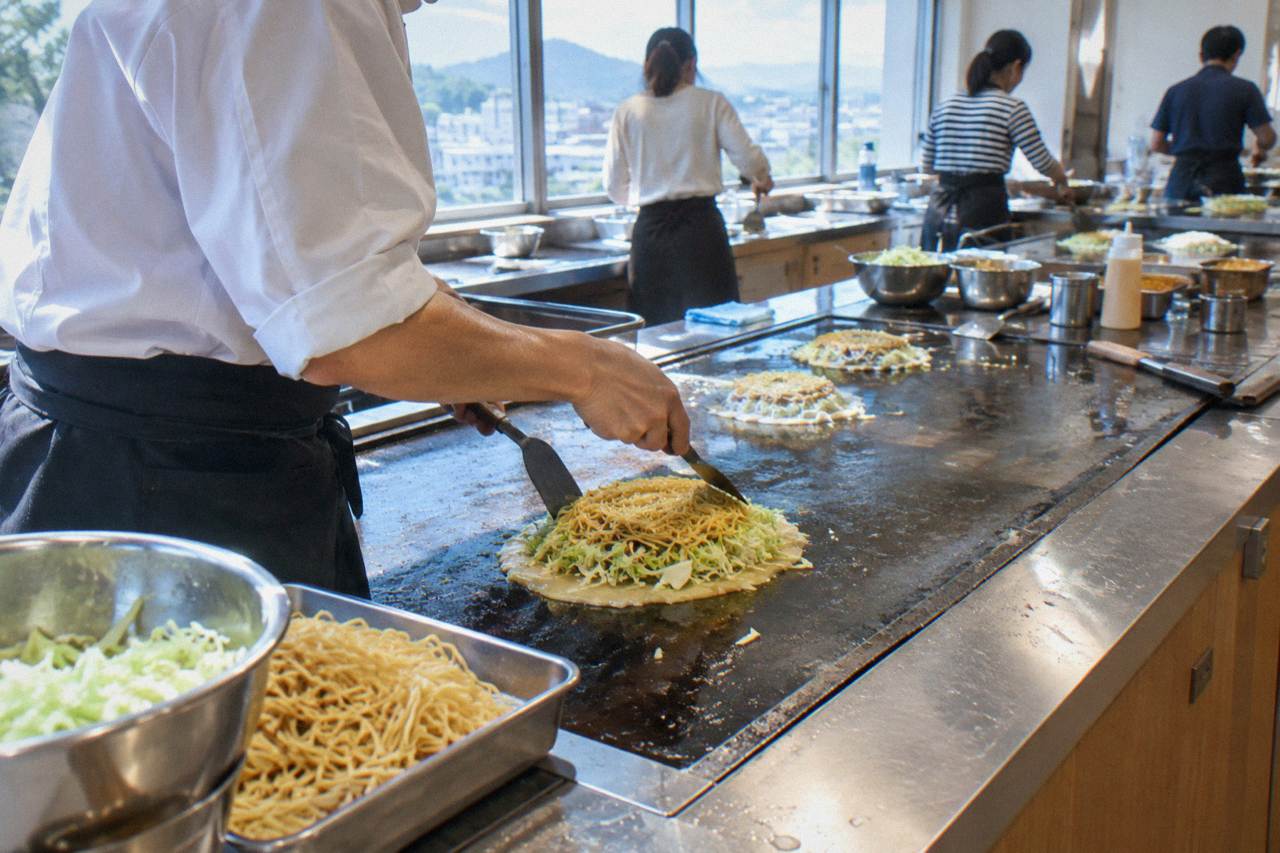
An okonomiyaki cooking class in Hiroshima teaches the city's layered style of the dish on a teppan griddle. The best documented option is OKOSTA, the Otafuku-run workshop inside ekie at Hiroshima Station, where a session costs 2,500 yen tax included and must be reserved at least three days ahead.
The best documented venue is OKOSTA, the okonomiyaki workshop run by the sauce maker Otafuku inside the ekie mall at Hiroshima Station, where participants cook the dish themselves across a 90-minute session. This page sets out what a class actually teaches, what it costs, what dietary adaptations exist, and how the rest of a Hiroshima day fits around it, with the practical figures that the operators and the city publish.
What Is An Okonomiyaki Cooking Class In Hiroshima?
An okonomiyaki cooking class in Hiroshima is a supervised session in which participants cook the city's own layered version of the dish on a hot griddle, finishing with the local sweet-savoury sauce. The best documented venue is OKOSTA at Hiroshima Station, where each of the three daily sessions lasts 1.5 hours, costs 2,500 yen tax included for the standard experience, and ends with the participant eating what they cooked. Sessions run at 10:30, 13:00 and 18:30, and reservations are required.
The class format matters because Hiroshima-style okonomiyaki is built in stages rather than mixed. A very thin crepe-like batter base is cooked first, then a large amount of cabbage is added, then pork, then yakisoba or udon noodles, and often a fried egg on top. Osaka-style, by contrast, mixes the ingredients into a thicker batter before cooking. Noodles are a standard layer in the Hiroshima version, while in Osaka they appear only in modan-yaki variations. A class walks a participant through that sequence with an instructor watching, which is the practical difference between a class and simply ordering the dish at a restaurant.
Each participant receives an original paper apron and hat as souvenirs of the session. The workshop's own pages give a maximum capacity of 20 participants per session and up to 40 in total, with groups of 30 or more able to book the entire venue, which makes it workable for families and small school or club groups as well as solo travellers.
The venue's own calendar lists daily opening from 10:00 to 20:30 with possible temporary closures, and fixed closures on 23 November 2026 and from 31 December 2026 to 3 January 2027 for the New Year holidays. Anyone planning a class around those dates should plan around those closures. The wider food context of the dish, from the street-level stalls of Okonomimura to the etiquette of eating at a counter, is covered in the site's Hiroshima okonomiyaki guide.
| OKOSTA Session | Time | Standard Price | Party Options |
|---|---|---|---|
| Morning | 10:30 to 12:00 | 2,500 yen tax included | Evening party plans, 18:30 only |
| Afternoon | 13:00 to 14:30 | 2,500 yen tax included | 3,300 yen with one drink |
| Evening | 18:30 to 20:00 | 2,500 yen tax included | 5,500 yen, 2-hour all-you-can-drink |
How Much Does An Okonomiyaki Class In Hiroshima Cost?
The standard, Muslim-friendly, vegetarian and gluten-free experiences at OKOSTA all cost 2,500 yen tax included, and each includes one topping choice. Evening party plans at the 18:30 session cost 3,300 yen with one drink or 5,500 yen for a 2-hour all-you-can-drink format, also tax included. The Hiroden streetcar fare to reach the venue is a flat 240 yen for adults anywhere in the city zone, or a 700 yen day pass.
The flat pricing across the four dietary versions is worth noticing: the gluten-free adaptation, which uses rice flour noodles and a gluten-free sauce, carries no surcharge over the standard pork version, and neither does the Muslim-friendly version, which uses halal okonomi sauce from Otafuku's Malaysia factory along with squid and shrimp instead of pork. The vegetarian version substitutes corn for pork and uses a vegetarian sauce. A traveller with a dietary constraint is not paying a premium for it at this venue, which is not always the case with food experiences in Japan.
Reservations are required at least three days in advance by phone or web form, and same-day bookings are accepted by phone only. The reservation phone line, (+81)-(0)82-207-1277, operates from 10:00 to 18:00. One age rule applies: elementary school children in grades 1 to 4 must be accompanied by one guardian per child, so a family with several young children needs an adult per child rather than one supervising adult for the group.
Against the cost of eating the dish in the city, the class price sits in a sensible place. A standard okonomiyaki at the Okonomimura stall building costs in the region of 800 to 1,500 yen, with toppings pushing an order to 1,500 to 2,200 yen. The class premium buys the instruction, the paper apron and hat souvenirs, and the topping, and the venue's own pricing table confirms the figure of 2,500 yen for every dietary variant.
| Experience At OKOSTA | Price (Tax Included) | Dietary Notes |
|---|---|---|
| Standard okonomiyaki | 2,500 yen | Includes one topping choice |
| Muslim-friendly | 2,500 yen | Halal sauce, squid and shrimp, no pork |
| Vegetarian | 2,500 yen | Corn instead of pork, vegetarian sauce |
| Gluten-free | 2,500 yen | Rice flour noodles, gluten-free sauce |
| Evening party, one drink | 3,300 yen | 18:30 session only |
| Evening party, 2-hour plan | 5,500 yen | 2-hour all-you-can-drink |
For moving around the city on a class day, the Hiroden network charges a flat 240 yen for adults and 120 yen for children on all lines including the Miyajima line, and a 1-Day Streetcar Pass costs 700 yen and is valid on all lines. The site's page on the 1-Day Visit Hiroshima Tourist Pass covers the wider city pass option for visitors planning several paid attractions in one day.
Where Can You Cook Okonomiyaki In Hiroshima?
The documented cooking venue is OKOSTA, the Otafuku okonomiyaki museum and workshop at 1-2 Matsubara-cho, Minami-ku, inside ekie on the 1st floor of Hiroshima Station, a 2-minute walk from the north exit. Beyond a class, the eating side of the dish is concentrated at Okonomimura, a building of 24 okonomiyaki stalls across 4 floors at 5-13 Shintenchi, Naka-ku, a 3-minute walk from the Hacchobori tram stop.
The station end also has its own eating options. The ekie mall at 1-2 Matsubara-cho houses three documented okonomiyaki branches: Mitchan Sohonten, open 11:00 to 22:00; Reichan, which serves a soba-based version and operates 11:00 to 21:30; and Denko Sekka, open 11:00 to 23:00 and known for a 3D-stacked style of the dish. A visitor staying near the station can eat the dish three different ways without a tram ride.
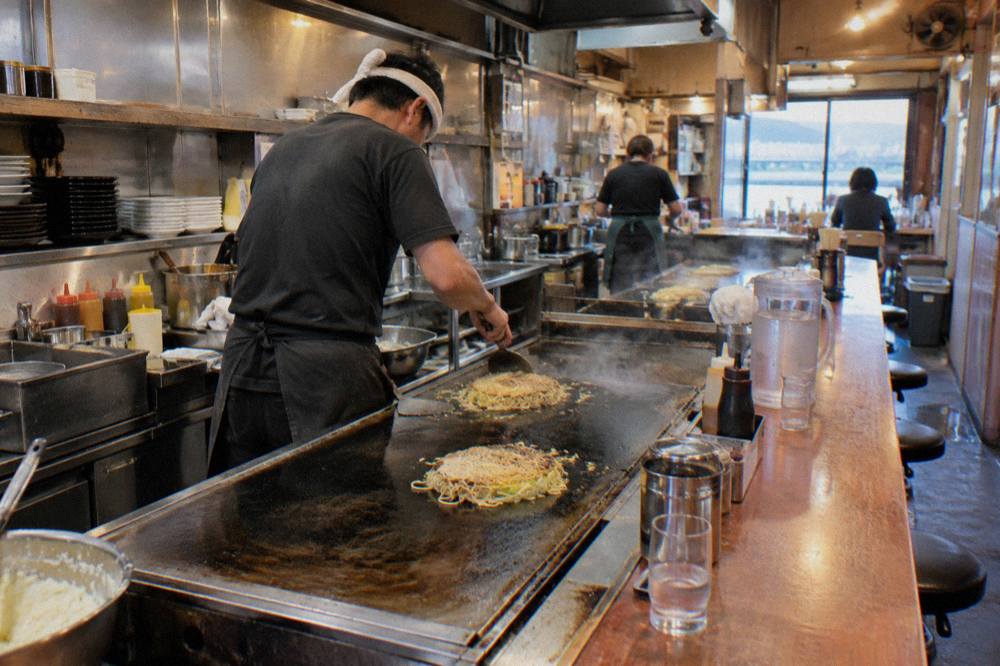
Okonomimura itself is the fullest expression of the dish's place in the city. The building houses 24 stalls across 4 floors, most operating 11:00 to 22:00 with last orders around 21:30, and many stalls provide English menus for international visitors. Hiroshima, as reported in comparative food writing, has more okonomiyaki restaurants than Osaka, which is the city usually credited as the dish's other capital. The site's dedicated page on Okonomimura covers the building stall by stall.
| Venue | Address Area | Hours | Notes |
|---|---|---|---|
| OKOSTA workshop | 1-2 Matsubara-cho, Minami-ku (ekie 1F) | 10:00 to 20:30 | Sessions 10:30, 13:00, 18:30 |
| Mitchan Sohonten ekie | 1-2 Matsubara-cho, Minami-ku | 11:00 to 22:00 | Hiroshima-style |
| Reichan ekie | 1-2 Matsubara-cho, Minami-ku | 11:00 to 21:30 | Soba-based version |
| Denko Sekka ekie | 1-2 Matsubara-cho, Minami-ku | 11:00 to 23:00 | 3D okonomiyaki |
| Okonomimura | 5-13 Shintenchi, Naka-ku | Most stalls 11:00 to 22:00 | 24 stalls, 4 floors |
For evening planning beyond the griddle, the Hiroshima at night itinerary ties the food districts to the city's after-dark sights.
What Do You Actually Learn In A Hiroshima Okonomiyaki Class?
A Hiroshima okonomiyaki class teaches the layering sequence that defines the local style: a thin batter base cooked first, then a large amount of cabbage, then the protein, then yakisoba or udon noodles as a standard layer, and often a fried egg, sauced and finished on the griddle. Participants cook each stage themselves under instruction and then eat the result, which is the whole point of the format.
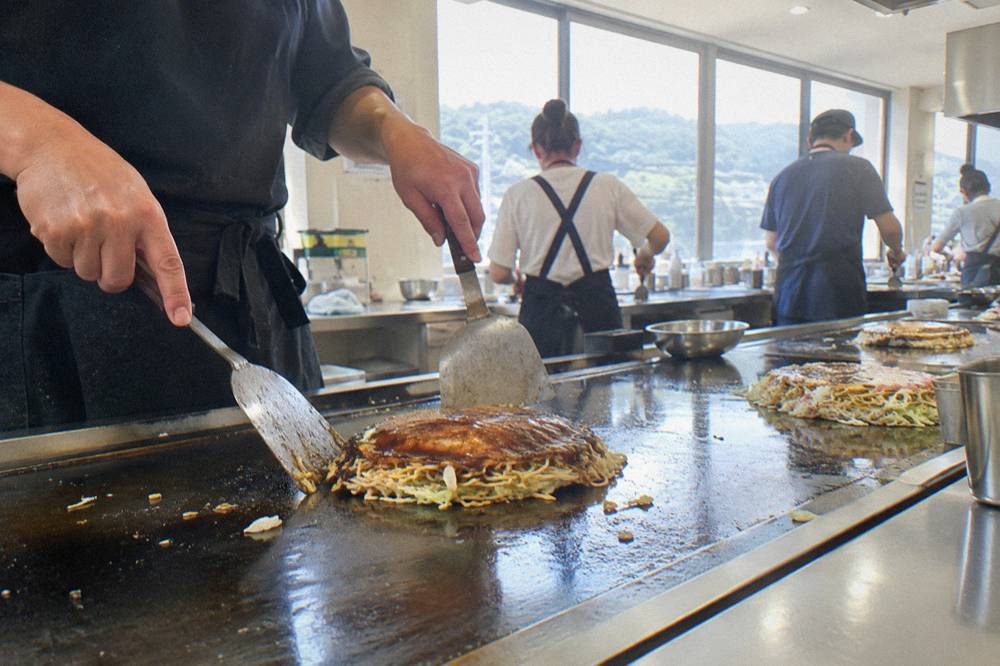
The layering is the technical heart of it. In the Hiroshima method the batter is spread very thin, almost like a crepe, and each ingredient is added in turn rather than folded into a mix. The noodles sit inside the stack as a distinct layer, which is the clearest single difference from the Osaka method of combining everything into a thicker batter. Soba is the default noodle in many versions, and Reichan at Hiroshima Station is an example of a restaurant built specifically around a soba-based version of the dish.
The health angle is a fair question for a class built around noodles, pork and sauce. The site's assessment of whether okonomiyaki is healthy breaks the dish down by component, and the OKOSTA dietary versions, particularly the vegetarian variant with corn, give a class participant some control over what goes into the stack.
Can You Take An Okonomiyaki Class With Dietary Restrictions In Hiroshima?
Yes. OKOSTA in Hiroshima runs Muslim-friendly, vegetarian and gluten-free versions of its cooking experience at the same 2,500 yen price as the standard class, all tax included and all with one topping choice. The Muslim-friendly version uses halal okonomi sauce from Otafuku's Malaysia factory with squid and shrimp instead of pork, the vegetarian version uses corn and a vegetarian sauce, and the gluten-free version uses rice flour noodles and a gluten-free sauce.
The halal sourcing is the detail worth knowing: the sauce is made at Otafuku's Malaysia factory rather than adapted from a standard production line, which is what the company's own experience page states. The gluten-free version substitutes rice flour noodles for wheat noodles and pairs them with a gluten-free sauce, so the restriction is handled at both the noodle and sauce stages rather than only one. The wider set of guides lives on Hiroshima Travel Guide.
Reservation rules are the same across all versions: booking at least three days ahead by phone or form, with same-day bookings by phone only, on (+81)-(0)82-207-1277 between 10:00 and 18:00. The one-to-one guardian rule for children in grades 1 to 4 also applies regardless of the dietary version booked.
How Do You Book An Okonomiyaki Class In Hiroshima?
Book OKOSTA by phone or web form at least three days before the session, with same-day bookings accepted by phone only. The reservation line, (+81)-(0)82-207-1277, answers from 10:00 to 18:00. Sessions run at 10:30 to 12:00, 13:00 to 14:30 and 18:30 to 20:00, each lasting 1.5 hours, and the venue caps participation at 20 per session and 40 in total.
The three-day lead time is the operative constraint for travellers building a tight itinerary. A visitor arriving in Hiroshima for two nights can book the third day's session before leaving home. The session times themselves split cleanly across a day plan: the morning session ends at noon, the afternoon session ends at 14:30, and the evening session runs into dinner time, which makes it the one that doubles as a meal.
Getting there is simple by design: the venue is inside the station complex itself, on the 1st floor of ekie, a 2-minute walk from the north exit. Hiroden trams now enter the Hiroshima Station building directly, reported since August 2025, so a visitor staying anywhere on the tram network can ride to the station and reach the workshop without going outdoors. The flat fare is 240 yen adult and 120 yen child on every line, including the Miyajima line, and the 700 yen day pass covers unlimited rides for a day of combining the class with the Peace Memorial Park and the castle.
How Do You Fit A Cooking Class Into One Day In Hiroshima?
A class at OKOSTA anchors one end of a Hiroshima day: the 10:30 session finishes at noon, leaving the afternoon for the Peace Memorial Museum at 200 yen adult admission, the park grounds and A-Bomb Dome which are free and open 24 hours, and the castle exterior, before an evening okonomiyaki dinner at Okonomimura, a 3-minute walk from the Hacchobori tram stop. The Hiroden flat fare between all of these is 240 yen.
The museum timing matters because its hours shift by season: 7:30 to 19:00 from March to July and September to November, 7:30 to 20:00 in August, and 7:30 to 18:00 from December to February, with closures on 30 and 31 December and in mid-February. A morning class followed by an afternoon museum visit works within the 19:00 close for most of the year. Admission is 200 yen for adults, 100 yen for high school students, free for junior high and younger, and 100 yen for visitors 65 and older with a passport.
The castle needs one correction to older guidebooks: the keep has been closed to visitors since 22 March 2026 due to concrete deterioration and ageing equipment, and exterior viewing is what remains. The reconstructed Ni-no-maru buildings are open with free admission, 9:00 to 17:30 from April to September and 9:00 to 16:30 from October to March, per the castle's own site. The site's pages on Hiroshima Castle, the Peace Memorial Museum and the Peace Memorial Park carry each site in full, and the Hiroshima in one day itinerary sequences a day around them.
| Day Plan Segment | Place | Cost | Notes |
|---|---|---|---|
| Morning | OKOSTA class, ekie 1F | 2,500 yen | 10:30 to 12:00 session |
| Afternoon | Peace Memorial Museum | 200 yen adult | 7:30 open, seasonal close |
| Afternoon | Peace Park and A-Bomb Dome | Free | Grounds open 24 hours |
| Late afternoon | Hiroshima Castle exterior | Free | Keep closed since March 2026 |
| Evening | Okonomimura stalls | 800 to 1,500 yen a serving | Most stalls to 22:00 |
For a second day, Miyajima extends the same trip. The island is a 10-minute JR ferry from Miyajimaguchi, with a 100 yen Miyajima Visitor Tax charged separately on entering, and Itsukushima Shrine charges 300 yen adult admission. The Mount Misen ropeway costs 2,000 yen return for an adult. The site's Miyajima tour page covers the island in detail.
When Is The Best Time Of Year For A Cooking Class In Hiroshima?
The class itself runs indoors year round at OKOSTA in Hiroshima, so the season matters mainly for the rest of the day around it. The Japan Meteorological Agency (JMA) station normals for 1991 to 2020 show August with the highest average daily high at 32.8 °C and January with the lowest average daily low at 2.0 °C, while July has the highest monthly rainfall at 279.8 mm and January the lowest at 46.2 mm.
For a plan that pairs a class with walking, the numbers argue for spring or autumn. April averages a high of 19.8 °C with 141.0 mm of rain, October a high of 23.7 °C with 109.2 mm. The wet months are June at 226.5 mm and July at 279.8 mm, the two heaviest in the table, and the mid-summer heat peaks in August at a 32.8 °C average high. None of this stops a class: the 18:30 evening session sits after the warmest part of an August day, and the workshop is indoors regardless.
| Month | Average High °C | Average Low °C | Rain Mm |
|---|---|---|---|
| January | 9.9 | 2.0 | 46.2 |
| April | 19.8 | 10.1 | 141.0 |
| July | 30.9 | 24.1 | 279.8 |
| August | 32.8 | 25.1 | 131.4 |
| October | 23.7 | 14.9 | 109.2 |
Winters are mild on the same normals, with a December average high of 12.1 °C, and the museum's shorter 18:00 close from December to February is the main seasonal adjustment to a class-day plan. The site's best time to visit Hiroshima page carries the full seasonal breakdown.
Is A Hiroshima Okonomiyaki Class Worth It Compared With A Food Tour?
A cooking class and a guided food tour in Hiroshima serve different aims: the class teaches one dish in 1.5 supervised hours at a fixed 2,500 yen venue price, while a guided eating tour moves between several venues with a guide explaining the city's food culture along the way. A visitor who wants to reproduce the dish at home needs the class; a visitor who wants to taste widely needs the tour, and a two-day stay supports both.
The honest comparison runs through what each format delivers. A class participant leaves with the layering sequence, the sauce knowledge, the apron and hat souvenirs, and one cooked dish eaten.
For visitors who want the history side of the city rather than only the food, the guided walks of the Peace Memorial Park are the other format worth weighing, and the Hiroshima Travel Guide's walking options include a flexible-length version below.
Common Questions About Okonomiyaki Cooking Classes In Hiroshima
How Much Is An Okonomiyaki Cooking Class In Hiroshima?
The standard, Muslim-friendly, vegetarian and gluten-free experiences at OKOSTA each cost 2,500 yen tax included, with one topping choice. Evening party plans at the 18:30 session cost 3,300 yen with one drink or 5,500 yen for a 2-hour all-you-can-drink format.
Where Is The Okonomiyaki Cooking Class In Hiroshima Held?
OKOSTA is on the 1st floor of ekie at 1-2 Matsubara-cho, Minami-ku, inside Hiroshima Station, a 2-minute walk from the north exit. The venue operates daily from 10:00 to 20:30 with possible temporary closures.
How Far In Advance Should You Book An Okonomiyaki Class In Hiroshima?
Reservations are required at least three days in advance by phone or web form. Same-day bookings are accepted by phone only, on (+81)-(0)82-207-1277 between 10:00 and 18:00.
Can Children Take An Okonomiyaki Cooking Class In Hiroshima?
Yes, with one rule: elementary school children in grades 1 to 4 must be accompanied by one guardian per child. Sessions hold a maximum of 20 participants, and groups of 30 or more can book the entire venue.
Is There A Vegetarian Or Gluten-Free Okonomiyaki Class In Hiroshima?
Yes. OKOSTA runs vegetarian, gluten-free and Muslim-friendly versions of the same 1.5-hour experience at the same 2,500 yen price, using corn and vegetarian sauce, rice flour noodles with gluten-free sauce, and halal sauce with squid and shrimp respectively.
What Is The Difference Between Hiroshima And Osaka Okonomiyaki?
Hiroshima-style cooks a very thin batter base first and layers cabbage, pork, noodles and often a fried egg on top, while Osaka-style mixes the ingredients into a thicker batter. Noodles are a standard layer in the Hiroshima version and appear in Osaka only in modan-yaki variations.
Book the session three days out, check the seasonal museum hours if the Peace Park shares the day, and the rest of the plan falls into place around the griddle.