Best Time To Visit Hiroshima, Season By Season
The Japan Meteorological Agency 1991-2020 normals, the blossom record and the festival calendar together give a clear picture of what each season offers.
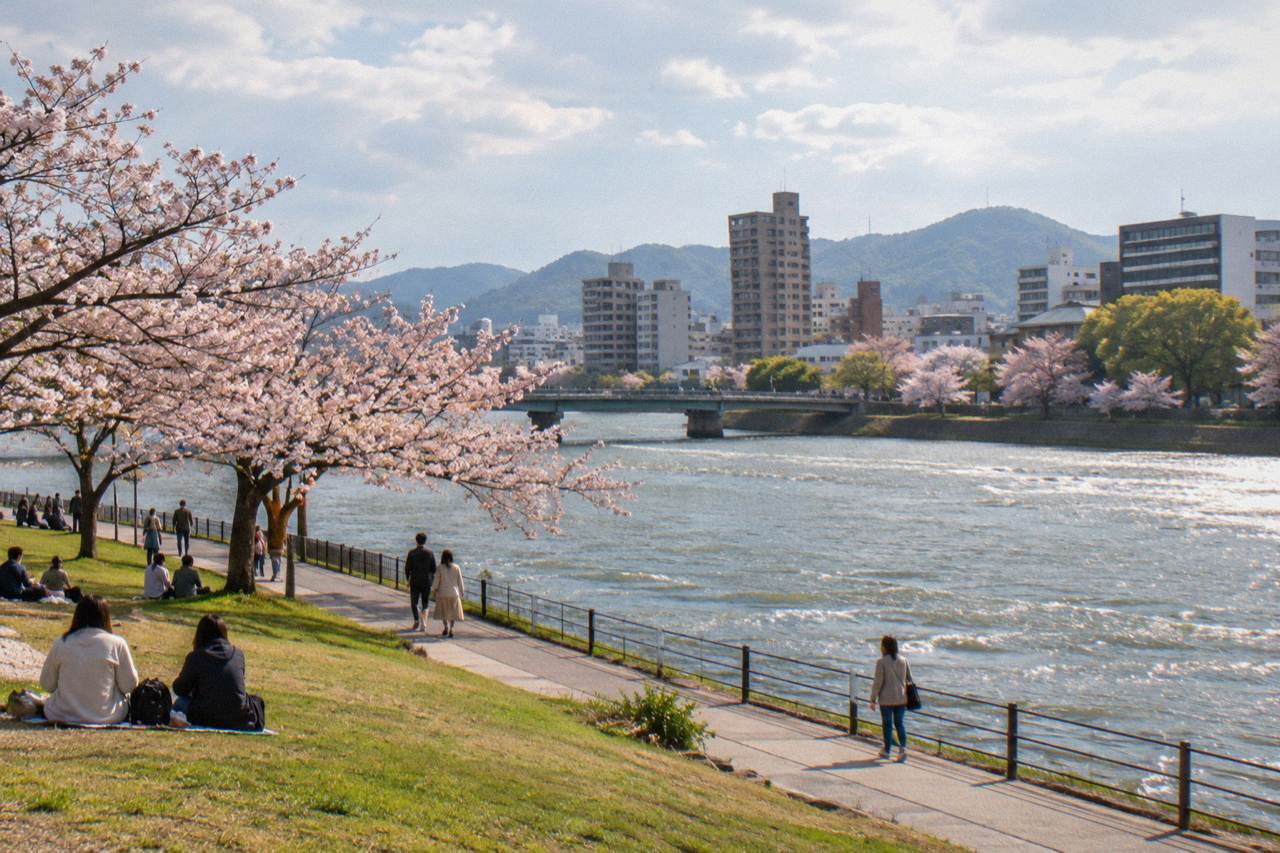
There is no single best month for everyone: spring brings the late March to early April cherry blossom, August 6 carries the Peace Memorial Ceremony, mid to late November peaks the Momijidani maple colour on Miyajima, and winter is a mild season with average January highs near 10 C.
Cherry blossoms average first bloom on March 25 and full bloom on April 4, the Peace Memorial Ceremony falls every August 6, and the maple colour in Miyajima's Momijidani Park typically peaks mid to late November. This page from the Hiroshima Travel Guide lays out each season with the figures the sources give, so the choice of when to go rests on data rather than guesswork.
When Is The Best Time To Visit Hiroshima?
No single month is the answer for every traveller, because the three strongest draws sit in three different seasons: cherry blossoms average full bloom on April 4, the Peace Memorial Ceremony is fixed on August 6, and the Momijidani Park maples on Miyajima typically peak mid to late November. Between those anchors, the JMA normals show July rainfall at about 279.8 mm and January rainfall at about 46.2 mm.
The honest way to frame the question is by priority. A visitor whose main goal is the blossom should plan around the JMA specimen tree record for the city: first bloom averages March 25 and full bloom April 4 over 30 years of data, and in 2026 the actual dates were March 19 and March 30, both early. A visitor whose trip is about the peace memorials may find the August 6 ceremony, held from 8:00 to about 8:50 in Peace Memorial Park, the most meaningful date on the calendar, and accept summer heat for it. A visitor coming for colour and comfortable walking weather will find the mid to late November maple peak on Miyajima paired with an average November high of about 17.7 C.
Rain is the other axis. The JMA table gives 226.5 mm for June and 279.8 mm for July, while January through February and November through December all sit at or under about 69.3 mm. Summer also carries the highest humidity implied by the minima: nights in July and August average about 24.1 °C and 25.1 C.
What Is The Weather Like In Hiroshima Month By Month?
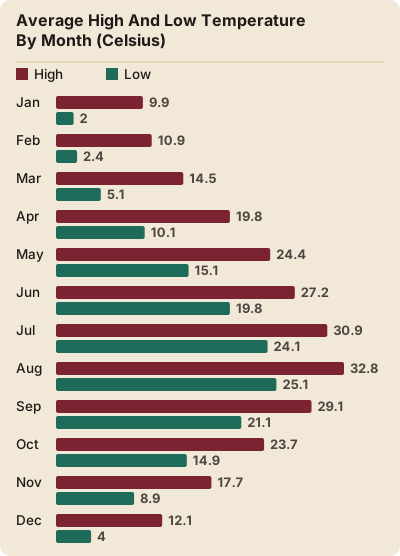
The JMA station normals for Hiroshima, 1991-2020, show average daily highs climbing from 9.9 °C in January to a peak of 32.8 °C in August, then falling back to 12.1 °C by December, while rainfall runs from a low of 46.2 mm in January to a high of 279.8 mm in July, with the annual total at 1,572.2 mm.
The table below is the full monthly picture from the Japan Meteorological Agency station data. These are 30 year averages, so any single year will sit above or below them.
| Month | Average High °C | Average Low °C | Average Rain mm |
|---|---|---|---|
| Jan | 9.9 | 2.0 | 46.2 |
| Feb | 10.9 | 2.4 | 64.0 |
| Mar | 14.5 | 5.1 | 118.3 |
| Apr | 19.8 | 10.1 | 141.0 |
| May | 24.4 | 15.1 | 169.8 |
| Jun | 27.2 | 19.8 | 226.5 |
| Jul | 30.9 | 24.1 | 279.8 |
| Aug | 32.8 | 25.1 | 131.4 |
| Sep | 29.1 | 21.1 | 162.7 |
| Oct | 23.7 | 14.9 | 109.2 |
| Nov | 17.7 | 8.9 | 69.3 |
| Dec | 12.1 | 4.0 | 54.0 |
Two patterns matter for planning. First, the rainfall peak lands in July, not in the August heat: August averages about 131.4 mm, though August nights stay warm at about 25.1 C. Second, the March to June ramp combines rising warmth with rising rain, so spring visitors should carry rain gear even in blossom season: March averages about 118.3 mm and April about 141.0 mm.
Day to day detail, typhoon tracking and live forecasts belong on the Hiroshima weather page, which is updated separately from this seasonal overview.
Is Spring The Best Season For Cherry Blossom In Hiroshima?
Yes, if blossom is the priority, the last week of March into the first days of April is the window the data supports: 30 year JMA specimen tree data puts average first bloom on March 25 and average full bloom on April 4, and in 2026 the blossoms ran early, with first bloom on March 19 and full bloom on March 30.
The spread between the average dates and the 2026 dates is the practical lesson. Blossom timing moves by roughly a week or more year to year, so a trip anchored to the average full bloom date of April 4 gives a better chance of catching colour than one anchored to the calendar alone. The cherry blossom guide covers where the specimen trees and viewing spots sit; this page only carries the dates.
Spring temperatures are kind to walking. April averages about 19.8 °C high and 10.1 °C low, and May about 24.4 °C and 15.1 °C, which suits the Peace Memorial Park, Shukkeien and the castle grounds. The trade off is rain: every spring month from March onward averages at least about 118.3 mm, so a compact umbrella earns its place.
Golden Week, May 3 to 5, brings the Hiroshima Flower Festival onto Peace Boulevard, a fixed annual event worth knowing when choosing spring dates.
How Hot And Rainy Is Hiroshima In Summer?
Summer in Hiroshima is hot and humid: average daily highs run about 27.2 °C in June, 30.9 °C in July and 32.8 °C in August, with overnight lows above about 19.8 °C in all three months, and the rain concentrates in June and July at about 226.5 mm and 279.8 mm respectively, while August drops to about 131.4 mm.
The practical shape of the season is a wet June and July followed by a drier but hotter August. The rainy season peak in July means any summer itinerary should hold indoor alternatives, and the city has several: the Peace Memorial Museum is open 7:30 to 19:00 from March to July and from September to November, with August hours extended to 20:00 and to 21:00 on August 5 and 6, and the museum's extended early morning and evening slots need online reservation. Admission is 200 yen for adults, 100 yen for high school students, free for junior high and younger, and 100 yen for visitors 65 and over with a passport.
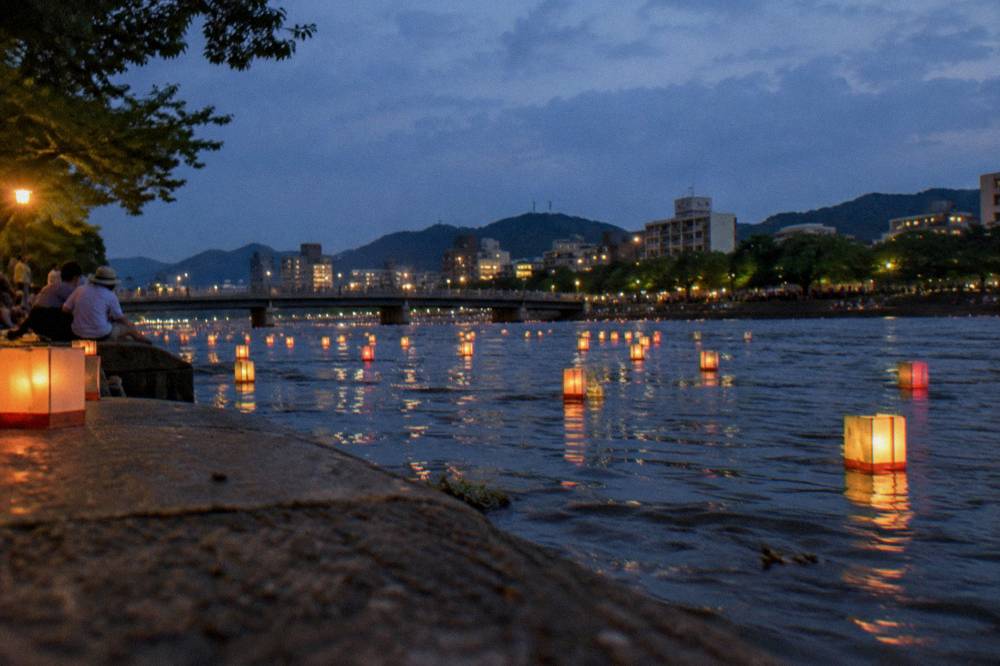
August 6 is the fixed point of the summer calendar. The Peace Memorial Ceremony runs from 8:00 to about 8:50 in Peace Memorial Park, with about 7,000 seats plus about 2,200 indoor seats at the International Conference Center, per the city's own ceremony page. The August 6 peace ceremony guide covers the detail of attending respectfully; etiquette at the park and museum is quiet behaviour and respectful photography, as the official pages state.
For food-led evenings, summer suits the izakaya districts, and the Hiroshima okonomiyaki guide explains the local layered style of the dish and how ordering works.
Is Autumn The Best Time To Visit Miyajima?
Autumn is the season Miyajima is most famous for in the colour sense: the Momijidani Park maples typically peak mid to late November, around November 10 to 30, and average November weather in Hiroshima is about 17.7 °C high and 8.9 °C low with only about 69.3 mm of rain, which pairs the strongest colour with comfortable walking conditions.
The island is a short JR ferry ride from Miyajimaguchi, about 10 minutes each way, with the one way adult fare at 200 yen plus the separate 100 yen Miyajima visitor tax collected on entry, preschool children exempt. Daytime departures run roughly every 15 minutes. Itsukushima Shrine opens at 6:30 a.m. except on 1 January, closing at 18:00 from March 1 to October 14 and 17:30 from October 15 to November 30, which shifts the last useful entry earlier from mid-October, ahead of the maple peak in mid to late November. Admission is 300 yen adult, 200 yen high school, 100 yen elementary and junior high, cash preferred.
The Mount Misen ropeway costs 2,000 yen adult return or 1,100 yen one way, runs 9:00 to 16:00 with last descent at 16:30, and the Miyajima autumn colour is dense enough that the Miyajima autumn leaves guide treats the island as its own sub-season. Tide also shapes an island day: the Great Torii can be walked to when the tide is below about 100 cm and appears to float above about 250 cm, and the live tide block on this site tracks Hiroshima Bay rather than guessing a time.
| Miyajima Autumn Visit Item | Figure | Note |
|---|---|---|
| JR ferry one way, adult | 200 yen | About 10 minute crossing |
| Miyajima visitor tax | 100 yen | Charged on entry, preschool children exempt |
| Itsukushima Shrine admission, adult | 300 yen | Cash preferred |
| Shrine hours, Oct 15 to Nov 30 | 6:30 to 17:30 | Opens at 6:30 a.m. except on 1 January |
| Mount Misen ropeway, adult return | 2,000 yen | 9:00 to 16:00, last descent 16:30 |
| Momijidani maple peak | Mid to late November | Around Nov 10 to 30 |
October should not be overlooked: about 23.7 °C average high and 109.2 mm of rain make it a calm month for the Miyajima tour options before the November colour arrives.
Is Winter A Good Time To Visit Hiroshima?
Winter is a dry and mild season in Hiroshima: January averages about 9.9 °C high and 2.0 °C low with just 46.2 mm of rain, December about 12.1 °C and 4.0 °C with 54.0 mm, and February about 10.9 °C and 2.4 °C with 64.0 mm, so the winter months also carry daytime temperatures near or above 10 C.
That combination, dry air and mild afternoons, suits the outdoor memorials and gardens. Shukkeien is open 9:00 to 17:00 from September 16 to March 15, with last entry 30 minutes before closing, and admission is 350 yen for adults, 150 yen for university students and free for elementary to high school students since April 14, 2025. The Peace Memorial Museum shortens to 7:30 to 18:00 from December to February and closes on December 30 and 31 and in mid February for exhibit change, so winter visitors should check those dates against their itinerary.
One correction matters for winter and every other season: the Hiroshima Castle keep has been closed to visitors since March 22, 2026, permanently. The exterior and grounds remain viewable, and a Sannomaru history museum is planned for June 2027, but no visit inside the keep is possible.
Oysters also feature in the local food calendar, a subject the Hiroshima oysters guide covers in full.
What Does A Hiroshima Trip Cost In Each Season?
The fixed local costs do not change with the season: the Peace Memorial Museum is 200 yen for adults, Shukkeien 350 yen, Itsukushima Shrine 300 yen, the Mount Misen ropeway 2,000 yen return, the Hiroden streetcar a flat 240 yen per adult ride, and the JR Miyajima ferry 200 yen each way plus the 100 yen visitor tax, so seasonal budgeting turns on transport passes and how many paid sights a day includes.
The table gathers the entry and transport figures this page's sources verify. Nothing in it varies by month; what varies is how many of these line items an itinerary uses.
| Item | Cost | Detail |
|---|---|---|
| Peace Memorial Museum, adult | 200 yen | College and up; high school 100 yen |
| Shukkeien, adult | 350 yen | University 150 yen, school students free |
| Itsukushima Shrine, adult | 300 yen | Combined shrine and Treasure Hall 500 yen |
| Senjokaku | 100 yen | Separate from the shrine |
| Mount Misen ropeway, adult return | 2,000 yen | One way 1,100 yen |
| Hiroden streetcar, adult | 240 yen flat | Child 120 yen, all lines, since Feb 2025 |
| JR Miyajima ferry, adult one way | 200 yen | Plus 100 yen visitor tax |
For trip level budgeting by rail and season, the Hiroshima trip cost guide breaks the planning ranges down. Product prices for guided days and passes render live from their listings rather than being typed here; the Hiroshima and Yamaguchi regional rail pass, which covers five consecutive days on JR West lines including some shinkansen segments, is available to Check availability through the operator's live listing.
Which Transport Pass Fits Which Season In Hiroshima?
A one day Hiroden streetcar pass costs 700 yen for adults and covers all lines, the one day streetcar and ferry combo pass costs 1,000 yen including the Miyajima Matsudai ferry and the 100 yen visitor tax, and the combo pass also discounts the Miyajima ropeway round trip to 1,500 yen, so the break even against the flat 240 yen single fare depends purely on how many rides a day's plan holds.
At 240 yen per adult ride, the 700 yen day pass pays off from the third ride onward, and a day that mixes city tram trips with the Miyajima line tips the 1,000 yen combo pass into range on the ferry alone. The Visit Hiroshima Tourist Pass 1 day version, at 1,000 yen, covers all Hiroden streetcars, selected ferries and buses, which suits an island day in any season. The getting around Hiroshima guide and the Hiroshima to Miyajima guide carry the full route detail.
For multi day, multi city trips, the JR pass options for Hiroshima compare the regional products, including the five day Hiroshima and Yamaguchi area pass, whose JR West page lists it at 15,000 yen for five consecutive days of adult travel including some shinkansen segments. Arriving visitors should also note the airport connection: the limousine bus from Hiroshima Airport to Hiroshima Station's Shinkansen gate takes about 45 to 50 minutes for 1,500 yen one way, per the airport's own timetable page.
How Do Season And Tide Together Shape A Miyajima Day?
The tide, not the season, decides whether the Great Torii can be walked to or appears to float: walking out is possible when the tide is below about 100 cm and the floating effect appears above about 250 cm, so in every season the plan should pair the live Hiroshima Bay tide prediction with the fixed opening hours, which for Itsukushima Shrine run from 6:30 a.m. to a seasonal close of 18:00, 17:30 or 17:00.
An August visitor can see the Great Torii lit in the evening after the morning ceremony, but must plan around extended museum hours rather than the shrine's. The shrine and torii are lit until 23:00, though the shrine itself closes earlier, per the shrine's admission information.
| Itsukushima Shrine Period | Hours |
|---|---|
| January 1 | 0:00 to 18:30 |
| January 2 to 3 | 6:30 to 18:30 |
| January 4 to end of February | 6:30 to 17:30 |
| March 1 to October 14 | 6:30 to 18:00 |
| October 15 to November 30 | 6:30 to 17:30 |
| December | 6:30 to 17:00 |
The full tide and timing discussion lives on the best time to go to Miyajima answer page, and first time visitors will find the ordering logic that works on the first time in Hiroshima itinerary.
Which Months Suit Which Kind Of Hiroshima Trip?
A blossom trip centres on late March to early April, a ceremony and memory trip centres on August 6, a colour and walking trip centres on mid to late November, and a dry, mild, low rainfall trip centres on January, February or December, with the JMA normals, the blossom record and the Momijidani peak supplying every date in that mapping.
The summary table matches each priority to its season anchor and its climate profile. No row claims a single winner; each row states what the sources support.
| Trip Priority | Season Anchor | Average High °C | Average Rain mm |
|---|---|---|---|
| Cherry blossom | First bloom avg March 25, full bloom avg April 4 | Apr 19.8 | Apr 141.0 |
| Peace Memorial Ceremony | August 6, 8:00 to 8:50 | Aug 32.8 | Aug 131.4 |
| Momijidani maple colour | Mid to late November, around Nov 10 to 30 | Nov 17.7 | Nov 69.3 |
| Dry, mild city walking | January and February | Jan 9.9, Feb 10.9 | Jan 46.2, Feb 64.0 |
| Flower Festival | May 3 to 5 on Peace Boulevard | May 24.4 | May 169.8 |
| Quiet garden season | December | Dec 12.1 | Dec 54.0 |
Interseason months hold their own value. March combines about 14.5 °C average highs with the start of blossom season, and October pairs about 23.7 °C days with 109.2 mm of rain, between the summer peak and the autumn colour. July, about 279.8 mm, is the one month whose numbers argue most clearly for indoor weighted planning.
Should The Season Change Where You Stay In Hiroshima?
The season changes how much time a trip spends indoors and on the water, but the source backed guidance is practical rather than climatic: the Hiroden network fixes the flat 240 yen fare on every line, the streetcar to Miyajimaguchi takes 66 minutes on Line 2, and a stay within walking distance of the station or the Peace Park area keeps both the museum and the ferry connection short, whatever the month.
Winter and rainy season trips lean more on covered spaces, evening food streets and museum time, which the where to stay in Hiroshima guide maps by district. Summer trips lean toward early mornings, which the shrine's 6:30 a.m. opening and the museum's 7:30 a.m. start both reward. Spring and autumn trips earn their value outdoors, and an overnight on Miyajima, covered on the Miyajima guide, moves the torii and Momijidani into first and last light.
Getting to the city in the first place is season independent: the Hiroshima airport guide covers the limousine bus, and the route pages for Tokyo to Hiroshima, Osaka to Hiroshima and Kyoto to Hiroshima cover the rail connections from each gateway.
To compare flights for your chosen dates, book a flight to Hiroshima here.
Common Questions About The Best Time To Visit Hiroshima
When Is The Best Time To Visit Hiroshima?
It depends on the priority: cherry blossoms average full bloom on April 4, the Peace Memorial Ceremony is held on August 6 from 8:00 to about 8:50, the Momijidani maples on Miyajima peak mid to late November, and January brings about 46.2 mm of rain with mild average highs near 9.9 C.
What Month Has The Most Rain In Hiroshima?
July has the highest average rainfall at about 279.8 mm per the JMA 1991-2020 station normals, followed by June at about 226.5 mm. August is lower, at about 131.4 mm, despite being the warmest month.
When Do Cherry Blossoms Bloom In Hiroshima?
Based on 30 years of JMA specimen tree data, first bloom averages March 25 and full bloom April 4. In 2026, first bloom came on March 19 and full bloom on March 30, five days ahead of the average full bloom date.
Is Hiroshima Too Hot In August?
August average daily highs are about 32.8 °C with overnight lows about 25.1 °C, per the JMA normals. It is warm, and the Peace Memorial Museum extends its August hours to 20:00, and to 21:00 on August 5 and 6, which shifts sightseeing toward early and late hours.
When Do The Autumn Leaves Peak On Miyajima?
The Momijidani Park maples on Miyajima typically peak mid to late November, around November 10 to 30. Hiroshima's average November high is about 17.7 °C with about 69.3 mm of rain.
Is Winter A Good Time To Visit Hiroshima?
In winter, January averages about 46.2 mm of rain and February about 64.0 mm, with daytime highs around 9.9 °C to 12.1 °C across the three months. The Peace Memorial Museum shortens to 7:30 to 18:00 from December to February and closes on December 30 and 31 and in mid February for exhibit change.
Whichever window the calendar allows, the same figures hold: the blossoms keep their late March to early April average, the ceremony keeps its August 6 morning, and the maples keep their mid to late November peak, so a Hiroshima trip planned around any one of them lands on data rather than luck.