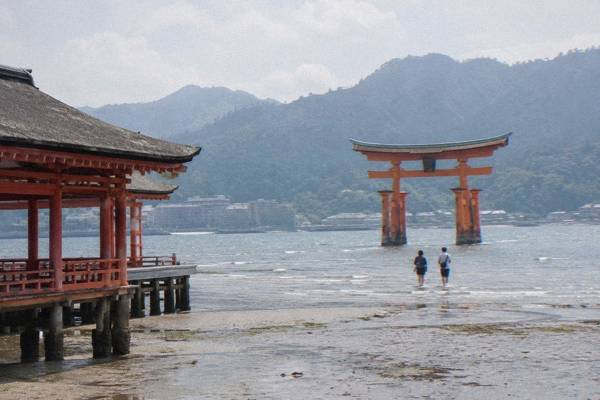
When Is Low Tide At Miyajima?
Low tide at Miyajima depends on the day: the Hiroshima Bay tide cycle decides whether you walk to the Great Torii or see the shrine float. Here is how to plan around it.
There is no fixed clock answer to the question of low tide at Miyajima, the island in Hiroshima Bay that hosts Itsukushima Shrine and its Great Torii. The tide in this arm of the Seto Inland Sea runs on a roughly semidiurnal cycle, with two highs and two lows each day, and the whole pattern slides later by about 50 minutes daily. On one date the foreshore around the torii may be walkable at dawn, and a week later the same water will not drop until late afternoon. The Miyajima Tourism Association publishes an annual tide table with hourly levels, and this site's Hiroshima Travel Guide tide block carries the live figures, so the practical answer is always to read the day's prediction rather than a rule of thumb.
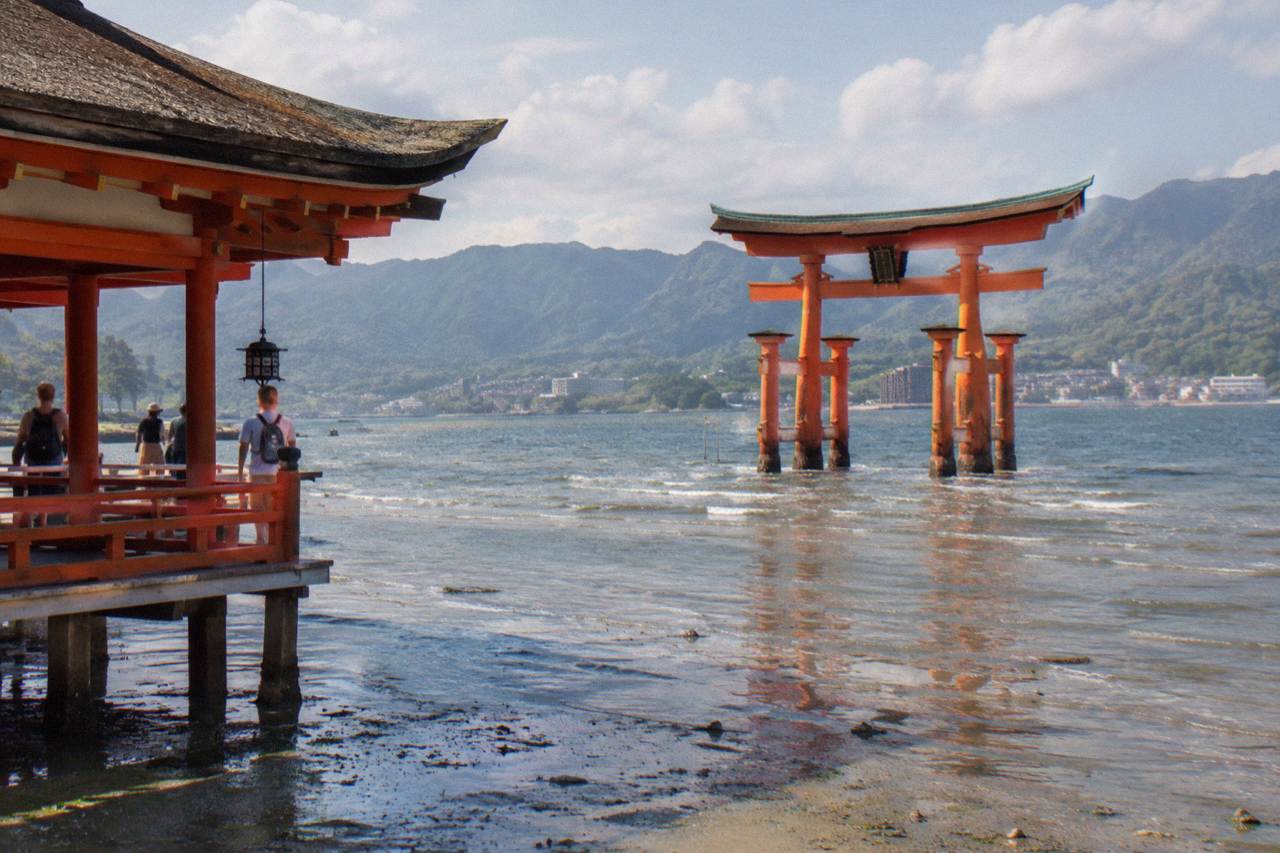
Low tide at Miyajima falls twice on an ordinary day, and the times move roughly 50 minutes later each day, so the answer changes completely from one date to the next. The only reliable way to know the day's low tide is the Miyajima Tourism Association tide table, which the live Hiroshima Bay tide block on this page reports. Some days run a single high and a single low instead of two of each.
That 50-minute daily drift is the single most useful fact for a visitor. If you look at a tide table on Monday, see a morning low, and assume Tuesday will match, you will arrive nearly an hour early. Over a week the low-tide window can slide from before breakfast to well past lunch. Trip reports that name "the best time of day" for the torii without a date attached are describing one day's tide, not a pattern.
A worked example shows how wide the swing is within a single day. On 29 October 2026 the association's tide figures for the island gave a low of 0 cm at 5:07 in the morning and a second low of 126 cm at 17:40 in the evening, with highs of 372 cm at 11:41 and 321 cm at 23:19. The morning low opened a long walkable window; the evening low, at 126 cm, did not. Two lows in one day, and only one of them put the seabed bare.
That example also explains why the level matters as much as the time. The torii becomes walkable only when the water drops below about 100 cm on the Hiroshima Port reference scale, and the shrine takes on its floating look only above about 250 cm. A "low tide" of 126 cm is still a low tide, but it is not a low enough one to walk out.
Why The Tide Level Decides What You Can Do At The Torii
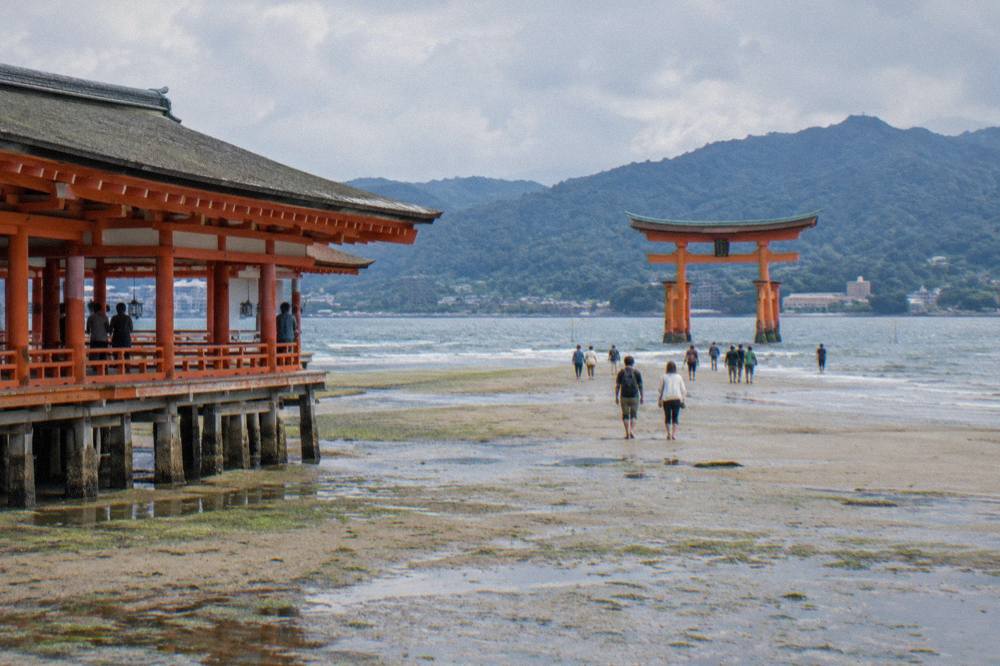
The Great Torii of Itsukushima Shrine can be walked to across the seabed only when the tide level falls below about 100 cm, and the shrine appears to float only when the level rises above about 250 cm, according to the Miyajima Tourism Association's tide guidance. Everything else on the foreshore sits between those two thresholds, half-submerged and photogenic but not walkable.
The thresholds are the key planning tool. Below 100 cm you can stand on the sand beside the torii's camphor-wood legs. Between roughly 100 and 250 cm the gate rises out of shallow water with no access.
| Tide level (Hiroshima Port reference) | State of the Great Torii | What you can do |
|---|---|---|
| Below about 100 cm | Seabed exposed around the base | Walk out to the gate across the sand |
| About 100 to 250 cm | Standing in shallow water | View from the shore and the shrine corridors |
| Above about 250 cm | Appears to float on the sea | View from the shore, piers and ferry |
The two states are not in competition; they are two halves of the same visit. A day that gives you a low around mid-morning gives you a floating gate by late afternoon, because the water climbs back through the 250 cm line within hours. Visitors who time a single visit badly sometimes see neither: an arriving tide that sits between the thresholds for hours on end shows a gate that is neither reachable nor floating.
The torii itself is a fixed and imposing object in all three states. It stands about 160 m offshore from the shrine buildings, reaches 16.6 m in height with a crossbeam 24.2 m long, and weighs about 60 tonnes. Its main pillars measure 9.9 m around. The present gate is the ninth on the site and was erected in 1875, and it holds itself up by its own weight on a base of driven wooden piles, without deep burial in the seabed. Restoration of the gate finished in December 2022; repair work on the shrine's East Corridor and five-storey pagoda is under way with the shrine open throughout.
The tide question and the gate question are close cousins. If the floating-gate effect interests you, the companion page Why The Miyajima Torii Gate Stands In The Water covers the design and history in depth.
A guided morning in the city before an afternoon on the island is one way to make the tide arithmetic work for you rather than against you. The Walking Through History: Hiroshima's Path To Peace walk covers the Peace Memorial Park ground with a guide, while a private custom tour with a local guide can be shaped around the day's tide table, and the Hiroshima and Miyajima by Bike and Boat combo puts the crossing itself into the itinerary. Check availability if a guided peace walk fits your dates.
How To Read The Hiroshima Bay Tide Table
The tide figures published for Miyajima are predictions referenced to Hiroshima Port, and actual conditions at the island can arrive slightly earlier, so treat the table as a guide with a small margin rather than a timetable to the minute. Read three numbers for your date: the time of the low, the level in centimetres, and the time of the next high.
The first number tells you when to be there. The second tells you whether the low is low enough: below 100 cm means walkable, anything higher does not. The third tells you how long you have before the water returns, and when the floating view begins as the level climbs past 250 cm on the flood.
A few practical notes make the table easier to use. Tides shift later by about 50 minutes each day, so yesterday's answer is already stale. There are normally two highs and two lows, but some days run a single high and a single low, a diurnal tide, which halves your chances of catching the walkable state. And because the reference is Hiroshima Port rather than the island itself, arriving water can run a little ahead of the printed time.
Illumination extends the day either side of the tide. The torii and shrine are lit from about 30 minutes after sunset until around 23:00, so an evening high tide after dark gives a floating gate in floodlit water. The companion page Is The Miyajima Torii Gate Lit Up At Night? covers the lighting hours.
Which Low Tide Should You Aim For?
Aim for a low below 100 cm that falls between sunrise and late afternoon, because that is the only combination that lets you walk to the gate in daylight and still see the water return before the shrine closes. A sub-100 cm low at night satisfies the tide but not the visit.
The shrine's own hours frame the day. Itsukushima Shrine opens at 6:30 except on 1 January, and closes at 18:00 from 1 March to 14 October, 17:30 from 15 October to 30 November and from 4 January to the end of February, and 17:00 in December. Admission is 300 yen for adults, 200 yen for high school students and 100 yen for elementary and junior high students, with a combined shrine and Treasure Hall ticket at 500 yen for adults. A dawn low can be walked before the shrine even opens, which is a fair trade if the gate matters more than the corridors.
| Season at Itsukushima Shrine | Opening | Closing |
|---|---|---|
| 1 March to 14 October | 6:30 | 18:00 |
| 15 October to 30 November | 6:30 | 17:30 |
| 4 January to end of February | 6:30 | 17:30 |
| December | 6:30 | 17:00 |
| 2 to 3 January | 6:30 | 18:30 |
| 1 January | 0:00 | 18:30 |
Should I Take The Ropeway Up Mount Misen Instead?
Not instead, but alongside. The Mount Misen ropeway runs 9:00 to 16:00 with a last descent at 16:30, at 2,000 yen adult return or 1,100 yen one way, children 1,000 and 550. Because the ropeway's day ends in the late afternoon, a common shape for a tide-aware visit is a morning low tide at the torii, the ropeway after lunch, and the flood tide at the shore before the last ferry. The Mount Misen guide lays out the summit paths.
Getting To Miyajima Around The Tide
Miyajima is reached by a ferry of about 10 minutes from Miyajimaguchi on the mainland, with JR ferries running roughly every 15 minutes from about 6:25 in the morning until about 22:00 at night, so transport almost never limits a tide plan; the water does. A 100 yen visitor tax is charged on entering the island, collected with the ferry ticket.
Matsudai Kisen runs a parallel service on its own timetable, about every 15 minutes from 7:00 into the evening. Japan Rail Pass and JR-West rail passes are valid on the JR ferry, though the 100 yen visitor tax still applies separately, and preschool children are exempt from it. Ferries departing Miyajimaguchi between 9:10 and 16:10 follow the Great Torii route and pass close to the gate, which adds a water-level view of the torii to the crossing itself.
The practical sequence for a tide-driven day is simple. Check the day's low tide and its level against the 100 cm threshold the night before. Take an early tram or train to Miyajimaguchi, cross on the first convenient ferry, and walk the 10 to 15 minutes from the pier to the shrine. Walk out to the gate if the level allows, tour the shrine while the water returns, and finish with the floating view from the shore or a Torii-route ferry. The full route from the city is mapped in How To Get From Hiroshima To Miyajima.
Can You Do The Torii And The Deer On The Same Tide?
Yes, and the deer do not care about the water level. About 500 deer live on the island, with roughly 200 of them in the town area near the pier and the shrine, and they are wild animals: the island's guidance is not to feed them and not to let them reach into bags. Feeding has been prohibited since 2007 and deer crackers are no longer sold. The etiquette details are in Can You Touch The Deer On Miyajima?.
The Miyajima Private Tour: A Journey To The Floating Torii offers a way to see the floating torii, and a longer Miyajima tour covers the same ground over a full day.
Does The Tide Affect Swimming Or The Ferry?
The tide governs the foreshore and the swimming question alike, and the state of the water around the gate changes hour by hour. The specifics of where swimming fits into a Miyajima day are covered in Can You Swim At Miyajima?, and the ferry itself runs on its own clock, unaffected by the level except at the margins of its timetable.
Common Questions About Miyajima Tides
When Is Low Tide At Miyajima?
There is no fixed time. Miyajima's tides follow a semidiurnal cycle with two lows, and the times drift about 50 minutes later each day. Check the Miyajima Tourism Association tide table or the live Hiroshima Bay tide block for your specific date, and look for a low below about 100 cm if you want to walk to the Great Torii.
Can You Always Walk To The Torii At Low Tide?
No. The gate is walkable only when the tide level drops below about 100 cm on the Hiroshima Port reference scale. A low tide of, say, 126 cm is still a low tide, but the water does not fall far enough to expose the seabed around the base.
When Does The Shrine Look Like It Is Floating?
When the tide level rises above about 250 cm. As with the walkable state, this is a level threshold rather than a time of day, and a high tide below that level will not produce the floating effect.
Do The Tide Times Stay The Same All Week?
No. The tides shift later by roughly 50 minutes each day, and some days run a single high and a single low instead of the usual two of each. Always read the table for your own date.
Is The Tide Forecast Exact?
The published figures are predictions referenced to Hiroshima Port, and actual conditions at Miyajima may arrive slightly earlier. Treat the table as a guide with a small margin, not a timetable to the minute.
Does The 100 Yen Miyajima Visitor Tax Change With The Tide?
No. The 100 yen per person visitor tax is charged on entering the island, collected with the ferry ticket, regardless of the state of the tide. Preschool children are exempt.
The tide is the one schedule on Miyajima that no operator controls, and the visitors who get the most from the island are the ones who read the day's numbers first and build the rest of the day around them.