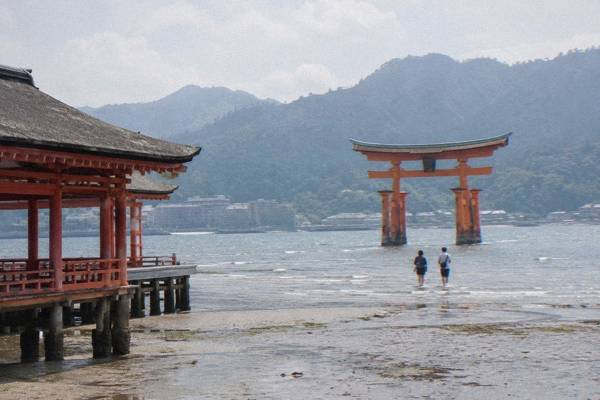
Why Is The Miyajima Torii Gate In The Water?
The Great Torii of Itsukushima Shrine on Miyajima stands in the sea because the shrine was built to venerate the island itself, and the tide turns it from a floating gate to a walkable monument.
The Great Torii of Itsukushima Shrine on Miyajima stands in the water of Hiroshima Bay because the shrine itself was built at the shoreline rather than on the island's ridge, as a gate in the sea marking the approach to a mountain the shrine was created to venerate. The Miyajima Tourist Association's own page for the O-torii records that the current gate, the ninth, was erected in 1875 and stands about 16.6 meters tall.
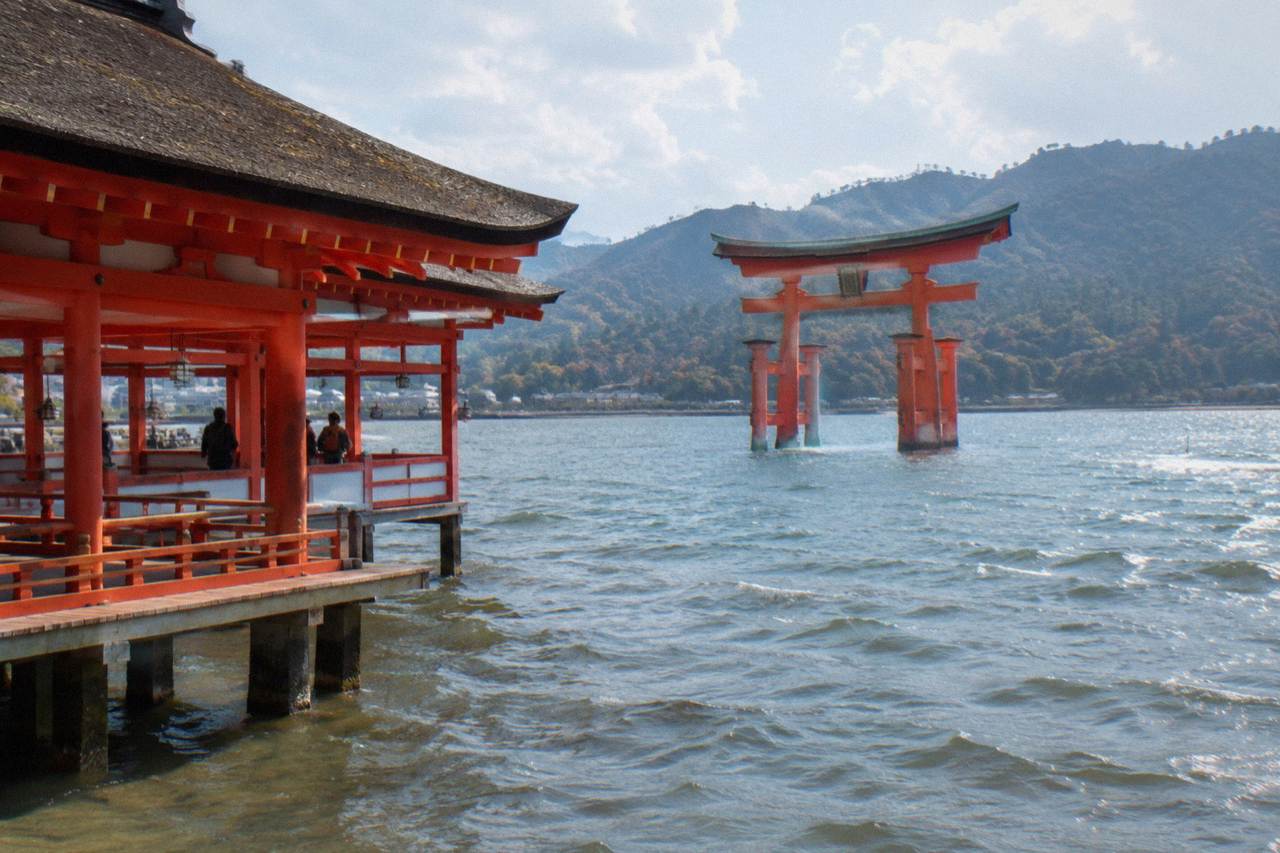
The Miyajima torii gate stands in the water because Itsukushima Shrine treats the whole island of Miyajima as sacred, so the shrine and its gate were built on the shore and in the shallows rather than on the mountain, leaving the deity the island itself untouched. The shrine's own admission page records a founding in 593 and a rebuilding in its present form in 1168 under Taira no Kiyomori.
The Miyajima Tourist Association notes that the shrine complex includes 37 buildings in the main inner shrine and 19 in the outer shrine, many designated national treasures or important cultural properties, with corridors running roughly 260 meters in total at about 4 meters wide.
The gate therefore does something a landlocked torii cannot: it greets arrivals on the water, frames the view of the mountain behind it, and changes character completely as Hiroshima Bay rises and falls. The Japan-stroll guide to the shrine records that the Noh stage at Itsukushima is the only one in Japan built over water, part of the same shoreline-building logic that put the gate in the sea. More on the shrine complex itself is in the Itsukushima Shrine attraction guide.
How Does The Tide Change The Torii View In Hiroshima Bay?
The tide changes everything about the view: the Miyajima Tourist Association's tide page records that the torii appears to float when the tide level exceeds 250 cm referenced to Hiroshima Port, and that visitors can walk across the seabed to its base when the tide falls below about 100 cm. Between those levels the gate stands in shifting shallows.
The floating look and the walk-out look are the same structure about 212.7 meters from the shrine's main worshipping hall, separated only by hours.
| Tide level (Hiroshima Port reference) | What The Torii Looks Like | What You Can Do |
|---|---|---|
| Above about 250 cm | Appears to float on the water | View from the shore or from a boat |
| Roughly 100 cm to 250 cm | Standing in shallow water | View from the shore and the shrine corridors |
| Below about 100 cm | Seabed exposed around the base | Walk out to the pillars, per the Tourist Association's tide page |
The dedicated low tide at Miyajima answer page goes into how the tide tables work. The Great Torii's last major restoration finished in December 2022, and the shrine remains open while separate corridor and pagoda repairs continue, a status covered in Is The Miyajima Torii Gate Still Under Renovation?
What Is The Great Torii Made Of And How Does It Stand Up?
The Great Torii is made primarily of camphor wood, weighs about 60 tons, and stands about 16.6 meters tall on its own weight, resting on a foundation of driven wooden piles rather than being fixed deep into the seabed, according to the Japan-stroll history page. The current structure is the ninth, erected in 1875, and the Miyajima Tourist Association records it as a designated Important Cultural Property since 29 March 1952.
The Japan-stroll history of the gate adds that it is a ryobu-style torii, with four supporting pillars arranged around the two main ones, a six-pillar form chosen for stability in open water. The main pillars are approximately 13.4 meters tall with a circumference of about 9.9 meters, and the crossbeam runs about 24.2 meters long, figures published on the Tourist Association's O-torii page.
| Great Torii figure | Value | Source detail |
|---|---|---|
| Height | About 16.6 meters | Miyajima Tourist Association O-torii page |
| Main pillar height | About 13.4 meters | Miyajima Tourist Association O-torii page |
| Main pillar circumference | About 9.9 meters | Miyajima Tourist Association O-torii page |
| Crossbeam length | About 24.2 meters | Miyajima Tourist Association O-torii page |
| Weight | About 60 tons | Torii history page |
| Current structure | Ninth gate, erected 1875 | Miyajima Tourist Association O-torii page |
| Material | Camphor wood | Japan-stroll torii history page |
The self-weight design is the quiet engineering point: a gate that simply stands heavy on pile foundations can be repaired or renewed generation by generation, which is why the current gate is the ninth rather than the first. The wood has already outlasted well over a century of typhoons and tide cycles in its present form.
The gate's latest major restoration wrapped up in December 2022, according to the shrine's construction notices, and work continues nearby: the East Corridor is being reinforced from April 2024 into December 2026, and the five-story pagoda is under repair into 2027, though the shrine stays open throughout.
Tide shapes any visit. Guides cite about 100 centimeters as the water level below which you can walk out to the base of the pillars, and about 250 centimeters as the point where the gate seems to float. Sightseeing sailings that pass close to the torii run from 9:10 to 16:10, on a crossing of roughly 10 minutes.
Itsukushima Shrine admits adults for 300 yen, high school students for 200 and elementary and junior high students for 100, with a combined ticket that adds the Treasure Hall at 500, 300 and 150 yen. The corridor floorboards carry deliberate gaps that relieve high-tide pressure, so comfortable shoes help. The shrine opens at 6:30 and closes between 17:00 and 18:30 depending on the season.
Can You Walk To The Torii At Low Tide On Miyajima?
Yes, when the tide falls below about 100 cm referenced to Hiroshima Port, the seabed is exposed and the Tourist Association's tide page records that visitors can walk across it to the base of the Great Torii, while Itsukushima Shrine's admission page lists entry at 300 yen for adults, 200 yen for high school students and 100 yen for elementary and junior high students.
The walk-out is the counterpoint to the floating view, and it is entirely tide-dependent: the same gate that stands unreachable over open water at high tide stands at the end of a short wet-sand walk a few hours later. The shrine opens at 6:30 except on 1 January, when it is open from midnight, and closing time runs 18:00 from 1 March to 14 October, 17:30 from 15 October to 30 November and 17:00 in December, per the admission page, so the gate can be seen from the shore outside those hours in any case. A combined ticket for the shrine and the Treasure Hall is 500 yen for adults. Everything else covered here is indexed on Hiroshima Travel Guide.
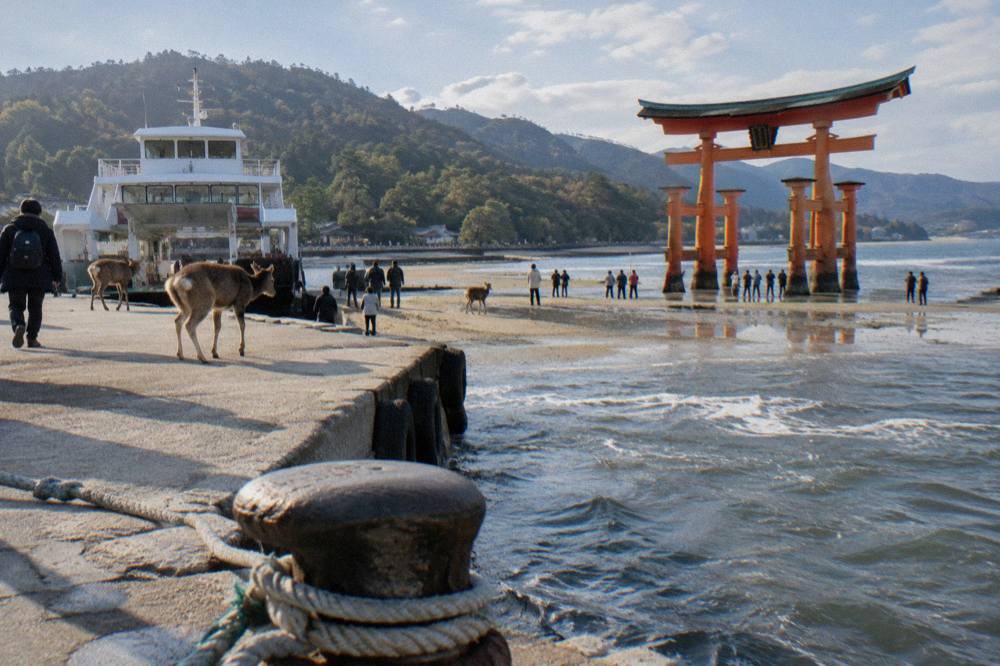
Getting to the island to see either state is straightforward. The JR ferry from Miyajimaguchi takes about 10 minutes, the Japan Rail Pass is valid on it, and a separate Miyajima Visitor Tax of 100 yen is collected with the ferry ticket on entering the island, with preschool children exempt. A guided option is the Miyajima private torii tour, a private walk built around the gate and the shrine. Check availability
Once you step off the ferry, book a rickshaw ride here.
Is The Torii Lit Up At Night Over The Water?
Yes: the Miyajima Tourist Association's illumination page records that the Grand Gate, the main sanctuary, the five-storied pagoda, the Tahoto pagoda and the stone lanterns along Nishi-matsubara are lit every day from about 30 minutes after sunset until 23:00, and the illuminations can be watched from land or from the sea when the tide is high enough to approach the gate.
The last JR ferry leaves Miyajima at 22:14, which keeps the illumination reachable as an evening trip from Hiroshima, though staying over on the island removes the timing pressure entirely, as the Miyajima overnight itinerary sets out. The full illumination detail sits in the Is The Miyajima Torii Gate Lit Up At Night? answer.
Does Standing In Seawater Ever Harm The Miyajima Torii?
Standing in the tide is the condition the gate was built for rather than an accident slowly destroying it: the current camphor-wood structure has stood in Hiroshima Bay since 1875 on its own weight over pile foundations, and the major repair programme recorded by the shrine concerns the buildings, an east corridor reinforcement running to December 2026 and a five-storey pagoda repair to 2027, not the gate.
The gate's own renewal cycle is generational, the ninth since the shrine's shoreline form was established, and the December 2022 finish of the Great Torii restoration is the most recent chapter in that cycle. The shrine stayed open through that work, and it stays open through the current building repairs, with visitor passage through the east corridor not blocked, per the shrine's construction page as reported. The shrine's practical notes also flag that the corridor floorboards carry gaps that let high-tide pressure through, a small reminder that every part of the complex is designed around the water.
The vernacular answer to the original question, then, has two layers: the torii is in the water because the shrine venerates the island and never meant to build on it, and it stays in the water because the tide that surrounds it is exactly what makes it read as a gate between the everyday world and the sacred one, as the Hiroshima Travel Guide's Miyajima pages set out. More on planning around the island's deer, swimming and timing sits in Can You Touch The Deer On Miyajima? and What Is The Best Time To Go To Miyajima?.
Common Questions About The Miyajima Torii Gate
Why Is The Miyajima Torii Gate In The Water?
The shrine treats the island itself as the sacred object, so its halls were built on pilings at the shoreline and the gate was placed in the shallows as the sea approach, leaving the mountain undisturbed. The founding tradition recorded by the shrine dates to 593, with the present shoreline form rebuilt in 1168.
How Tall Is The Great Torii Of Itsukushima Shrine?
The Miyajima Tourist Association's page gives about 16.6 meters in height, with main pillars about 13.4 meters tall and about 9.9 meters around, a crossbeam about 24.2 meters long, and a total weight of about 60 tons in camphor wood.
When Does The Torii Look Like It Is Floating?
The Miyajima Tourist Association's tide page records that the gate appears to float when the tide level exceeds 250 cm referenced to Hiroshima Port, and that the seabed opens for walking to its base when the tide falls below about 100 cm.
Can You Walk Out To The Torii?
Yes, at tide levels below about 100 cm referenced to Hiroshima Port the seabed is exposed and visitors can walk to the pillars, per the Tourist Association's tide page. The state of the gate depends entirely on that day's tide table.
Is The Great Torii Still Being Repaired?
The Great Torii's own restoration finished in December 2022. Ongoing work at the shrine concerns the east corridor, reported to run to December 2026, and the five-storey pagoda, reported to 2027, and the shrine remains open through both.