Naoshima From Hiroshima: Is The Art Island Doable?
Naoshima sits in the Seto Inland Sea about three hours from Hiroshima by train and ferry, and the Benesse art museums on it are among the most distinctive day-trip destinations reachable from the city.
Yes. From Hiroshima Station the Sanyo Shinkansen reaches Okayama in under 50 minutes, the JR Uno Line adds about 50 minutes to Uno Station, and the ferry to Naoshima's Miyanoura Port takes about 20 minutes, so the art island works as a long day trip from Hiroshima.
Naoshima, the art island in the Seto Inland Sea, lies within reach of Hiroshima for a day of underground museums, seaside sculpture and quiet island lanes. This page sets out the legs of that journey, the published admission prices of the Benesse Art Site museums, and how a one-day visit from Hiroshima holds together.
Where Is Naoshima Relative To Hiroshima?
Naoshima sits across the water from the port of Uno in Okayama Prefecture rather than near Hiroshima itself. The island is part of the same island world that fills the sea between Honshu and Shikoku. Other pieces of that world closer to Hiroshima include Miyajima, with Itsukushima Shrine and Mount Misen, and the wider scatter described on the Seto Inland Sea islands overview.
Naoshima's distinction is art: since Benesse House Museum opened in 1992, the Benesse Art Site has placed museums and installations across the island, and the island's ferry ports, shrines and village lanes sit around them. The Hiroshima Travel Guide covers the city end of the trip, including the station you leave from. The island's geography shapes the day more than its size suggests. Knowing that structure before arrival is what separates a calm visit from a rushed one.
What Is The Fastest Route From Hiroshima To Naoshima?
The standard route from Hiroshima is the Sanyo Shinkansen from Hiroshima Station to Okayama Station, then the JR Uno Line from Okayama to Uno Station, then a ferry from Uno Port to Naoshima's Miyanoura Port. The Shinkansen leg takes under 50 minutes, the Uno Line about 50 minutes, and the ferry about 20 minutes as a car ferry or 15 minutes as a passenger boat.
The Uno Line fare is 590 yen one way, and the ferry's adult one-way fare is 370 yen. Shikoku Kisen operates the Uno to Miyanoura route with several departures a day, one example being a departure from Uno at 08:22 arriving at Miyanoura at 08:42. Because the ferry runs to a timetable and the museums run to timed entry, the Shinkansen connection at Okayama is the leg that decides the whole day.
| Leg | Operator or line | Time | Fare |
|---|---|---|---|
| Hiroshima Station to Okayama Station | Sanyo Shinkansen | Under 50 minutes | Not stated here |
| Okayama Station to Uno Station | JR Uno Line | About 50 minutes | 590 yen one way |
| Uno Port to Miyanoura Port | Shikoku Kisen car ferry | About 20 minutes | 370 yen adult one way |
| Uno Port to Miyanoura Port | Shikoku Kisen passenger boat | About 15 minutes | 370 yen adult one way |
The Matsuyama by ferry guide explains the sea links on the Shikoku side of the inland sea, but for a Hiroshima departure the Shikoku approach is the long way round. Okayama and Uno remain the practical corridor.
Okayama's own attractions are covered in the Kurashiki and Okayama day-trip guide, and the corridor north of Naoshima is worth knowing even if you ride straight through. If your interest is the inland sea itself rather than its museums, a guided small-boat cruise out of Onomichi, described on the Onomichi RIB cruise page, puts you on the water between Hiroshima and the island belt, and you can Check availability for a date.
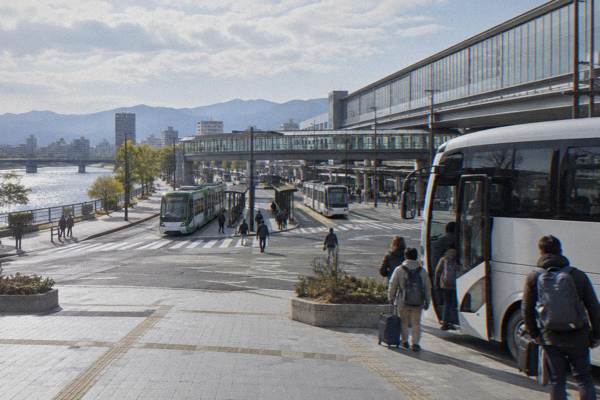
Getting to the point of departure is the first practical question, and Hiroshima makes it an easy one. Since 1 February 2025 the streetcar network has charged a flat fare of 240 yen for adults and 120 yen for children on every line, including the Miyajima line. In August 2025 the streetcars began entering the Hiroshima Station building itself, stopping on its second floor, a change that followed the opening of the new station building in March 2025. Visitors arriving by air have a simple option as well. The airport limousine bus runs to the Shinkansen exit of Hiroshima Station in about 50 minutes, costs 1,500 yen for an adult and 730 yen for a child, and departs from Bus Stop 2, while the same fare buys a roughly 55 minute ride to the Hiroshima Bus Center from Stop 1. IC cards are accepted on the airport buses.
Travelers folding the Naoshima run into a longer rail itinerary should keep the wider Shinkansen picture in mind. The Nozomi covers Shin-Osaka to Hiroshima in roughly 80 to 85 minutes, and Tokyo to Hiroshima in about 3 hours 45 minutes to 4 hours. Anyone weighing a Japan Rail Pass against individual tickets should also note a reported price rise taking effect on 1 October 2026, under which the seven-day ordinary pass would cost 53,000 yen. Because the increase is reported rather than officially confirmed, it pays to check the current price before buying.
Weather deserves a place in the planning, because a Naoshima day mixes boat crossings with long stretches outdoors. The 1991 to 2020 climate normals for Hiroshima show mean monthly temperatures climbing from 9.5 °C in March to 14.8 °C in April, 19.6 °C in May and 23.2 °C in June, with July averaging 27.2 °C and average daily highs around 30.9 C. Rain builds along the same slope, from 118.3 mm in March to 141.0 mm in April, 169.8 mm in May, 226.5 mm in June and 279.8 mm in July. Sunshine favors the shoulder season, with May recording 210.8 hours, April 191.9 hours and March 176.7 hours. January and February are drier than any spring month, at 46.2 mm and 64.0 mm of rain, though means of 5.4 °C and 6.2 °C make for cold crossings, and the two months still average 138.6 and 140.1 hours of sunshine.
What Do Naoshima Museum Tickets Cost?
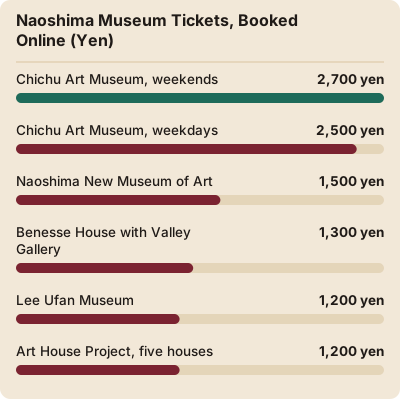
Chichu Art Museum, the island's flagship, charges 2,500 yen online or 2,800 yen on-site on weekdays, and 2,700 yen online or 3,000 yen on-site on weekends and holidays, with children 15 and under free everywhere on the Benesse Art Site. Benesse House Museum is 1,300 or 1,500 yen, Lee Ufan Museum 1,200 or 1,400 yen, the New Museum of Art 1,500 or 1,700 yen, and the five-house Art House Project ticket 1,200 or 1,400 yen.
Every price splits the same way: a lower figure if you buy online in advance, a higher figure at the door. Buying online is not only a saving, it is the mechanism for the timed reservations the popular sites use.
| Facility | Online | On-site | Children 15 and under |
|---|---|---|---|
| Chichu Art Museum, weekdays | 2,500 yen | 2,800 yen | Free |
| Chichu Art Museum, weekends and holidays | 2,700 yen | 3,000 yen | Free |
| Benesse House Museum, with Valley Gallery | 1,300 yen | 1,500 yen | Free |
| Lee Ufan Museum | 1,200 yen | 1,400 yen | Free |
| Naoshima New Museum of Art | 1,500 yen | 1,700 yen | Free |
| Art House Project, five houses | 1,200 yen | 1,400 yen | Free |
Two notes on that table. Benesse House Museum admission is also free for overnight guests of the museum-hotel, and the Art House Project ticket covers all five houses: Kadoya, Go'o Shrine, Ishibashi, Gokaisho and Haisha. The museums sit within a single art-site administration, so the child-free rule applies uniformly across them.
The savings from booking online are small per museum but add up across a full day. Since the reservation system and the cheaper price are the same transaction, there is no reason to pay the on-site rate for a planned itinerary.
Which Naoshima Museums Need Advance Reservations?
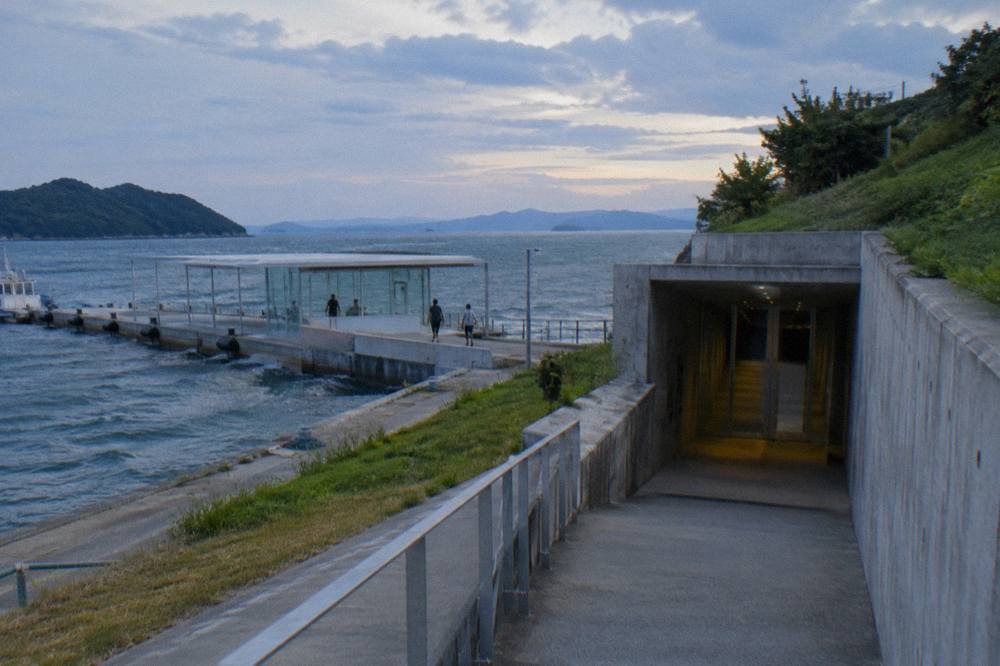
All Benesse Art Site museums on Naoshima use advance online reservations for timed entry, and at popular sites such as Chichu Art Museum walk-up entry may not be available if the day's slots are sold out. Chichu is open 10:00 to 17:00 with last admittance at 16:00, closed Mondays, and the New Museum of Art is open 10:00 to 16:30 with last admittance at 16:00, also closed Mondays.
Beyond that, the island's scheduling quirks are few, with occasional seasonal hour adjustments during holiday weeks rather than long renovations.
| Facility | Hours | Closed | Notes |
|---|---|---|---|
| Chichu Art Museum | 10:00 to 17:00, last entry 16:00 | Mondays | Timed reservations required |
| Naoshima New Museum of Art | 10:00 to 16:30, last entry 16:00 | Mondays | Opened spring 2025 |
| Benesse House Museum | Within the Benesse Art Site schedule | Mondays | Free for overnight guests |
| Art House Project houses | Within the Honmura area schedule | Mondays | Five houses on one ticket |
Reserving before you leave Hiroshima matters more on this trip than on a city museum day. A day trip from Hiroshima arrives on Naoshima with a fixed return ferry chain behind it, and a sold-out Chichu slot cannot be recovered later in the afternoon. The last-admittance times matter too: Chichu stops admitting at 16:00 although it stays open to 17:00, so a late ferry chain can cost the museum even when the building is still open.
What Can You See On Naoshima Beyond The Museum Halls?
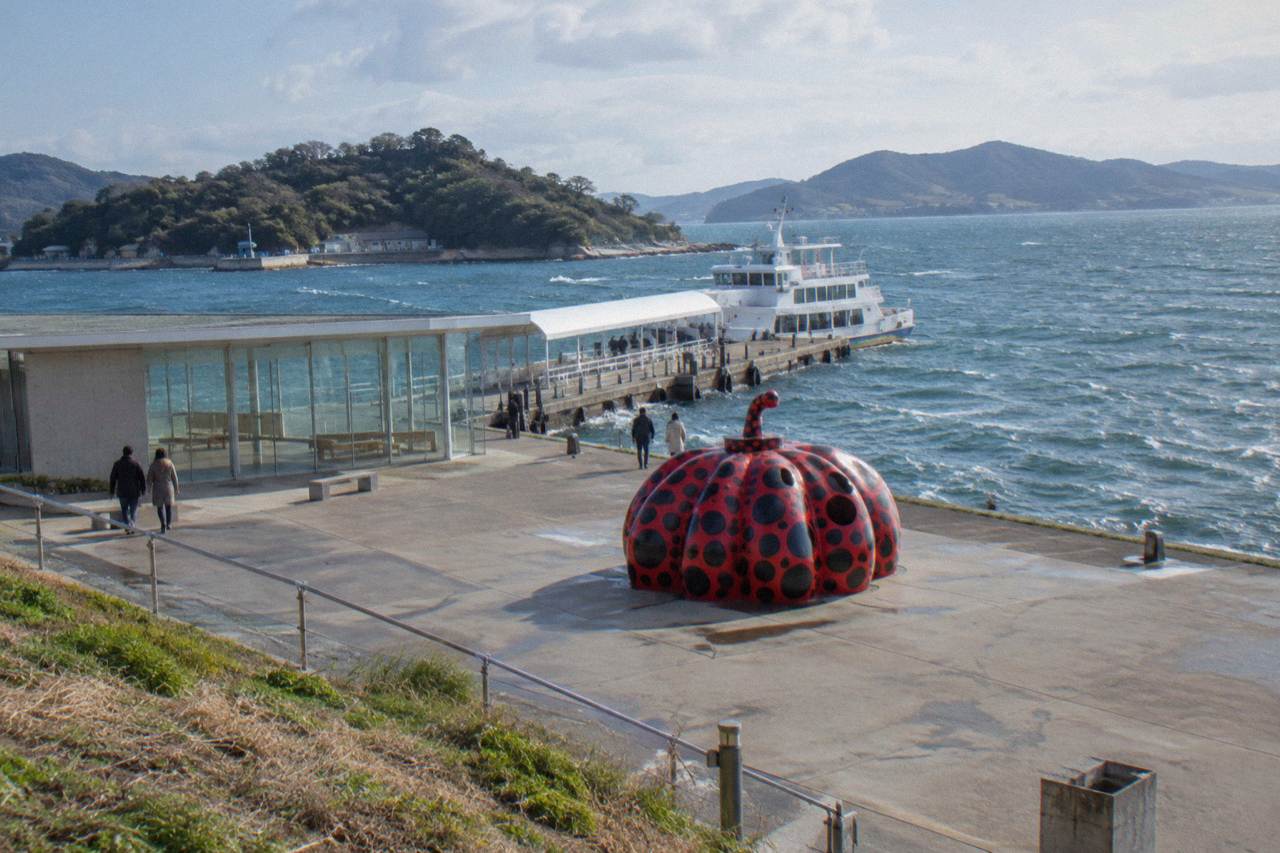
Yayoi Kusama's Red Pumpkin stands at Miyanoura Port as the island's arrival marker, the Art House Project places installations inside five restored houses in Honmura, and Benesse House Museum, opened in 1992, integrates art, architecture and nature as a museum-hotel.
The Red Pumpkin sits where the ferry berths, so it is usually the first and last artwork of the day.
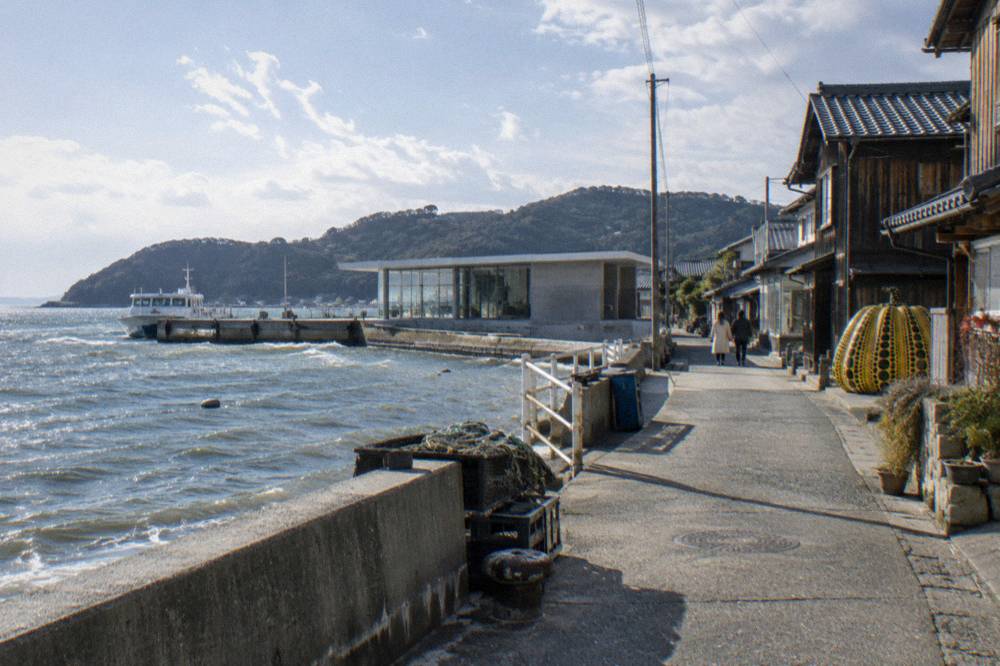
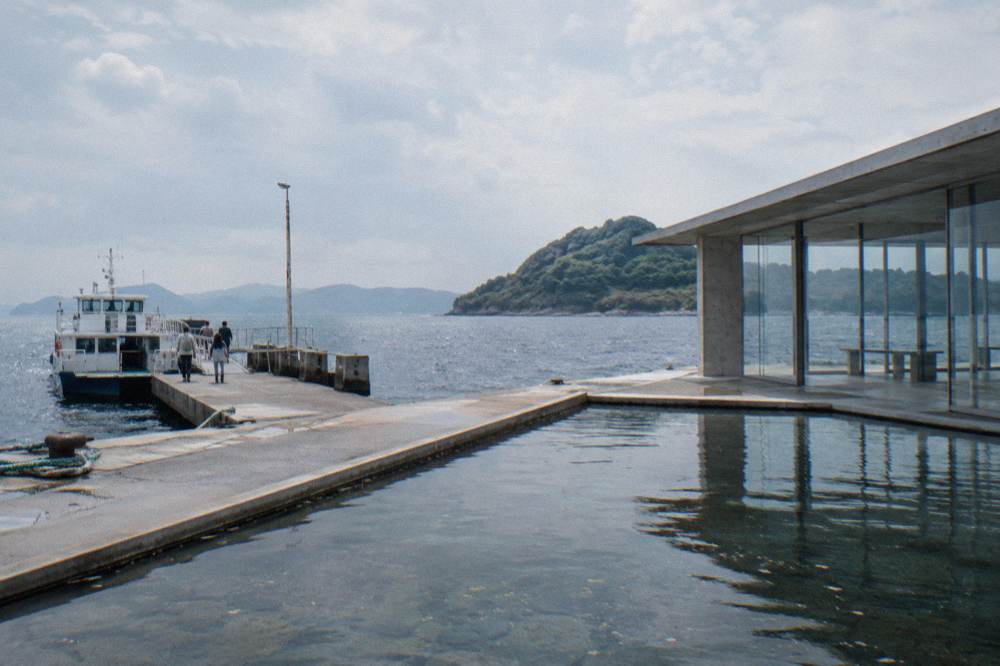
The New Museum of Art, opened in spring 2025, is the newest layer, and its 1,500 yen online ticket extends the day without changing the plan's shape.
How Do You Get Around Naoshima Island Itself?
The Naoshima town bus runs one to three times per hour linking Miyanoura, Honmura and the museum area at a flat fare of 100 yen one way from Miyanoura Ferry Terminal to Tsutsujiso, free shuttle buses then connect Tsutsujiso to Benesse House, Lee Ufan Museum and Chichu Art Museum, and bicycles can be rented at Miyanoura Port, with electric-assist models recommended for the island's hills.
That is the whole system, and it is enough. The town bus covers the island's spine, the free shuttles cover the museum loop, and a bicycle covers everything at your own pace if the hills do not put you off.
| Method | Route or area | Fare | Frequency or note |
|---|---|---|---|
| Town bus | Miyanoura, Honmura, museum area | 100 yen one way to Tsutsujiso, flat | 1 to 3 departures per hour |
| Free shuttle | Tsutsujiso to Benesse House, Lee Ufan, Chichu | Free | Museum-area loop |
| Bicycle rental | From Miyanoura Port | Not stated here | Electric-assist recommended for hills |
| On foot | Miyanoura to Honmura, village lanes | Free | Distances not stated here |
The electric-assist recommendation exists for a reason, and the free shuttle exists to spare you the climb. Budgeting the 100 yen bus fare in coins is worth doing, since the fare is a flat one-way figure rather than a distance-based one.
Can You Do Naoshima From Hiroshima In One Day?
A one-day Naoshima trip from Hiroshima is realistic but full: the journey runs about 2.5 to 3.5 hours each way, and the island itself rewards roughly 6 to 8 hours of visiting. That means an early Shinkansen out of Hiroshima Station, a timed museum reservation for early afternoon, and an evening ferry chain back through Uno and Okayama.
The arithmetic is tight rather than impossible. An 08:22 ferry from Uno, arriving Miyanoura at 08:42, implies a Shinkansen from Hiroshima soon after 06:30, and the return mirrors it with the last ferries and the last Uno Line trains in mind.
| Time of day | Step |
|---|---|
| Early morning | Sanyo Shinkansen, Hiroshima Station to Okayama, under 50 minutes |
| Morning | JR Uno Line to Uno Station, about 50 minutes, 590 yen |
| Morning | Ferry from Uno Port to Miyanoura, about 20 minutes, 370 yen |
| Midday to afternoon | Museums and Honmura, about 6 to 8 hours available on the island |
| Evening | Ferry to Uno, Uno Line to Okayama, Shinkansen to Hiroshima |
Two mitigations exist. One is to shorten the island wish-list to Chichu plus the Red Pumpkin and Honmura. The other is to split the trip with a night on the island or in Okayama, which turns the museum day into something calmer and adds Benesse House's free-for-guests admission to the ledger. The Shimanami Kaido guide covers another slow option that threads the same sea by bicycle.
Everything except the Shinkansen is a small, published, stable number.
Is Naoshima Or Miyajima The Better Hiroshima Island Day Trip?
Miyajima is Hiroshima's own island, a 10-minute JR ferry ride from Miyajimaguchi with Itsukushima Shrine at 300 yen adult admission, while Naoshima is an art destination roughly three hours away in another prefecture. If the day is short, Miyajima wins on geography alone. The Miyajima day-trip guide and the Itsukushima Shrine page cover that crossing in detail, including the tide behaviour of the Great Torii. The cost contrast is just as sharp as the time contrast.
A Miyajima day from Hiroshima needs the Hiroden tram at 240 yen flat and a shrine ticket at 300 yen, against Naoshima's Shinkansen corridor and four-figure museum tickets.
Travellers with two spare days can take both, and the pairing works because they sit at opposite ends of the same body of water. Hiroshima's own things to do overview holds the city-side options for the days between.
What Else Sits Between Hiroshima And Naoshima?
Between Hiroshima and Naoshima the corridor passes through more than two stations, each able to carry half a day: the Onomichi temple town with its 2.5 km temple walk linking 25 Buddhist temples and Cat Alley's lucky stone cats, the Shimanami Kaido cycling route starting from Onomichi, and Kurashiki's canal district near Okayama at the Shinkansen transfer.
Onomichi, with its 2.5 km temple walk linking 25 Buddhist temples, Cat Alley's lucky stone cats and the Mt. Senkoji Ropeway at 700 yen round trip for adults, is covered in the Onomichi day-trip guide. A morning in Onomichi pairs naturally with an afternoon RIB cruise on the same water the Naoshima ferries cross. The ropeway runs from 09:00 to 17:15 with departures about every 15 minutes, and the ride itself lasts about 3 minutes, so the hilltop temple and the waterfront fit inside the same half day.
Kurashiki and Okayama, at the Shinkansen transfer, reward a slower return from Naoshima. A timetable that leaves Naoshima on an earlier ferry turns the last two hours of daylight into a canal walk instead of a station wait. The general things to do in Hiroshima overview remains the index for the city days around the trip, and every destination named here has its own page in the day-trips section.
Common Questions About Naoshima From Hiroshima
Is Naoshima From Hiroshima Doable In A Day?
Yes. The journey runs about 2.5 to 3.5 hours each way, and the island supports about 6 to 8 hours of visiting, so an early start from Hiroshima Station gives a full afternoon of museums before the evening ferry chain back.
How Much Does The Ferry To Naoshima Cost?
The adult one-way fare from Uno Port to Miyanoura is 370 yen, with the crossing taking about 20 minutes by car ferry or 15 minutes by passenger boat. From Takamatsu the ferry is 680 yen and the high-speed boat 1,590 yen.
Do Children Pay For The Naoshima Museums?
Children 15 and under enter every listed Benesse Art Site Naoshima facility free of charge, including Chichu Art Museum, Benesse House Museum, Lee Ufan Museum, the Naoshima New Museum of Art and the Art House Project.
Are The Naoshima Museums Open On Mondays?
No. Plan a Hiroshima-side activity for Mondays.
Can You Reserve Chichu Art Museum On The Day?
All Benesse Art Site museums use advance online reservations for timed entry, and at popular sites such as Chichu walk-up entry may not be available if the day is sold out. Book before leaving Hiroshima.
How Do You Travel Around Naoshima Without A Car?
The town bus runs 1 to 3 times per hour between Miyanoura, Honmura and the museum area at a 100 yen flat fare to Tsutsujiso, free shuttles continue to the south-coast museums, and bicycles rent at Miyanoura Port, with electric-assist recommended for the hills.
The art island answers its own question: with an early Shinkansen, a reserved Chichu slot and the 08:22 ferry in mind, Naoshima from Hiroshima is a long day that lands you back in the city the same night, with prices and timetables that are published, checkable and stable enough to plan around.