Matsuyama By Ferry From Hiroshima
Setonaikai Kisen runs two boat services from Hiroshima Port to Matsuyama across the Seto Inland Sea: a 2 hour 40 minute Cruise Ferry and a 70 minute Linear Jet. Here is what each one costs, how the ports work, and how a day trip fits together.
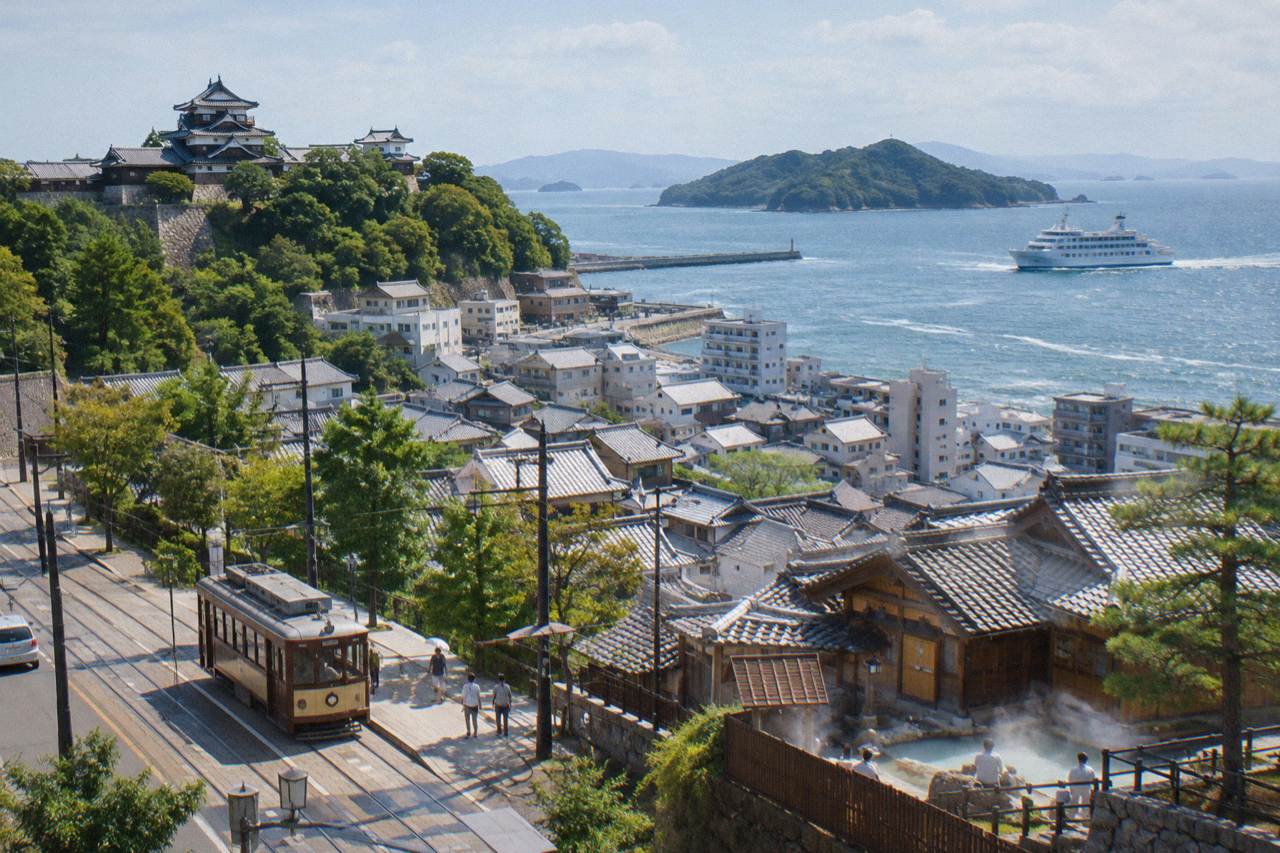
The Hiroshima to Matsuyama ferry is run by Setonaikai Kisen from Hiroshima Port Ujina to Matsuyama Kanko Port. The Cruise Ferry takes about 2 hours 40 minutes and costs 6,000 yen one way for adults; the high-speed Linear Jet takes about 70 minutes and costs 9,000 yen one way.
Hiroshima sits on the north shore of the Seto Inland Sea, and the sea itself is one of the easiest day-trip tools the city has. Setonaikai Kisen operates the Hiroshima to Matsuyama ferry from Hiroshima Port on the Ujina waterfront to Matsuyama Kanko Port on Shikoku, a crossing of 66.2 km through island-studded water. The regular Cruise Ferry takes approximately 2 hours 40 minutes, and a high-speed alternative, the Linear Jet, covers the same route in about 70 minutes.
Read on for the two services, the fares, the ports at both ends, and how the crossing compares with the other island day trips covered on this site, from Miyajima to the wider Seto Inland Sea islands. Everything priced below is in yen, and each figure comes from the operator's own published fare table.
What Is The Hiroshima To Matsuyama Ferry?
The Hiroshima to Matsuyama ferry is a scheduled passenger and vehicle service run by Setonaikai Kisen across the Seto Inland Sea, linking Hiroshima Port Ujina Passenger Terminal in Minami Ward with Matsuyama Kanko Port in Ehime Prefecture. Two services run: the Cruise Ferry, a conventional vessel carrying vehicles and passengers, and the Linear Jet, or Super Jet, a high-speed passenger-only craft. The sea is sheltered by islands along the way.
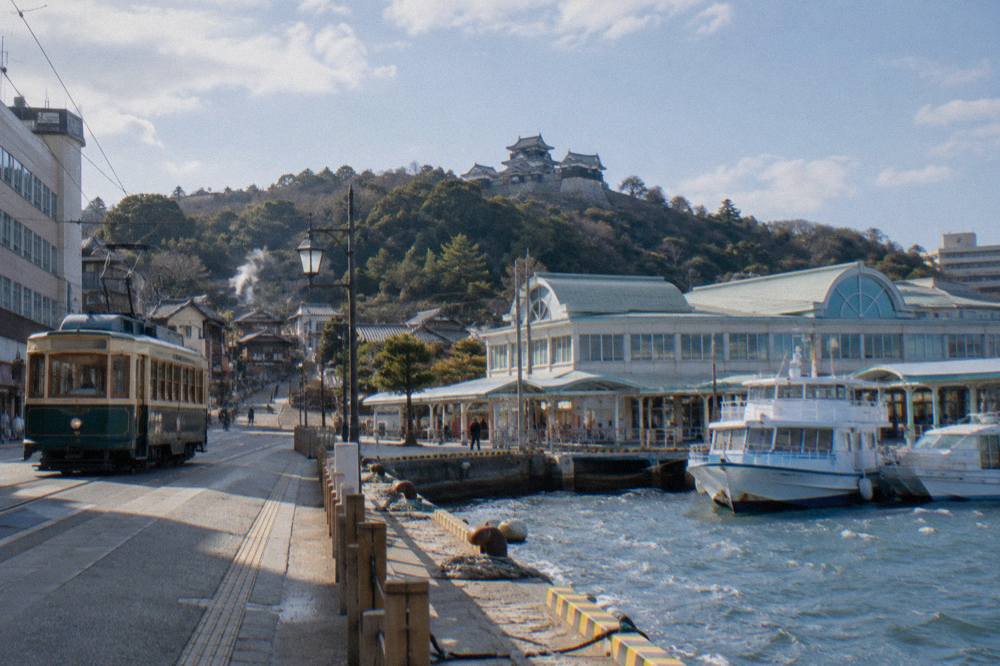
The route passes through the Seto Inland Sea with views of islands along the way, and the Cruise Ferry has outdoor decks for the crossing. The sea between Hiroshima and Shikoku is sheltered by those islands, which is why the crossing works as an ordinary scheduled service rather than an open-sea voyage.
Matsuyama Kanko Port, also called Matsuyama Sightseeing Port, is the terminal on the Ehime side. Its address is 5-2259-1 Takahama Town, Matsuyama City, Ehime Prefecture, and it sits outside the city centre, with limousine bus connections to JR Matsuyama Station or Dogo Onsen taking about 20 to 40 minutes. The port position matters for day-trip planning: the ferry delivers you to the edge of Matsuyama, not to its centre, and the bus leg is part of the total journey time.
Two distinct services run on the route, and they behave differently. The Cruise Ferry is a conventional vessel that carries vehicles as well as passengers. The Linear Jet, a high-speed craft also called the Super Jet, carries passengers only.
How Much Does The Hiroshima To Matsuyama Ferry Cost?
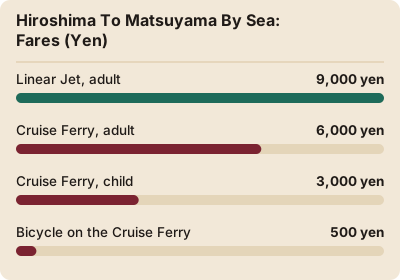
The Cruise Ferry costs 6,000 yen one way per adult and 3,000 yen one way per child of elementary school age, under fares effective after September 1, 2026. The high-speed Linear Jet costs 9,000 yen one way per adult. Bicycles are carried on the Cruise Ferry for 500 yen one way, vehicles from 7,700 yen one way, and the 100 yen Miyajima Visitor Tax has nothing to do with this route.
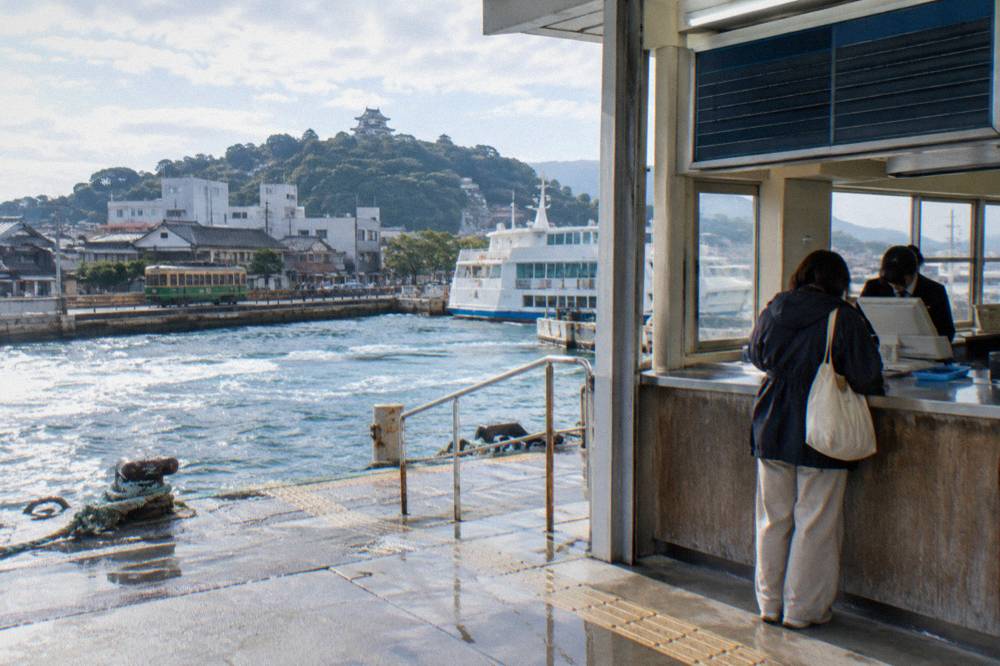
The adult and child fares are the core of a day-trip budget. A round trip on the Cruise Ferry means paying the one-way adult fare twice before anything is spent in Matsuyama, so the Linear Jet premium of 3,000 yen each way buys back roughly three hours of a day. That trade, time against money, is the single biggest decision on this route.
| Ticket | Cruise Ferry, One Way | Notes |
|---|---|---|
| Adult | 6,000 yen | Fares effective after September 1, 2026 |
| Child, elementary school age | 3,000 yen | Same fare table |
| Bicycle | 500 yen | Carried on the Cruise Ferry only |
| Vehicle under 3 m | from 7,700 yen | Post-August 2025 pricing |
| Linear Jet adult | 9,000 yen | Passengers only, about 70 minutes |
The vehicle fare table starts at 7,700 yen for the smallest class, under 3 m in length, and rises with vehicle size. The Cruise Ferry is the only one of the two services that takes vehicles at all, which makes it the only sea option if the trip is part of a driving itinerary.
| Item | Cruise Ferry | Linear Jet |
|---|---|---|
| Crossing time | about 2 hours 40 minutes | about 70 minutes |
| Adult one-way fare | 6,000 yen | 9,000 yen |
| Vehicles carried | yes, from 7,700 yen | no |
| Bicycles carried | yes, 500 yen | no |
| Reservation for foot passenger | not required | not required |
| Deck space | outdoor decks | high-speed craft |
No overseas visitor discount applies to Cruise Ferry fares after March 31, 2025, so the printed fare is the fare.
If a sea crossing and a guided day in the Hiroshima area are both on the list, the guided options below cover the city and Miyajima side while the ferry handles the Matsuyama leg on its own timetable.
Other regional fares put that crossing in perspective. Hiroshima's Hiroden trams charge a flat 240 yen per adult and 120 yen per child on every line, including the Miyajima line, under fares in force since February 2025.
The ten-minute JR ferry to Miyajima sails roughly every fifteen minutes between 8:00 and 18:00, with a first departure around 6:25 and a last around 22:42; groups of eight or more pay 160 yen per adult one way, and the Japan Rail Pass and JR-West Rail Pass are valid. A rival operator, Matsudai Kisen, runs its own boats about every fifteen minutes from 7:00 into the evening. On the island, Itsukushima Shrine costs 300 yen for adults and the ropeway is 2,000 yen round trip.
Cruise Ferry Or Linear Jet: Which Hiroshima To Matsuyama Boat Fits A Day Trip?
The Linear Jet fits a tight day trip better, because its 70-minute crossing against the Cruise Ferry's 2 hours 40 minutes returns about three hours to the day for 3,000 yen more each way. The Cruise Ferry fits better when the crossing itself is part of the plan, when a vehicle or bicycle is coming along, or when the budget matters more than the clock.
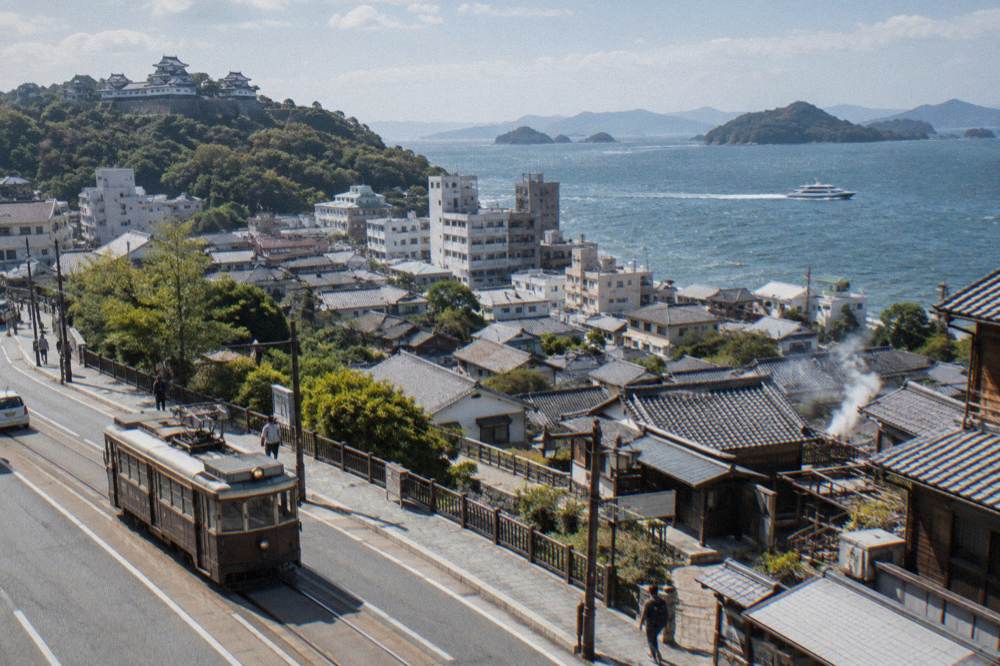
Do the arithmetic plainly. On the Cruise Ferry, a same-day return means roughly 5 hours 20 minutes at sea. On the Linear Jet it means roughly 2 hours 20 minutes. Add the limousine bus at the Matsuyama end, about 20 to 40 minutes to JR Matsuyama Station or Dogo Onsen, and the door-to-door difference between the two services approaches three hours on a day trip. For a traveller with a fixed return sailing, that difference decides how much of Matsuyama is realistically visible.
| Day-Trip Factor | Cruise Ferry | Linear Jet |
|---|---|---|
| Total time at sea, same-day return | about 5 hours 20 minutes | about 2 hours 20 minutes |
| Adult one-way fare | 6,000 yen | 9,000 yen |
| Travels with a rented bicycle | yes | no |
| Travels with a vehicle | yes | no |
| Outdoor deck for island viewing | yes | no |
The bicycle point deserves a pause. The Shimanami Kaido cycling route, covered in the site's Shimanami Kaido guide, is another way across the same sea, and cyclists sometimes stitch sea legs together. The Cruise Ferry's 500 yen bicycle fare makes a Hiroshima-to-Matsuyama leg possible with a bike where the Linear Jet does not. Whether that suits a given itinerary depends on the cycling plan, not on the ferry.
For comfort of a different kind, the Cruise Ferry's outdoor decks and the island views along the 66.2 km route are part of what the fare buys. A crossing that is treated as transport is a Linear Jet trip; a crossing treated as a small cruise through the Seto Inland Sea is a Cruise Ferry trip.
How Do You Reach The Ports At Both Ends?
Hiroshima Port Ujina Passenger Terminal is at 1-13-26 Ujina Coast, Minami Ward, Hiroshima City, and Matsuyama Kanko Port is at 5-2259-1 Takahama Town, Matsuyama City, Ehime Prefecture, with limousine buses to JR Matsuyama Station or Dogo Onsen taking about 20 to 40 minutes. Foot passengers can buy tickets at the port counter up to 20 minutes before departure.
Ujina is south of the city centre, in the Minami Ward waterfront area also covered in the site's guide to Ujina Port. Getting there from central Hiroshima is a local transport question with its own costs, and the tram network described in getting around Hiroshima is the everyday answer for reaching the port district. Building in the time to reach Ujina is part of the day's arithmetic: the ferry clock starts at the port, not at the hotel door.
On the Matsuyama side, the port is outside the city centre, and the limousine bus is the stated connection. The 20 to 40 minute range to JR Matsuyama Station or Dogo Onsen covers the transfer in both directions, so a day plan should carry that number twice, once out and once back. A tight return sailing with no margin for the bus is the classic way a Matsuyama day trip goes wrong, so the return ferry time should be chosen with the bus leg already inside it. Other pages covering the same trip are gathered on Hiroshima Travel Guide.
Ticketing is simple for foot passengers. No reservation is needed, and tickets can be purchased at the port counter at least 20 minutes before departure.
| Leg | Time | Fare Basis |
|---|---|---|
| Central Hiroshima to Hiroshima Port Ujina | local transport, see city guides | Hiroden flat fare 240 yen adult |
| Cruise Ferry crossing | about 2 hours 40 minutes | 6,000 yen adult |
| Linear Jet crossing | about 70 minutes | 9,000 yen adult |
| Matsuyama Kanko Port to JR Matsuyama Station or Dogo Onsen | about 20 to 40 minutes by limousine bus | bus fare paid separately |
When Does The Hiroshima To Matsuyama Ferry Run, And Does It Ever Change?
The Cruise Ferry runs to a regular schedule, but between December 1 and December 25, 2026, weekdays operate on a reduced schedule with specific sailings suspended, while October and November 2026 keep the regular schedule. Foot passengers need no reservation at any time of year, and tickets are sold at the counter up to 20 minutes before departure.
The December reduction is the concrete example of why a scheduled sea service should be checked for the travel date rather than assumed. A winter weekday trip inside that window can meet a suspended sailing, and the knock-on effect on a fixed day plan is severe when each crossing is 2 hours 40 minutes. The regular schedule in October and November 2026 shows the other side of the picture: for most of the autumn the route runs as published.
| Period | Cruise Ferry Schedule |
|---|---|
| October to November 2026 | regular schedule applies |
| December 1 to 25, 2026, weekdays | reduced, specific sailings suspended |
| Fares in force | effective after September 1, 2026 |
| Vehicle fares in force | effective after August 2025 |
| Overseas visitor discount | none after March 31, 2025 |
Beyond the calendar, weather is the standing variable on any sea route. The Kintaikyo Bridge in Iwakuni, another Seto Inland Sea day trip covered in the site's Iwakuni guide, may close during high water, heavy rains or strong winds, and the same logic of weather-driven change applies to ferries even though the operator's own suspension rules are a matter for its notices. The practical habit is to check the sailing for the specific date, and to hold the return crossing loosely in a day plan.
What Can You Do In Matsuyama On A Ferry Day Trip?
The ferry's limousine buses run to JR Matsuyama Station and Dogo Onsen in about 20 to 40 minutes, which puts the city's downtown and its famous hot spring district within reach of a day trip built around the sailing times. The Cruise Ferry returns about five and a half hours of the day to the sea, the Linear Jet about two and a third, and that difference sets how much of the city is realistic.
The shape of a Linear Jet day is generous: out early, a full day around Matsuyama Station and Dogo Onsen, back on an evening boat, with the crossing short enough that the sea is a minor character. The shape of a Cruise Ferry day is different: the crossing is a destination in its own right, with outdoor decks and the island scenery of the Seto Inland Sea across 66.2 km, and the hours in Matsuyama itself are fewer. Neither shape is wrong, they are different trips.
For a taste of the same sea closer to Hiroshima, the island day trips on this site, from Onomichi to Kure and Tomonoura, sit on the same water without a long crossing. Matsuyama is the option that commits a day to open passage and comes back with the feeling of having reached a second island of Japan.
Is The Ferry The Best Way To See The Seto Inland Sea From Hiroshima?
The Hiroshima to Matsuyama ferry is a scheduled sea crossing from the city at 66.2 km, and it is the right choice when Matsuyama or Shikoku is the goal, but it is not the only way onto the water: the Seto Inland Sea islands, Onomichi, Kure, Tomonoura and the Shimanami Kaido all sit on the same sea with shorter hops, and the Setouchi Area Pass may tie several of them together.
Think of the sea as a menu rather than a single route.
For travellers whose main base is Hiroshima and whose time is short, a guided day covering the two UNESCO sites in the city and on Miyajima is the efficient first move, with the ferry saved for a second trip or a transfer day toward Kyushu or Shikoku. The related tour below covers that combination, and its live listing carries current times and prices.
For the ferry itself, the summary is short. Cruise Ferry, 6,000 yen one way per adult, about 2 hours 40 minutes, vehicles and bicycles aboard. Linear Jet, 9,000 yen one way, about 70 minutes, passengers only. Tickets at the counter, 20 minutes before departure, no reservation needed as a foot passenger, and a schedule worth checking for the specific travel date, as the December 2026 weekday reductions show. Check availability for the guided Hiroshima and Miyajima day that pairs with it, and let the boat handle the rest.
Common Questions About The Hiroshima To Matsuyama Ferry
How Long Is The Hiroshima To Matsuyama Ferry?
The Cruise Ferry from Hiroshima Port to Matsuyama Kanko Port takes approximately 2 hours 40 minutes over a distance of 66.2 km. The high-speed Linear Jet covers the same route in about 70 minutes.
How Much Does The Hiroshima To Matsuyama Ferry Cost?
Under fares effective after September 1, 2026, the Cruise Ferry one-way adult fare is 6,000 yen, with elementary school age children at 3,000 yen. The Linear Jet adult fare is 9,000 yen one way. Bicycles are 500 yen one way and vehicles from 7,700 yen one way on the Cruise Ferry.
Do I Need To Book The Hiroshima To Matsuyama Ferry In Advance?
Foot passengers do not require reservations and can purchase tickets at the port counter at least 20 minutes before departure. No overseas visitor discount applies to Cruise Ferry fares after March 31, 2025.
Where Do The Hiroshima To Matsuyama Ferries Leave From?
The Hiroshima terminal is Ujina Passenger Terminal at 1-13-26 Ujina Coast, Minami Ward, Hiroshima City. The Matsuyama terminal is Matsuyama Kanko Port at 5-2259-1 Takahama Town, Matsuyama City, Ehime Prefecture, with limousine buses to JR Matsuyama Station or Dogo Onsen taking about 20 to 40 minutes.
Can You Take A Car On The Hiroshima To Matsuyama Ferry?
Yes, on the Cruise Ferry, which carries vehicles from 7,700 yen one way for vehicles under 3 m in length, under pricing effective after August 2025. The Linear Jet does not carry vehicles.
Is The Hiroshima To Matsuyama Ferry Covered By The Japan Rail Pass?
Japan Rail Pass coverage for this Matsuyama route should be confirmed before travel.
The crossing from Hiroshima to Matsuyama is a short sea journey, and with fares, ports and sailing behaviour held in one place, it is a day trip that can be planned with confidence.