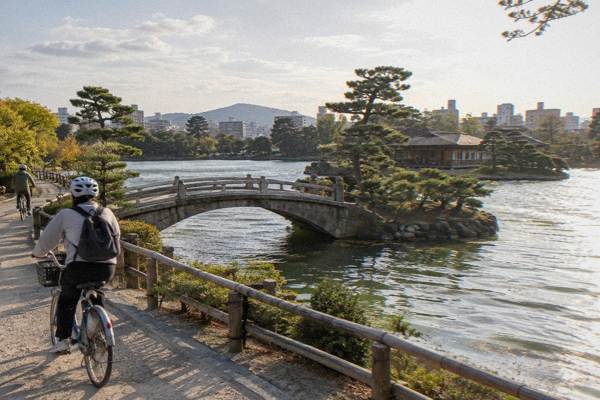
Onomichi: Temple Walk, Cat Alley And The Ropeway
Onomichi packs a 2.5 km temple walk, a cat-themed alley and a hilltop ropeway into a compact day trip.
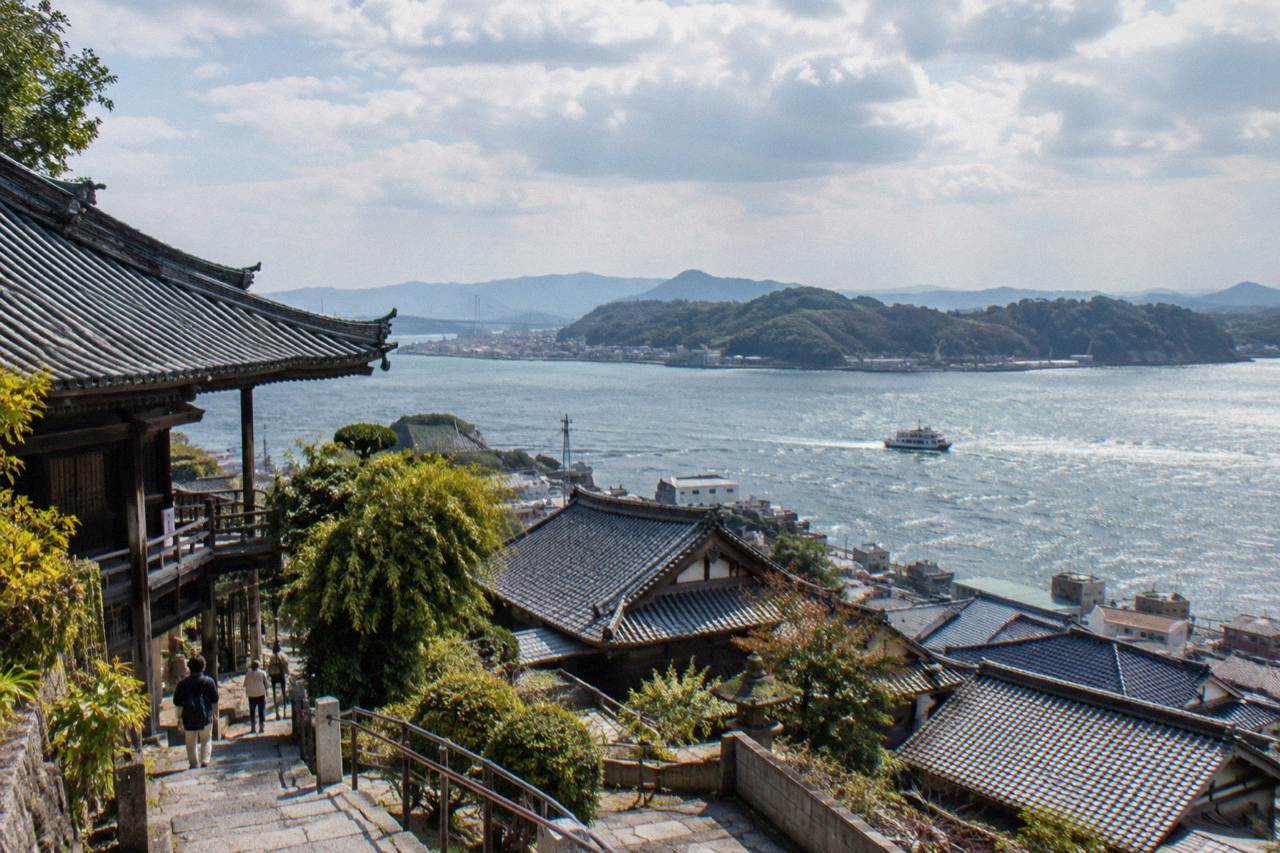
Onomichi is a coastal town in Hiroshima Prefecture reached from Hiroshima by train along the Sanyo line, known for its Temple Walk linking 25 Buddhist temples, Cat Alley and the Mt. Senkoji Ropeway, which costs 700 yen round trip for adults.
The town's core appeal for a Hiroshima-based visitor is compact: a linked route of 25 Buddhist temples, a narrow lane decorated with stone cats, and a ropeway that lifts you to a vermilion hall above the Onomichi Channel. Everything sits within walking distance of JR Onomichi Station, and the town also serves as the western starting point of the Shimanami Kaido cycling road, covered in the Shimanami Kaido cycling guide.
What Is Onomichi And Why Do Hiroshima Visitors Go There?
Onomichi is a hillside port town east of Hiroshima where houses, temples and shrines climb the slope directly behind the station. Visitors come for its 2.5 km Temple Walk linking 25 Buddhist temples, the stone-cat art lane called Cat Alley, and the Mt. Senkoji Ropeway, which carries visitors up to Senkoji Temple in about three minutes. The town is also the western terminus of the Shimanami Kaido, Japan's first bicycle road to cross a sea strait. The town is also the western terminus of the Shimanami Kaido, Japan's first bicycle road to cross a sea strait.
The town's geography does most of the work. Houses, temples and shrines climb a narrow band of hillside directly behind the station, so a single uphill walk delivers sea views, temple grounds and a downhill lane back to the port. Senkoji Temple sits near the top of that slope, and the ropeway serves it. According to the town's visitor information, the lower ropeway station stands about 15 minutes on foot from JR Onomichi Station, or 5 minutes by an eastbound bus to the Nagaeguchi stop.
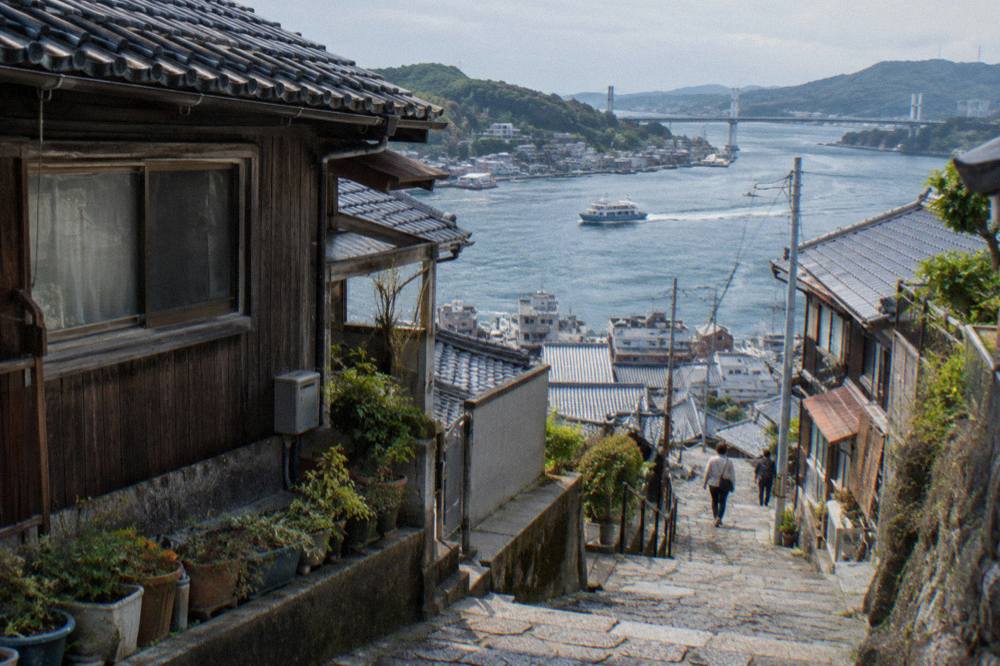
Onomichi also works as a base for wider Inland Sea travel. The same coastline leads west toward Hiroshima city and east toward Fukuyama, with other island and port destinations described in the Seto Inland Sea islands overview and the port town of Tomonoura.
To see the Seto Inland Sea from the water, book an Onomichi cruise here.
| Feature | Figure | Source basis |
|---|---|---|
| Temple Walk route | 2.5 km, 25 temples | Route description |
| Ropeway ride length | About 3 minutes | Operator description |
| Cat Alley path | About 200 meters | Lane description |
| Ropeway lower station walk from JR station | About 15 minutes | Visitor information |
| Senkoji Temple founding | 806 AD | Temple history |
| Red Hall main hall built | 1686 | Temple history |
How Much Does The Mt. Senkoji Ropeway Cost In Onomichi?
The Mt. Senkoji Ropeway charges adults 500 yen one way and 700 yen round trip, with children over 6 paying 250 yen one way and 350 yen round trip, and one child under 6 rides free per adult, per the ropeway's own fare page, which also grants a 50 percent reduction to disability certificate holders and their attendants. The ropeway runs daily from 09:00 to 17:15 with departures approximately every 15 minutes.
The fare table in full:
| Passenger | One way | Round trip |
|---|---|---|
| Adult | 500 yen | 700 yen |
| Child over 6 | 250 yen | 350 yen |
| Child under 6 | Free, one per adult | Free, one per adult |
| Disability certificate holder and attendant | 50% reduction | 50% reduction |
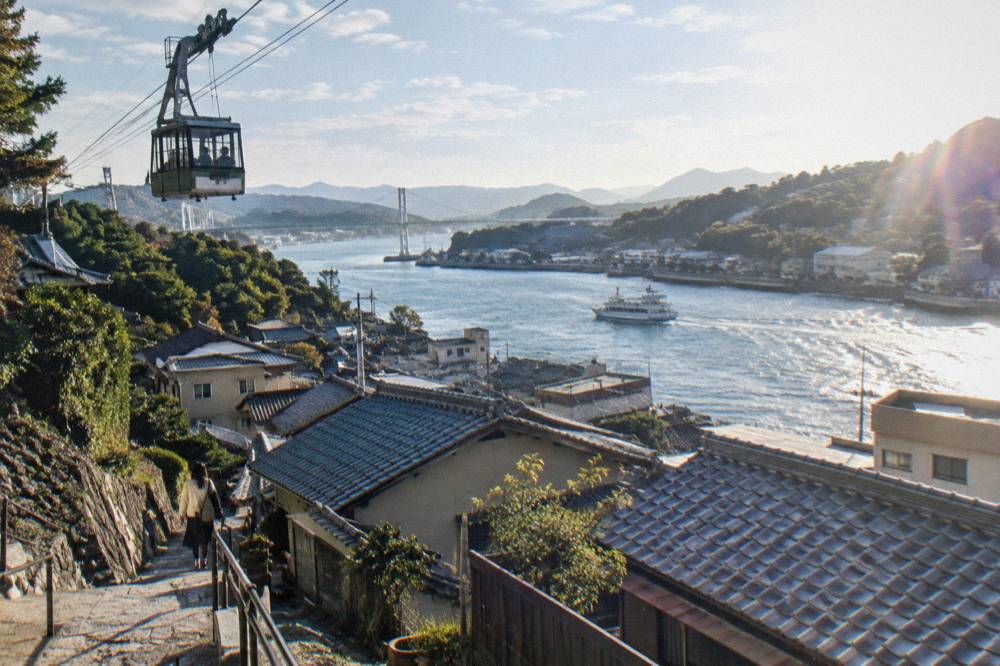
The ride itself lasts about three minutes and passes over the Onomichi Channel and the camphor trees of Ushitora Shrine, per the operator's description of the route. The ropeway operates every day but may suspend service for stormy weather or inspections. Because it stops at the top of the hill, the practical pattern is simple: ride up, visit Senkoji Temple, then walk down through the Temple Walk and Cat Alley rather than paying for a return leg.
The one-way option deserves a second look at the fare table. A walker who rides up at 500 yen and descends on foot saves 200 yen against the round-trip ticket and, more usefully, turns the ropeway into the opening act of the temple loop rather than a there-and-back ride. The every-15-minute departure pattern also means a missed cabin is a short wait, not a schedule problem.
What Does The Onomichi Temple Walk Actually Include?
The Onomichi Temple Walk is a 2.5 km walking route that connects 25 Buddhist temples, beginning near the north side of JR Onomichi Station and climbing into the hillside temple quarter until it reaches the Senkoji area near the top. Most temple grounds are free to enter, though some inner halls and treasure houses charge 200 to 500 yen.
The route's structure explains its popularity as a half-day activity. It starts in the town, threads uphill past temple gates and residential lanes, reaches the Senkoji area near the top, and can be combined with a ropeway ascent so the walking is mostly downhill. Senkoji Temple itself was founded in 806 AD by Kobo Daishi and restored in the mid-Heian period by Tada Mitsunaka; its vermilion main hall, the Red Hall, was built in 1686. The temple grounds and main areas are generally accessible from 09:00 to 17:00.
A short breakdown of the walking elements:
| Element | Detail |
|---|---|
| Route start | Near the north side of JR Onomichi Station |
| Route length | 2.5 km |
| Temples connected | 25 |
| Typical time | 2 to 4 hours steady pace, up to a full day with stops |
| Grounds entry | Mostly free |
| Inner halls and treasure houses | Some charge 200 to 500 yen |
For visitors who prefer structure over self-guided walking, the site's featured Hiroshima and Miyajima island private guided tour offers a licensed-guide alternative, and you can Check availability alongside the internal tour page. Onomichi itself has no equivalent guided walk in the site's roster, so a self-guided Temple Walk remains the standard approach here.
What Is Cat Alley In Onomichi?
Cat Alley, Neko no Hosomichi, is a roughly 200-meter narrow pedestrian path in Onomichi decorated with Fukuishi-neko lucky stone cat art installed from 1998 onward by the local artist Shunji Sonoyama, and it sits next to the ropeway's lower station and the Ushitora Shrine entrance, free to access as an outdoor public space. It is the natural final stretch of a downhill walk from Senkoji Temple back toward the station.
The lane's cat connection is deliberate rather than incidental. Because it is a public outdoor path rather than a ticketed attraction, there is no admission, no closing time and no fee of any kind, which makes it one of the zero-cost highlights of any eastern Hiroshima Prefecture day trip.
Its position matters for route planning. Since the alley adjoins the ropeway's Sanroku Station, a visitor who rides up, walks the Temple Walk downhill and finishes through Cat Alley covers all three of Onomichi's headline features in one continuous loop without backtracking. The alley's 24-hour access as a public space also means it costs nothing to revisit in the evening after a late arrival or an early dinner near the station, though the ropeway and temple grounds keep their own daytime hours.
Is Onomichi Worth Visiting?
Onomichi is worth visiting for travelers who want a compact, walkable old town within Hiroshima Prefecture, because it combines a 2.5 km route of 25 temples, a free 200-meter cat art alley and a 700 yen round-trip ropeway with sea views over the Onomichi Channel, all reachable on foot from JR Onomichi Station in a single half day. It suits a slow-paced day trip better than a tightly scheduled one.
The honest case against is equally clear. The town is small, the main loop is short once the ropeway replaces the climb, and a visitor focused on Hiroshima city's Peace Memorial Park, the A-Bomb Dome and Miyajima may find a full Onomichi day redundant if their time is limited to two or three days. The Hiroshima in 3 days itinerary shows how tight that competition can be.
A middle path exists too: keep the first day for Hiroshima city, the second for Miyajima, and give Onomichi the morning of day three before an afternoon ride along the first Shimanami bridges.
Can You Start A Shimanami Kaido Cycle Ride From Onomichi?
Yes, Onomichi is the official western terminus of the Shimanami Kaido, a cycling road of about 70 km crossing six islands and seven bridges from Onomichi Port to Imabari Port, and the Onomichi Station rental terminal opens 8:00 to 19:00 from March to November and 8:00 to 18:00 from December to February, renting adult cross bikes and city cycles at 3,000 yen per calendar day with drop-off at any of 10 terminals. Helmets are mandatory and provided free with every rental.
The rental ladder in detail:
| Bike type | Adult price per calendar day | Where available |
|---|---|---|
| Cross bike or city cycle | 3,000 yen | All 10 terminals |
| Battery-assisted bicycle | 4,000 yen | Select terminals incl. Onomichi Station, Setoda, Omishima, Imabari |
| E-bike | 8,000 yen | Onomichi Station, Imabari Itoyama, Imabari Station |
| Child 12 and under (cross/city) | 1,000 yen | All 10 terminals |
The full one-way route takes around 6 to 10 hours of steady cycling on a standard bike, with 2 to 3 days recommended for sightseeing, and reservations for rental bikes are highly recommended in spring, autumn, Golden Week and Obon, though walk-up rental is possible on a first-come basis. Island terminals such as Mukaishima, Innoshima, Setoda and Omishima operate 9:00 to 17:00 year-round. The full route, terminals and return logistics have their own page in the Shimanami Kaido guide, and the sister-road agreement with Taiwan's Sun Moon Lake Cycling Course signed on 25 October 2014 is marked by a monument along the way.
For a rider who does not want to commit to 70 km, Onomichi still works as a taste: rent at the station terminal, cross the first bridge and return, then spend the afternoon on the Temple Walk. The bike and the temple routes share the same starting point at the station. Riders who finish at the Imabari end have a documented return option: the Shimanami Liner highway bus connects Imabari to Fukuyama in about 1.5 hours for about 2,800 yen, from where local trains run back west along the coast.
The calendar matters nearly as much as the bike. Japan Meteorological Agency climate normals for Hiroshima, covering 1991 to 2020, show March averaging 9.5 degrees Celsius with 118.3 mm of rain, April 14.8 degrees with 141.0 mm, and May 19.6 degrees with 169.8 mm, while monthly sunshine climbs from 176.7 hours in March to 210.8 hours in May. June stays warm at an average of 23.2 degrees but collects 226.5 mm of rain, and July brings 279.8 mm along with an average of 27.2 degrees and typical highs near 30.9 degrees. Winter riding sees far less rain: January averages 5.4 degrees with just 46.2 mm, and February 6.2 degrees with 64.0 mm.
Visitors in Hiroshima on 6 August can attend the Peace Memorial Ceremony, which runs 8:00 to 8:50 in Peace Memorial Park and offers about 7,000 seats plus roughly 2,200 indoor seats at the International Conference Center. For a rest day off the bike, the Peace Memorial Museum keeps hours to match the seasons. Doors open at 7:30 and close at 19:00 from March through July and September through November, at 20:00 in August and as late as 21:00 on 5 and 6 August, and at 18:00 from December through February. Admission runs 200 yen for college students and other adults, 100 yen for high school students and for visitors 65 and older with a passport, and is free for junior high school students and younger. Entry in the early 7:30 to 8:30 slot and in the evening slots requires an online reservation. Closures fall on 30 and 31 December and in mid-February for an exhibit change.
How Much Does A Day In Onomichi Cost?
A day in Onomichi costs very little by Japanese sightseeing standards: the ropeway is 700 yen round trip for an adult, the Temple Walk grounds are mostly free with some inner halls at 200 to 500 yen, and Cat Alley is free, so a walker who takes the ropeway up and walks down spends only the 500 yen one-way fare plus whatever charged halls they enter. The town's paid attractions are few and individually cheap.
A realistic cost sheet for one adult:
| Item | Cost |
|---|---|
| Mt. Senkoji Ropeway, adult round trip | 700 yen |
| Mt. Senkoji Ropeway, adult one way | 500 yen |
| Temple Walk grounds | Mostly free |
| Temple inner halls and treasure houses | 200 to 500 yen each where charged |
| Cat Alley | Free |
| Shimanami cross bike rental, adult per day | 3,000 yen |
The comparison with Hiroshima city's own anchor sites is simple: the Peace Memorial Museum charges adults 200 yen, Itsukushima Shrine on Miyajima charges 300 yen, and the Mount Misen ropeway costs 2,000 yen return. Onomichi's ropeway at 700 yen round trip sits well below the Misen fare while serving a similar hilltop-and-view function.
When Should You Visit Onomichi From Hiroshima?
The Japan Meteorological Agency station normals for Hiroshima, 1991 to 2020, show dry and mild walking conditions in the cooler half of the year, with January averaging 46.2 mm of rain and highs of 9.9 °C, March 118.3 mm with highs of 14.5 °C, and November 69.3 mm with highs of 17.7 C. The Temple Walk is an outdoor hillside route, so rain matters more than temperature.
Monthly normals for the wider Hiroshima area, from Japan Meteorological Agency station data for 1991 to 2020:
| Month | Mean high °C | Mean low °C | Rain mm |
|---|---|---|---|
| Jan | 9.9 | 2.0 | 46.2 |
| Feb | 10.9 | 2.4 | 64.0 |
| Mar | 14.5 | 5.1 | 118.3 |
| Apr | 19.8 | 10.1 | 141.0 |
| May | 24.4 | 15.1 | 169.8 |
| Jun | 27.2 | 19.8 | 226.5 |
| Jul | 30.9 | 24.1 | 279.8 |
| Aug | 32.8 | 25.1 | 131.4 |
| Sep | 29.1 | 21.1 | 162.7 |
| Oct | 23.7 | 14.9 | 109.2 |
| Nov | 17.7 | 8.9 | 69.3 |
| Dec | 12.1 | 4.0 | 54.0 |
July has the highest monthly rain total at 279.8 mm and January the lowest at 46.2 mm. August has the highest mean daily high at 32.8 °C, which matters for a walk that climbs a hillside even when the ropeway handles the main ascent.
The ropeway may suspend runs in stormy weather, so a wet-season visit should treat the cable car as conditional and the downhill Temple Walk as the reliable spine of the day. Cyclists face the same calendar from the rental side: the Onomichi Station terminal shortens its hours to 8:00 to 18:00 from December to February, and spring, autumn, Golden Week and Obon are exactly the periods when rental reservations are highly recommended rather than optional.
How Does Onomichi Fit A Wider Hiroshima Itinerary?
Onomichi fits a Hiroshima itinerary as a full-day outing in the east of the prefecture, usually standing alone or paired with the Shimanami Kaido, because its station, temple hill and ropeway fill a half day and the cycling road can fill the rest, while travelers anchored on the Peace Park, Miyajima and the city's own districts will find it competes for time rather than complementing it. It belongs in the second or third day of a multi-day stay.
Miyajima, with Itsukushima Shrine and Mount Misen, sits in the opposite direction and is covered in full in the Miyajima day trip guide.
For travelers weighing a guided product against a self-guided eastern day, the Hiroshima Travel Guide covers the full range of tours, and the private island tour featured above also pairs Hiroshima and Miyajima in a single organized day if Onomichi ends up reserved for a later trip.
Common Questions About Onomichi
Is Onomichi Worth Visiting?
Yes, if a compact hillside temple town appeals. Onomichi combines a 2.5 km route linking 25 Buddhist temples, the free Cat Alley and a 700 yen round-trip ropeway with channel views, all walkable from JR Onomichi Station. It is a half-day town at heart, best for travelers with three or more days in the Hiroshima area.
How Long Does The Onomichi Temple Walk Take?
The 2.5 km route can stretch to a full day with stops at each of the 25 temples. Riding the ropeway up and walking downhill shortens the effort but not the sight count.
Is Cat Alley Free?
Yes. Cat Alley is an outdoor public space about 200 meters long, free to access and open around the clock. It sits next to the ropeway's Sanroku Station and the Ushitora Shrine entrance.
How Much Is The Mt. Senkoji Ropeway?
Adults pay 500 yen one way or 700 yen round trip. Children over 6 pay 250 yen one way or 350 yen round trip, one child under 6 travels free per adult, and disability certificate holders with attendants receive a 50 percent reduction.
Can You Rent Bicycles In Onomichi?
Yes. The Onomichi Station rental terminal rents adult cross bikes and city cycles at 3,000 yen per calendar day, battery-assisted bicycles at 4,000 yen and e-bikes at 8,000 yen, with drop-off permitted at any of the 10 Shimanami terminals. Helmets are mandatory and provided free.
When Was Senkoji Temple Founded?
Senkoji Temple was founded in 806 AD by Kobo Daishi and restored in the mid-Heian period by Tada Mitsunaka. Its vermilion main hall, the Red Hall, dates from 1686.
Onomichi rewards a slow loop: up by ropeway, across the temple hill, and down through Cat Alley to the station, with the sea on one side the whole way.