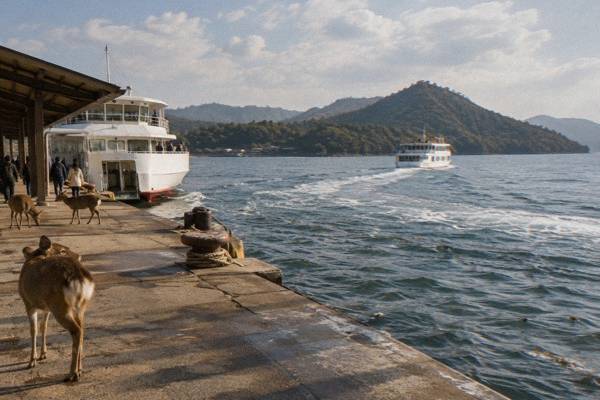
Seto Inland Sea Islands You Can Reach From Hiroshima
A string of islands sits within a short ferry ride of the city.
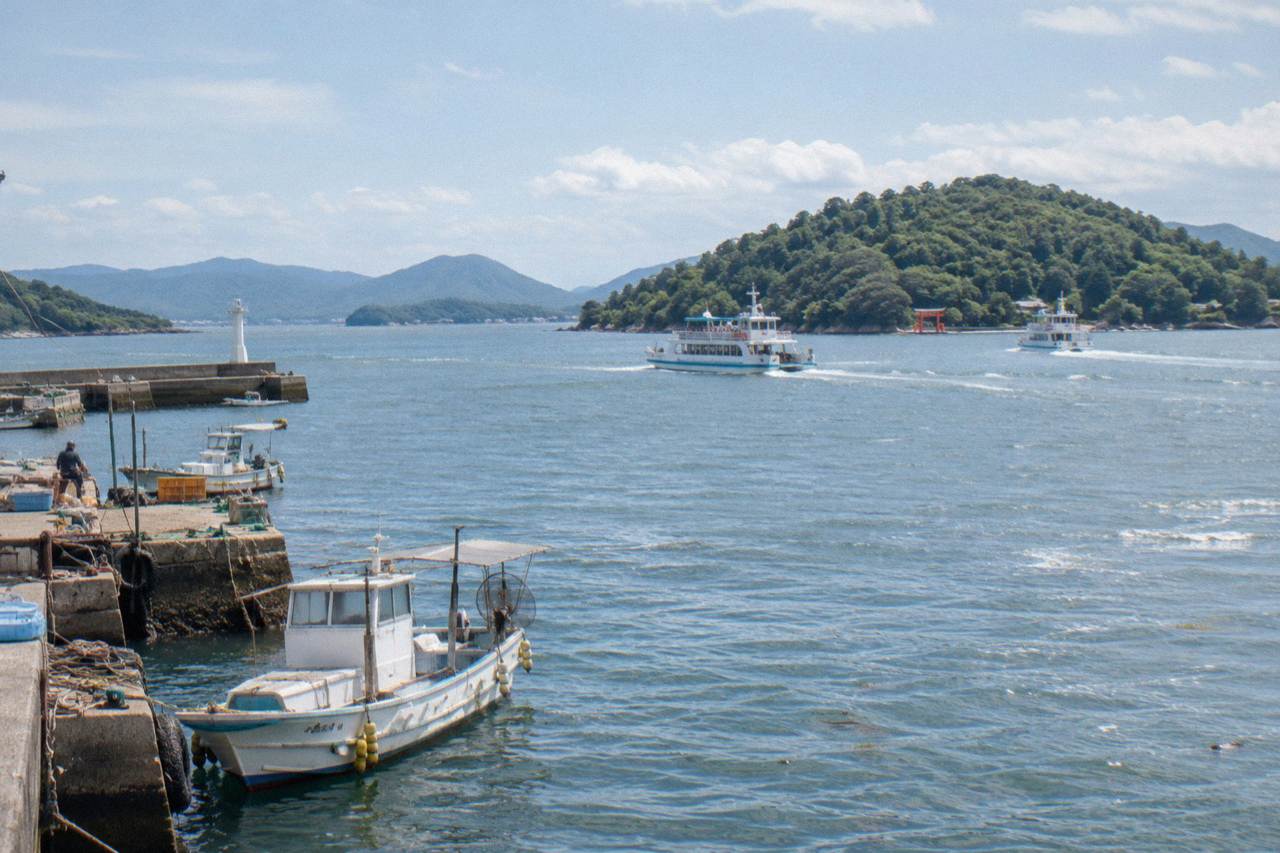
The Seto Inland Sea islands easiest from Hiroshima are Miyajima, about 10 minutes by ferry from Miyajimaguchi, and Okunoshima, about 15 minutes by ferry from Tadanoumi in Takehara. Osakikamijima and Omishima sit further east on the same web of short car ferries.
The sea between Honshu and Shikoku is scattered with islands, and several of them sit within a single short ferry ride of the Hiroshima area. This page sets out which islands you can actually reach from Hiroshima, what each crossing costs, what waits on the shore, and how the pieces fit together into a day trip.
The starting points matter. Miyajima leaves from Miyajimaguchi, a tram and rail stop west of the city. There is also a direct boat link from the Peace Memorial Park area to Miyajima. The rest of this page works through each island in order of how easy it is to reach, with the fares, times and admission fees for each.
Which Seto Inland Sea Islands Can You Reach From Hiroshima?
The Seto Inland Sea islands realistically reachable from Hiroshima are Miyajima, about 10 minutes by ferry from Miyajimaguchi, Okunoshima, about 15 minutes by ferry from Tadanoumi Port in Takehara, and Osakikamijima, 20 to 30 minutes by ferry from Takehara Port. Each of these is a genuine Seto Inland Sea island with regular public ferries, not a charter or a tour-only landing. Miyajima is already well known, since its Itsukushima Shrine has been a UNESCO World Heritage Site since 1996.
Okunoshima is part of Setonaikai National Park and carries a population of several hundred semi-wild rabbits. The list is not exhaustive, but it is honest about distance. The Hiroshima Travel Guide day-trip set covers each of these islands in its own page, and the tables below gather the numbers in one place so the planning stays simple. What no page can honestly give is a single day combining Okunoshima, Miyajima and Omishima: the ports point in different directions and the timetables do not stack.
How Do You Get From Hiroshima To Miyajima?
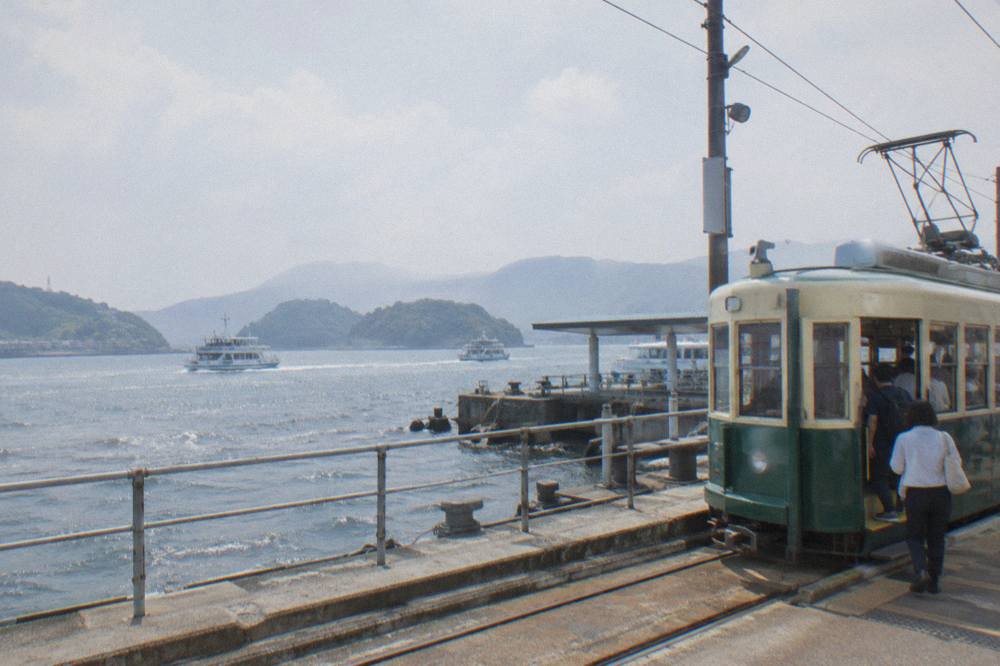
From Hiroshima Station, the JR Sanyo Line reaches Miyajimaguchi in 28 to 30 minutes for 420 yen, and the ferry from Miyajimaguchi to Miyajima takes about 10 minutes, with Matsudai Kisen charging 200 yen one way for an adult plus a separate 100 yen Miyajima visitor tax collected on entry. The Hiroden tram on Line 2 also reaches Miyajimaguchi at a flat 240 yen adult fare.
Two rail options compete for the same short hop, and both end at the same pier. The Hiroden streetcar is the flat-fare alternative: since 1 February 2025 every Hiroden line, including the Miyajima line, charges 240 yen per adult and 120 yen per child, and IC cards such as ICOCA and Suica are accepted on board.
The ferry itself is a genuinely short crossing. The JR West Miyajima Ferry runs from 6:25 in the morning until a last departure at 10:42 at night, with Great Torii view sailings between 9:10 and 16:10. Miyajima Matsudai Kisen runs its own boats roughly every 15 minutes from 7:00 into the evening, charges 200 yen one way for an adult and 100 yen for a child, and accepts IC cards, cash and credit card touch payment for both fare and tax. A third option, the Aqua Net high-speed boat, runs from Peace Memorial Park to Miyajima in about 45 minutes.
| Route | Operator | Time | Fare |
|---|---|---|---|
| Hiroshima Station to Miyajimaguchi | JR Sanyo Line | 28 to 30 min | 420 yen |
| Hiroshima city to Miyajimaguchi | Hiroden Line 2 | flat fare system | 240 yen adult, 120 yen child |
| Miyajimaguchi to Miyajima | JR West Miyajima Ferry | about 10 min | 200 yen adult one way plus 100 yen visitor tax |
| Miyajimaguchi to Miyajima | Miyajima Matsudai Kisen | about 10 min | 200 yen adult, 100 yen child, plus 100 yen visitor tax |
| Peace Memorial Park to Miyajima | Aqua Net high-speed boat | about 45 min | high-speed boat service |
The 100 yen visitor tax deserves its own sentence. It has applied since October 2023, is charged per person per entry, exempts preschool children, and is collected by the ferry operators, either in the ticket or automatically at the IC gates on the JR and Matsudai services. It funds the preservation of the island's natural and cultural sites, per the official visitor tax page.
If the rail-and-ferry choreography sounds like work, a booked day removes it. The Miyajima Half-Day Small Group Tour from Hiroshima Station starts at the station and folds the crossing into a guided four-hour island circuit, Check availability if that shape suits your morning.
What Does A Day On Miyajima Cost?
A day on Miyajima costs 400 yen per adult in ferry fare plus the 100 yen visitor tax, 300 yen to enter Itsukushima Shrine, and 2,000 yen for a return ticket on the Mount Misen ropeway, with school-age children paying less at every step.
Itsukushima Shrine opens at 6:30 except on 1 January (it opens at 0:00 that day), and its closing time moves with the seasons: 18:00 from 1 March to 14 October, 17:30 from 15 October to the end of November, and 17:00 in December, with winter hours of 17:30 for January after the 4th to the end of February. Admission is 300 yen for adults, 200 yen for high school students and 100 yen for elementary and junior high students, and a combined ticket with the Treasure Hall costs 500 yen for an adult. The shrine's admission page also notes that the corridor floorboards have deliberate gaps that let high-tide water pass through, so flat shoes are the practical choice.
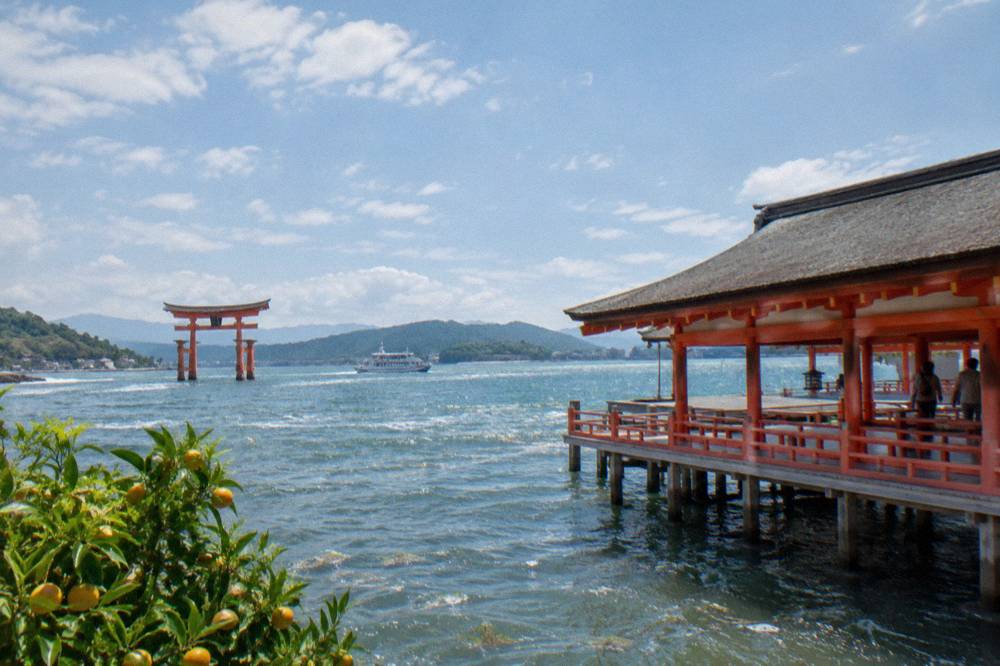
The tide decides what the Great Torii looks like. At high tide, at a tide level of about 250 cm or higher, the gate appears to float; at low tide, about 100 cm or lower, the seabed is exposed and the gate can be walked to. Which state you meet depends purely on the day's tide table, not on the season, so checking the Hiroshima Bay tide prediction before setting out is the one piece of planning that changes the visit.
The Mount Misen ropeway runs 9:00 to 16:00 with a last descent at 16:30. A return adult ticket is 2,000 yen, one way 1,100 yen, with children at 1,000 and 550 yen. The ropeway operator allows about an hour for the return trip including sightseeing, and the summit walk adds about an hour more.
| Item on Miyajima | Adult | Child | Notes |
|---|---|---|---|
| Ferry one way (Matsudai Kisen) | 200 yen | 100 yen | IC cards and touch payment accepted |
| Miyajima visitor tax | 100 yen | free for preschool | charged per entry |
| Itsukushima Shrine | 300 yen | 100 to 200 yen by school stage | opens 6:30 most mornings; 1 Jan from 0:00 |
| Shrine plus Treasure Hall combined | 500 yen | 150 to 300 yen | Treasure Hall alone 8:00 to 17:00 |
| Mount Misen ropeway return | 2,000 yen | 1,000 yen | 9:00 to 16:00, last descent 16:30 |
One repair note, kept factual: the Great Torii's own restoration finished in December 2022, while reinforcement of the shrine's East Corridor is reported to run from April 2024 to December 2026, and repair of the five-storey pagoda to 2027. The shrine remains open throughout. The Miyajima day trip page carries the fuller itinerary.
Can You Visit Okunoshima, Rabbit Island, From Hiroshima?
Okunoshima is reachable by a 15-minute ferry from Tadanoumi Port in Takehara, the island has a circumference of about 4.3 km and can be toured on foot, and it is home to several hundred semi-wild rabbits within Setonaikai National Park, so a Hiroshima day trip is possible but needs the ferry schedule built around the trains.
The port itself is the journey. Tadanoumi sits in Takehara, east of Hiroshima along the Sanyo coast, and the crossing from Tadanoumi to Okunoshima is a scheduled 15-minute ferry ride. Alternative routes exist: the Takehara Port crossing takes about 25 minutes but does not run on Tuesdays or Wednesdays. The Omishima Ferry also calls at Okunoshima, connecting it with Omishima in about 15 minutes, and it carries cars and bicycles.
| Okunoshima ferry route | Crossing | Operating pattern |
|---|---|---|
| Tadanoumi Port to Okunoshima | about 15 min | scheduled service from Tadanoumi |
| Takehara Port to Okunoshima | about 25 min | no sailings Tuesday or Wednesday |
| Omishima to Okunoshima | about 15 min | carries cars and bicycles |
The rabbits are the draw, and the numbers are worth repeating exactly: several hundred semi-wild rabbits on an island of roughly 4.3 km around. The island is part of Setonaikai National Park, which is the formal reason its landscape is protected. What the island was used for in the past is covered, with its history and its cautions, on the Okunoshima page, and the Takehara page covers the old merchant town on the route in.
What About Osakikamijima And The Smaller Ferry Islands?
Ferries from Takehara Port reach Osakikamijima, with thirty-two sailings a day, so the island works as local transport rather than a tourist boat. The island links onward through the Omishima Ferry toward Okunoshima, and east of Osakikamijima a cyclist starting in Onomichi can reach the Hiroshima-area islands entirely by bridge and ferry.
Thirty-two sailings a day is a genuine figure, not a rounding: it comes from the operator's own schedule and it means the island functions as local transport rather than a tourist boat. For a Hiroshima visitor, that density cuts both ways. It makes a spontaneous crossing easy once you are at Takehara Port, but it also means the interesting planning happens at the Honshu end, fitting the train to Takehara against the sailing you want.
For anyone whose interest is boat time rather than saddle time, a short cruise is also a bookable product: a rigid-inflatable boat tour runs on the water off Onomichi, and it appears among the picks below.
To combine saddle time and boat time on Miyajima, book a bike and boat tour here.
How Do Onomichi And Iwakuni Fit An Island Day From Hiroshima?
Neither is a true island, but both sit on the water and pair naturally with ferry days from Hiroshima: Onomichi offers the Mt. Senkoji Ropeway at 500 yen one way and a 2.5 km temple walk, while Iwakuni anchors the Nishiki River with the 1673 Kintaikyo Bridge, a 500 yen adult crossing, and a 1,550 yen bridge, ropeway and castle set ticket.
Neither is an island in the strict sense, but both belong in an island-hopping plan because they sit on the water and pair naturally with ferry days. Onomichi's Mt. Senkoji Ropeway runs daily 9:00 to 17:15 with departures about every 15 minutes, at 500 yen one way and 700 yen return for an adult, and the ropeway's lower station is about 15 minutes on foot from JR Onomichi Station. The temple walk runs 2.5 km through those 25 temples, most of them free to enter at the grounds level, with some inner halls charging 200 to 500 yen. Cat Alley, the roughly 200-metre lane of stone cats begun in 1998, is free and always open as a public path.
Iwakuni works differently. The Kintaikyo Bridge, first built in 1673 and rebuilt in timber by 1953 after typhoon damage, is 210 m on the surface with a 5 m width, and its ticket booths run 8:00 to 17:00 normally, extended to 18:00 or 19:00 in season, with the bridge itself reachable around the clock via a night fee box. The set ticket covering bridge, ropeway and Iwakuni Castle costs 1,550 yen for an adult and 700 yen for a child aged 6 to 11, and the city's own page allows roughly 1.5 to 2 hours for the set. From JR Iwakuni Station, the bus to the bridge takes 15 to 20 minutes and costs around 300 yen.
| Sight | Adult price | Child price | Hours |
|---|---|---|---|
| Onomichi Mt. Senkoji Ropeway, one way | 500 yen | 250 yen | 9:00 to 17:15, every 15 min |
| Onomichi Mt. Senkoji Ropeway, return | 700 yen | 350 yen | one child under 6 free per adult |
| Iwakuni Kintaikyo Bridge crossing | 500 yen | 250 yen | booths 8:00 to 17:00, night fee box after |
| Iwakuni bridge, ropeway and castle set | 1,550 yen | 700 yen | allow 1.5 to 2 hours |
| Iwakuni White Snake Museum | 200 yen | 100 yen | 9:00 to 17:00 year-round |
The fuller write-ups, including the cat alley detail and the white snakes, a National Natural Treasure since 1972, live on the Onomichi page and the Iwakuni page.
What Weather Should You Expect On The Seto Inland Sea Around Hiroshima?
The Japan Meteorological Agency station normals for Hiroshima, 1991 to 2020, show July averages 279.8 mm of rain and January averages 46.2 mm, August averages a daily high of 32.8 °C while January averages a daily low of 2.0 °C, and the year totals 1,572.2 mm of rain.
These are 30-year averages for the city station on the shore of the bay, and they describe the same water the ferries cross. Winter is mild by northern-Honshu standards, with average daily lows above freezing in every month and average daily highs near 10 °C in January.
| Month | Average high °C | Average low °C | Rain mm |
|---|---|---|---|
| Jan | 9.9 | 2.0 | 46.2 |
| Feb | 10.9 | 2.4 | 64.0 |
| Mar | 14.5 | 5.1 | 118.3 |
| Apr | 19.8 | 10.1 | 141.0 |
| May | 24.4 | 15.1 | 169.8 |
| Jun | 27.2 | 19.8 | 226.5 |
| Jul | 30.9 | 24.1 | 279.8 |
| Aug | 32.8 | 25.1 | 131.4 |
| Oct | 23.7 | 14.9 | 109.2 |
| Nov | 17.7 | 8.9 | 69.3 |
| Dec | 12.1 | 4.0 | 54.0 |
Two weather-dependent notes attach directly to the islands. The Kintaikyo Bridge in Iwakuni may close during high water, heavy rain or strong winds, and the Onomichi ropeway can suspend runs for stormy weather or inspections. Ferries across the bay are the same kind of operation, so a typhoon-season crossing plan should always carry a land alternative. The month-by-month detail, including blossom and foliage timing, sits on the site's best-time and weather pages.
Can You Combine Two Seto Inland Sea Islands In One Day From Hiroshima?
Miyajima plus a second Seto Inland Sea island in one day from Hiroshima is realistic only when the second stop is close to the same corridor, so the workable pairs are Miyajima with Iwakuni to the west or Miyajima with Onomichi to the east, while Okunoshima works better as its own full day because its ferries leave from Takehara, not from Miyajimaguchi.
Okunoshima needs a train out to the Takehara area, a ferry with fixed off days (no Tuesday or Wednesday sailings from Takehara Port), and enough island time to justify the travel.
For a first visit that wants the sea without the timetable study, a booked day does the assembly. The tours below cover the Miyajima crossing, a guided island loop and a private version of the same shore, and the all-inclusive evening walk returns the day to the Hiroshima food side.
Common Questions About Seto Inland Sea Islands From Hiroshima
How Do I Get From Hiroshima To Miyajima?
Take the JR Sanyo Line from Hiroshima Station to Miyajimaguchi, 28 to 30 minutes for 420 yen, or Hiroden Line 2 at a flat 240 yen adult fare, then a ferry of about 10 minutes across. Matsudai Kisen charges 200 yen one way for an adult, plus the 100 yen Miyajima visitor tax collected on entry.
How Much Is The Miyajima Ferry?
Miyajima Matsudai Kisen charges 200 yen one way for an adult and 100 yen for a child from Miyajimaguchi, with IC cards, cash and credit card touch payment all accepted. A separate 100 yen Miyajima visitor tax applies per person per entry, in effect since October 2023, with preschool children exempt.
Can You Visit Okunoshima From Hiroshima?
Yes. The island is about 15 minutes by ferry from Tadanoumi Port in Takehara, with alternatives from Takehara Port in about 25 minutes, closed Tuesdays and Wednesdays. Okunoshima has several hundred semi-wild rabbits and a circumference of about 4.3 km.
Is There A Ferry From Hiroshima City Direct To Miyajima?
Yes, the Aqua Net high-speed boat runs from Peace Memorial Park to Miyajima in about 45 minutes, in addition to the standard Miyajimaguchi ferries.
When Can You Walk To The Great Torii At Miyajima?
When the tide falls to about 100 cm or lower the seabed around the gate is exposed and it can be walked to; at about 250 cm or higher the gate appears to float. The state depends on the day's tide, so check the Hiroshima Bay tide prediction before you go.
What Does Itsukushima Shrine Cost To Enter?
Admission is 300 yen for adults, 200 yen for high school students and 100 yen for elementary and junior high students, with a combined ticket including the Treasure Hall at 500 yen for adults. The shrine opens every morning and closing times vary depending on the season.
The Seto Inland Sea is the reason Hiroshima has islands at all, and the ferry web that serves them is cheap, frequent and mostly IC-card friendly, so the only real decision is which shore to aim the day at.