Iwakuni From Hiroshima: Kintaikyo, The Castle And White Snakes
Iwakuni, a short hop west of Hiroshima across the prefectural line in Yamaguchi, pairs a 1673 wooden arch bridge with a mountaintop castle and a museum devoted to an albino snake. Here is what the official pages say about tickets, hours and how the day fits together.
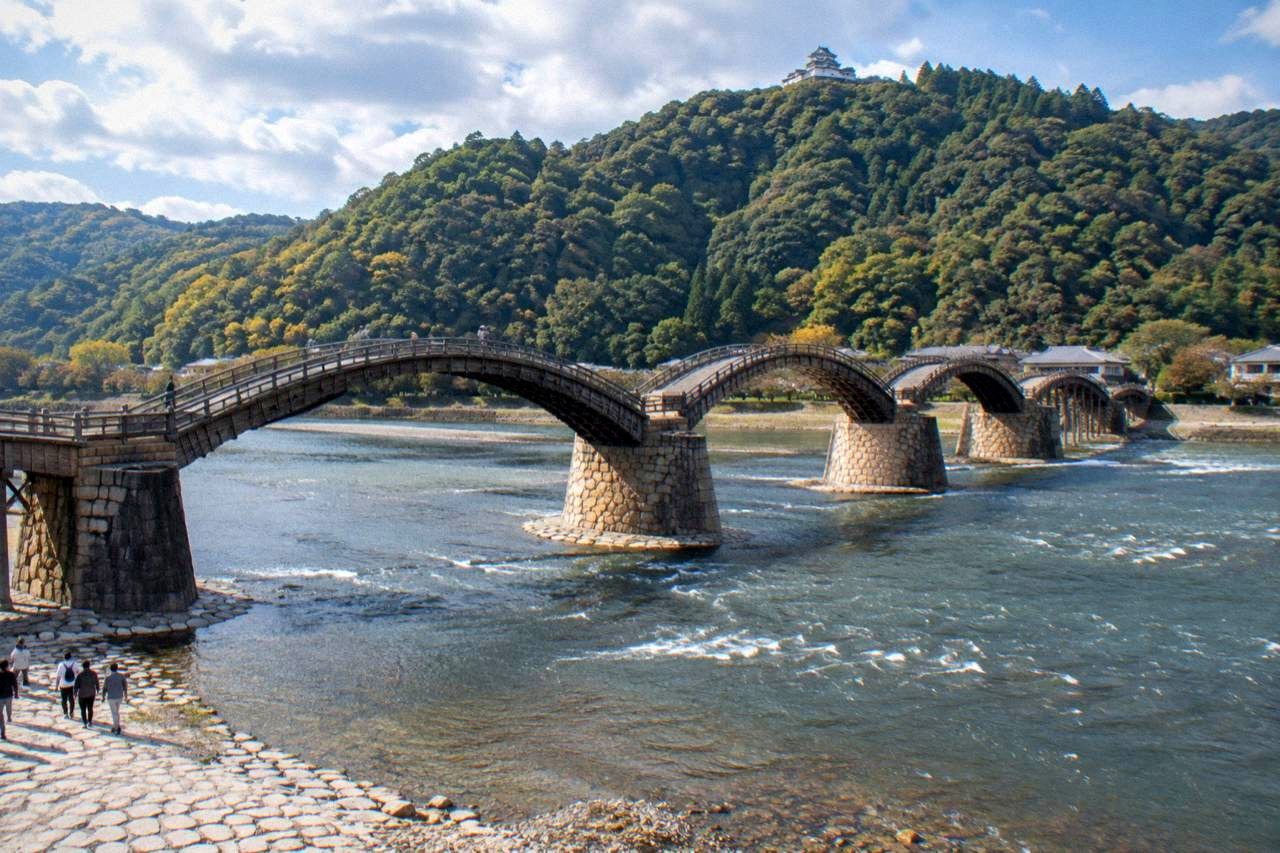
Iwakuni is a day trip from Hiroshima built around Kintaikyo Bridge, a 500 yen crossing, a ropeway and 1962 castle keep above the Nishiki River, plus the White Snake Museum. Buses from JR Iwakuni Station reach the bridge area in about 20 minutes.
Iwakuni sits one river valley west of Hiroshima, across the prefectural border in Yamaguchi, and its old castle town core is compact enough that a single day covers the bridge, the hilltop keep and the snake museum with room to spare. The town's sightseeing cluster runs along the Nishiki River: Kintaikyo Bridge at the bottom, a ropeway rising through the trees, and Iwakuni Castle on Mount Shiroyama above. The official Iwakuni City bridge page prices the adult round-trip crossing at 500 yen and sells a 1,550 yen set ticket that adds the ropeway and the castle, which frames the whole day in one sentence: this is a walk-and-look destination, not a queue-and-scan one. Seasonally the same valley shifts character, cherry blossoms in spring, cormorant fishing from June through August, autumn colour on the hillsides, and the bridge lit until 22:00 year round. This page sets out what the official sources state, ticket by ticket, hour by hour, and folds in the practical choices, trains, buses, set tickets and timing, that decide whether the day runs smoothly. For the wider map of the region, start with things to do in Hiroshima and read the deeper bridge detail on the Kintaikyo Bridge attraction page.
How Do You Get From Hiroshima To Iwakuni And The Bridge?
Iwakuni is reached from Hiroshima by rail to JR Iwakuni Station or Shin-Iwakuni Station, then a local bus to Kintaikyo Bus Center: from JR Iwakuni Station the bus takes about 20 minutes and runs every 10 to 15 minutes, and from Shin-Iwakuni Station about 15 minutes with one or two departures an hour, per the transport summary on the Iwakuni travel pages.
The bus fare from JR Iwakuni Station to the bridge runs around 300 yen, and from Shin-Iwakuni Station about 350 yen, both figures from the Iwakuni City bridge information page. The bus center sits at the town end of the bridge, so the walk from disembarking to the first arch is a matter of minutes rather than a connection. The White Snake Museum is a 10-minute walk from the same bus center, which keeps the whole cluster on foot once the bus ride ends.
Two stations serve the town and they suit two kinds of traveller. JR Iwakuni Station is on the local Sanyo line closer to the river town; Shin-Iwakuni Station is on the Sanyo Shinkansen line a little outside the centre and is the natural choice for anyone arriving on a fast train from Hiroshima. The trade-off is frequency: the Shin-Iwakuni bus runs one or two times an hour against the denser service from the older station.
| Route | Journey Time | Frequency | Fare |
|---|---|---|---|
| JR Iwakuni Station to Kintaikyo Bus Center | about 20 minutes | every 10 to 15 minutes | around 300 yen |
| Shin-Iwakuni Station to Kintaikyo Bus Center | about 15 minutes | 1 to 2 per hour | about 350 yen |
| Kintaikyo Bus Center to White Snake Museum | 10-minute walk | on foot | free |
| Kintaikyo Bridge to ropeway base station | 10-minute walk | on foot | free |
The table above carries only what the official pages state.
Planning the day against a Hiroshima base is straightforward: the bridge booths open at 8:00, the castle keep opens at 9:00, and the ropeway runs every 15 minutes from 9:00, so an arrival at the bridge area in the middle of the morning leaves the full cluster available. Anyone pairing Iwakuni with a second destination on the same day should treat the bridge, castle and snake museum as a half-day unit plus travel on either side.
Why Is Kintaikyo Bridge In Iwakuni Famous?
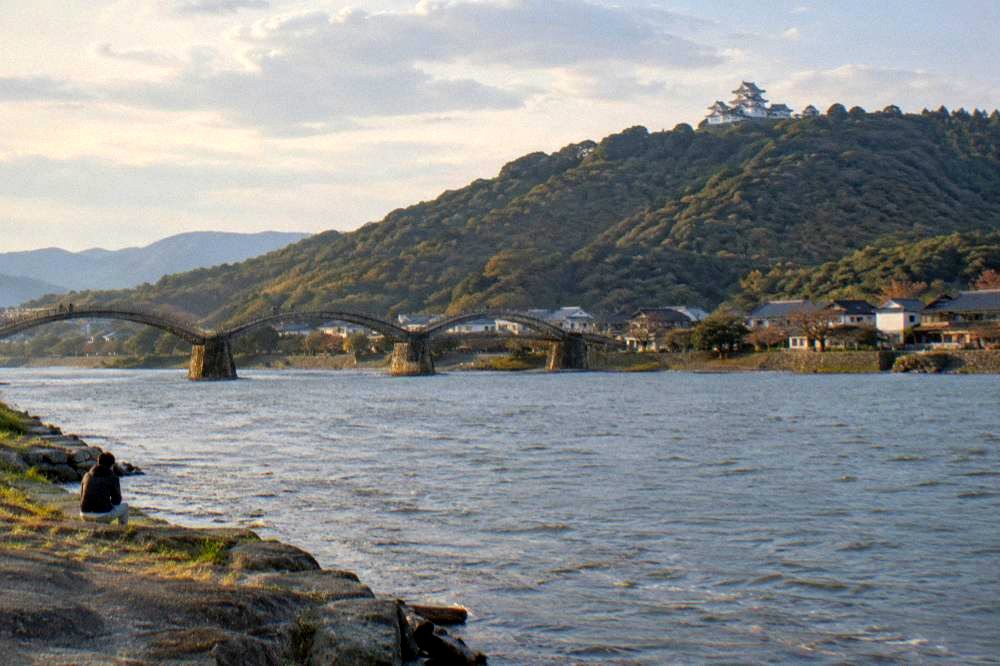
Kintaikyo is a five-arch wooden bridge first built in 1673 by Kikkawa Hiroyoshi, lord of Iwakuni Domain, across the Nishiki River; its current timbers date from a 1953 rebuild after Typhoon Kezia destroyed the 276-year-old predecessor in 1950, and Japan lists it as a national site of scenic beauty, per the official bridge history pages.
The construction story the city tells is one of persistence. Ground was broken in June 1673 and the bridge opened that October; floods washed the prototype away within a year, and the rebuilt version, with reinforced piers, stood from 1674 until the typhoon of September 1950. The 1953 reconstruction returned to traditional methods, and the bridge page credits the surviving technique, timberwork joined with metal belts and nails rather than heavy iron structure, for the arches' flexibility in flood.
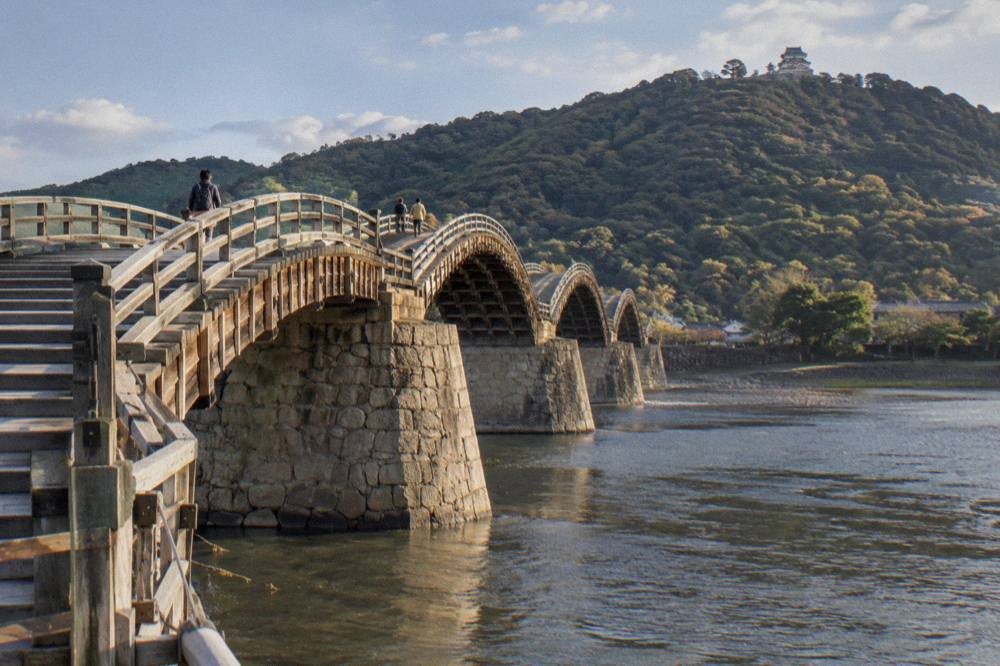
The numbers give the bridge its presence. The surface length is 210 m, the total length 193.3 m and the width 5 m, all from the official summary page. The five arches rise in steep stepped decks, and the city's own access note is blunt about them: the steps can be slippery in rain or snow, and the crossing is not fully barrier-free. There is no reservation required to cross, and the bridge can be crossed from both the town side and the mountain side.
| Year | Event |
|---|---|
| 1673 | Kikkawa Hiroyoshi builds the first Kintaikyo Bridge across the Nishiki River |
| 1674 | Flood washes the prototype away; rebuilt the same year with reinforced piers |
| 1950 | Typhoon Kezia destroys the bridge on 14 September after 276 years |
| 1953 | Bridge rebuilt in timber using traditional methods |
| 1972 | Iwakuni white snakes designated a National Natural Treasure |
Designation as a scenic beauty site is the bridge's formal standing; the white snake listing in the same table belongs to the museum covered further down, and both designations are stated on the respective official pages. The bridge is the anchor of the visit in a literal sense: every other sight in this guide, castle, ropeway, shrine, snake museum, sits within a short walk of one of its two abutments.
A bridge town pairs naturally with a riding morning in Hiroshima itself. The Peace Cycling Tour with Local Guide loops the rivers and memorials of the city, and Check availability before committing the day, since a morning ride and an afternoon train west make a full but workable schedule.
What Does Crossing Kintaikyo Bridge Cost And When Is It Open?
A round-trip crossing costs 500 yen for adults, junior high age and above, and 250 yen for elementary school children, with groups of 15 or more paying 450 and 200 yen; ticket booths operate 8:00 to 17:00, extended to 18:00 in the mid-March to mid-September tourist season and 19:00 in late July and August, per the official bridge page.
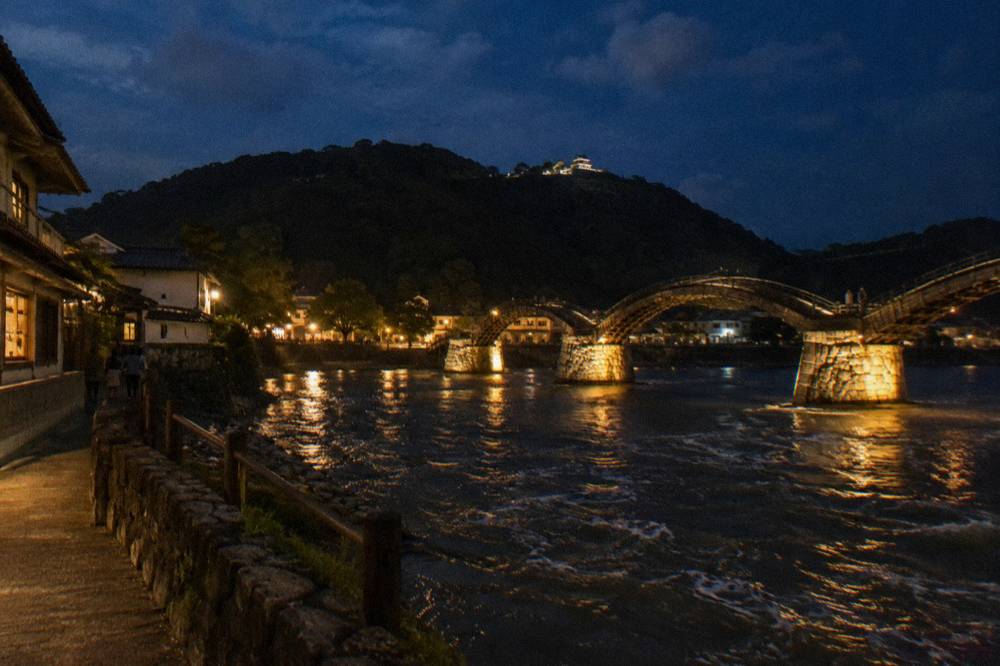
The fee is charged for the round trip only, there is no one-way ticket, and infants cross free. Outside booth hours the bridge stays open around the clock: the city asks unaccompanied-hour visitors to pay into a night fee box at the entrance. That 24-hour access is what makes the illumination practical, the arches are lit until 22:00 every evening, so a late dinner in the town still ends with the bridge reflected in the river.
The set ticket is the one genuine discount decision of the day. At 1,550 yen for an adult and 700 yen for an elementary child it bundles the bridge crossing, the ropeway round trip and castle admission, against 1,750 yen for an adult when the same three parts are bought separately. The city page estimates 1.5 to 2 hours for the combined visit, bridge, ropeway and castle together, which matches a comfortable morning or afternoon.
| Ticket | Adult (12+) | Child (6-11) |
|---|---|---|
| Kintaikyo Bridge round trip | 500 yen | 250 yen |
| Bridge group rate, 15 or more | 450 yen | 200 yen |
| Set ticket: bridge, ropeway, castle | 1,550 yen | 700 yen |
Two operational notes come straight from the official pages. First, the bridge may close during high water, heavy rain or strong winds; a typhoon-week visit carries real closure risk and the booths decide on the day. Second, the ropeway and castle close on irregular dates for maintenance and inspection, and the castle closes whenever the ropeway is out of service, because the ropeway is the practical route up. Checking both before travelling is not pessimism, it is the documented pattern.
The pricing structure rewards a decision made early. A visitor certain to do bridge, ropeway and castle should buy the set ticket at the booth and save; a visitor content with the crossing and the view from the base saves by skipping the bundle. There is no time pressure inside the ticket, the set covers one pass through each element in a single visit.
What Can You See At Iwakuni Castle And On The Ropeway From Hiroshima?
Iwakuni Castle's keep stands on Mount Shiroyama at 200 m elevation, built originally in 1608 by Kikkawa Hiroie and destroyed in 1615, with the current keep a 1962 reconstruction reached by a ropeway that runs every 15 minutes from 9:00 to 17:00, a 3-minute ride covering 412 m, with adult round-trip fare 560 yen, per the castle and ropeway official pages.
The route up is a sequence the city spells out precisely: a 10-minute walk from the bridge to the ropeway base station, the 3-minute ride to the summit, then a 5 to 10 minute walk to the keep. The keep itself opens 9:00 to 4:45 with last entry at 4:30.
The castle's short original life is the historical hook. Kikkawa Hiroie built it in 1608; it was demolished in 1615 under the shogunate's one-castle-per-domain policy, the standard reading of the timeline the city presents, and the hilltop then stood empty until the 1962 reconstruction. The keep now holds the castle's exhibits and, per the Japan.travel listing, looks out over the Nishiki River curve and the bridge below.
| Item | Figure |
|---|---|
| Castle built | 1608 by Kikkawa Hiroie |
| Original keep destroyed | 1615 |
| Current keep | 1962 reconstruction |
| Mount Shiroyama elevation | 200 m |
| Ropeway ride | 3 minutes, 412 m |
| Ropeway service | every 15 minutes, 9:00 to 17:00 |
| Keep hours | 9:00 to 16:45, last entry 16:30 |
The connection back to Hiroshima's own castle is worth a sentence, because travellers compare the two. Hiroshima Castle's keep, a 1958 concrete reconstruction that served as a museum for 68 years, closed to visitors on 22 March 2026, and its grounds are now an exterior-and-moat experience; the Iwakuni keep, by contrast, remains open daily, which quietly makes it the climbable castle of the pair. The full story of the Hiroshima closure is on Is Hiroshima Castle Open? and the Hiroshima Castle attraction page.
Maintenance closures are the one planning wrinkle. The city notes the ropeway and castle shut on irregular dates for inspection, and the castle closes when the ropeway does, so a set ticket bought at the bridge does not guarantee the upper half of the bundle on any given day.
What Are The Iwakuni White Snakes And Where Can You See Them?
The Iwakuni white snakes are a natural albino mutation of the Japanese rat snake with ruby red eyes, designated a National Natural Treasure in 1972 and revered locally as messengers of the gods; they can be seen at the White Snake Museum, open 9:00 to 17:00 year-round with admission of 200 yen for high school age and up and 100 yen for elementary and junior high students, per the museum's official page.
The museum sits at 2-6-52 Yokoyama in Iwakuni City, a 10-minute walk from the Kintaikyo Bridge bus center, and its exhibits are live snakes alongside models, videos and interactive displays. That combination, living animals plus explanation, is what the museum page itself lists, and it makes the stop a genuine half-hour indoor option in a day that is otherwise outdoors.
The reverence is not folklore attached by marketers. The museum's own English page states the snakes are viewed as bringers of good fortune, and the free White Snake Shrine nearby carries the same tradition: admission to the shrine grounds is free and worship is possible 24 hours, with the shrine office staffed 9:00 to 17:00. The shrine and museum together give the snake theme a footprint of about an hour, walking included.
For a Hiroshima visitor the white snakes are the part of Iwakuni with no substitute elsewhere in the region. The bridge has cousins, the castle has cousins, but a National Natural Treasure albino snake colony attached to a castle town is a singular item, and the museum's year-round 9-to-5 schedule makes it the reliable fallback on any Iwakuni day.
What Events And Seasons Shape The Iwakuni Year Near Hiroshima?
The Kintaikyo area runs a seasonal calendar the official pages list plainly: cherry blossoms in spring, cormorant fishing, ukai, on the Nishiki River from 1 June to 31 August, autumn leaves on the surrounding hills, winter snow, and the Kintaikyo Festival on 29 April, with bridge illuminations lit until 22:00 through the year.
Summer carries the densest programme. The ukai season, river fishing with trained cormorants conducted from firelit boats, runs the whole of June, July and August, and the same months bring fireworks to the river, per the Japan.travel listing of the area's seasonal calendar. The bridge's summer booth hours, extended to 19:00 in late July and August, are themselves a seasonal signal: the city expects evening visitors then.
Spring is the blossom season across Kikko Park and the riverbanks, and the Kintaikyo Festival on 29 April sits inside it. Autumn turns the hillsides above the ropeway, and the city's calendar notes snow in winter, which matters for one practical reason the bridge page states itself: the arch steps can be slippery in rain or snow, so winter crossing calls for steady footwear.
| Season | What The Official Calendar Lists |
|---|---|
| Spring | Cherry blossoms around the bridge and Kikko Park |
| 29 April | Kintaikyo Festival |
| 1 June to 31 August | Ukai cormorant fishing season on the Nishiki River |
| Summer | Fireworks over the river; bridge booths open to 19:00 |
| Autumn | Autumn leaves on the hillsides |
| Winter | Snow in the area; bridge steps slippery when wet or snowy |
Choosing a season is choosing a version of the town. The bridge at 500 yen is the same crossing in April and November; what changes is the frame, blossom on the banks, fire on the water, colour on the ridge. No single month is named here as the one to pick, because the official sources list the calendar without ranking it, and daylight, weather tolerance and appetite for festivals decide the rest.
How Does Iwakuni Compare With Other Hiroshima Day Trips?
Iwakuni is the castle-and-bridge day trip from Hiroshima, standing apart from the island days, Miyajima and the Seto Inland Sea islands, the cycling routes of the Shimanami Kaido and Onomichi, the naval and sake towns of Kure and Saijo, and the art islands reached via Naoshima; only Iwakuni bundles a historic wooden bridge, a ropeway castle and a natural-treasure museum in one walkable river valley.
The comparison is practical, not a ranking. A traveller with two days west of Hiroshima can pair Iwakuni with one of the coastal or island destinations without overlap: Miyajima for the shrine and torii in the water, Onomichi for the temple slopes, the Shimanami Kaido for the sea crossing by bicycle, Kure for its maritime museums, or the Saijo sake district for brewery street tastings. Each of those days is documented on its own page on this site, and this article's figures apply to Iwakuni alone.
What Iwakuni does not offer is water. The Nishiki River is a river, swift and clear, and the bridge crosses it rather than a bay. Readers deciding between Iwakuni and Miyajima on a single spare day are choosing between a castle valley and a shrine island with tides and deer; the tide question at Miyajima is covered by Hiroshima Travel Guide in its own Miyajima pages.
| Day Trip From Hiroshima | What It Is Known For |
|---|---|
| Iwakuni | Kintaikyo Bridge, ropeway castle, white snake museum |
| Miyajima | Itsukushima Shrine and the Great Torii in the tide |
| Onomichi | Temple slopes above a working port town |
| Shimanami Kaido | Island-hopping cycling route across the inland sea |
| Kure | Maritime and shipbuilding heritage |
| Saijo sake district | Brewery street and sake tastings |
The table names each place in general terms; fares and journey times for the other routes sit on their own pages and are not repeated here. The figures that can be given are internal to Iwakuni: the 1,550 yen set ticket covers the bridge, ropeway and castle, and the White Snake Museum adds 200 yen, so the core adult day prices out from those two figures alone.
For visitors stringing days together, Hiroshima in one day shows the city baseline against which a Iwakuni day is measured: one is rivers, memorials and okonomiyaki, the other is a river of a different kind, timber arches and a hilltop keep.
Is Iwakuni Worth Visiting?
Iwakuni is worth a day trip from Hiroshima for visitors drawn to historical architecture and unusual sights: a 1673 bridge lineage rebuilt in timber, a castle keep open daily with a ropeway ride through the forest, and a National Natural Treasure white snake colony, with the core cluster covered by the 1,550 yen adult set ticket plus 200 yen museum entry, according to the official pages for each site.
The honest case against is travel shape. The town is a border crossing away in Yamaguchi, and the bus from the shinkansen station runs only one or two times an hour, so the day is paced by connections in a way that Miyajima, with ferries every 15 minutes, is not. A visitor with exactly one spare half-day and no tolerance for timetables gets more certainty from staying inside Hiroshima.
The case for is density of the unrepeatable. Nowhere else within day-trip range pairs a national scenic beauty bridge you can cross for 500 yen with a climbable castle keep, and Hiroshima's own keep has been closed since March 2026, which shifts the castle-in-the-region question toward Iwakuni by default. Add the snake museum at 200 yen and the lit bridge at night, and the day holds a morning, an afternoon and an evening option on one 1,550 yen set ticket.
The verdict this site can defend from sources: for a second or third day in the region, or for a traveller based in Hiroshima with a specific interest in bridges, castles or the white snakes, Iwakuni earns the journey. For a first-time visitor with a single day outside the city, Miyajima's ferry-and-shrine day remains the lower-friction choice on this site's own coverage.
What Should You Know Before Crossing The Bridge In Iwakuni?
The bridge steps are steep and can be slippery in rain or snow, the crossing is not fully barrier-free, the bridge can close during high water, heavy rain or strong winds, and the castle closes whenever the ropeway does, so the day's practical risks are weather and maintenance closures rather than tickets, according to the official access notes for the bridge, ropeway and castle.
Money handling is simple. The booths take the crossing and set ticket fees in person, the night fee box covers unstaffed hours, and every figure in this article is in yen with no conversion needed. The ropeway runs on a 15-minute headway from 9:00, so the summit half of the day never needs a schedule beyond arriving before the 17:00 close.
Time budgeting comes from the city's own estimate: 15 to 30 minutes for the bridge area on its own, and 1.5 to 2 hours for the bridge, ropeway and castle combined. Adding the snake museum and the shrine, plus the bus rides at each end, the on-site day is roughly three hours, which is why Iwakuni works both as a full day with a long lunch and as a compressed half-day attached to a morning in Hiroshima.
Common Questions About Iwakuni From Hiroshima
Is Iwakuni Worth Visiting?
Yes, for a second or third day in the Hiroshima region. The set ticket prices the bridge, ropeway and castle at 1,550 yen per adult and the city estimates the combined visit at 1.5 to 2 hours, with the White Snake Museum a 10-minute walk away at 200 yen. A first-time visitor with only one day outside Hiroshima gets a simpler journey from Miyajima's 15-minute ferry cadence.
How Much Does It Cost To Cross Kintaikyo Bridge?
A round-trip crossing costs 500 yen for adults, junior high and above, and 250 yen for elementary school children, with infants free. Groups of 15 or more pay 450 and 200 yen. The fee is round trip only and there is no reservation.
What Time Does Kintaikyo Bridge Close?
Ticket booths run 8:00 to 17:00, extended to 18:00 in the mid-March to mid-September tourist season and 19:00 in late July and August. The bridge itself is accessible 24 hours, with a night fee box when booths are unstaffed, and illuminations are lit until 22:00.
Is The Iwakuni Castle Keep Open?
Yes, unlike the closed keep in Hiroshima. Iwakuni Castle opens 9:00 to 16:45 with last entry at 16:30. The castle closes on irregular maintenance dates and whenever the ropeway is out of service.
How Do You Get To Kintaikyo Bridge From Iwakuni Stations?
From JR Iwakuni Station, buses to Kintaikyo Bus Center take about 20 minutes and run every 10 to 15 minutes, costing around 300 yen. From Shin-Iwakuni Station the bus takes about 15 minutes, runs one or two times an hour, and costs about 350 yen.
Can You See The Iwakuni White Snakes?
Yes, at the White Snake Museum, open 9:00 to 17:00 year-round with possible temporary maintenance closures. Admission is 200 yen for high school age and up and 100 yen for elementary and junior high students, and the museum displays live snakes alongside models and videos.
Iwakuni rewards a traveller who reads two numbers before leaving Hiroshima: the 1,550 yen set ticket and the 10-minute bus-center-to-museum walk that holds the whole valley together.