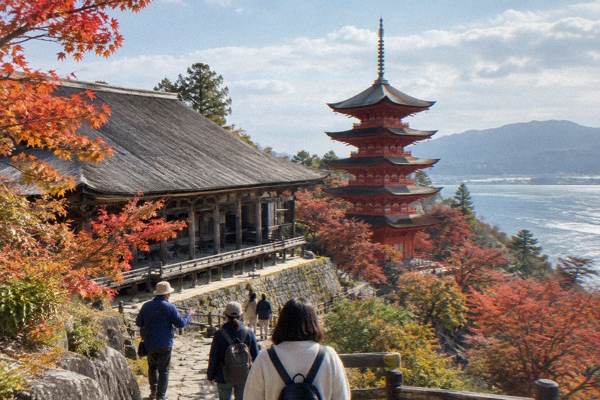
Okunoshima: Rabbit Island From Hiroshima
Okunoshima, a small island of about 4 km circumference in the Seto Inland Sea, is administered by Takehara City in Hiroshima Prefecture and is home to several hundred wild rabbits, reached by a 15-minute ferry from Tadanoumi Port.
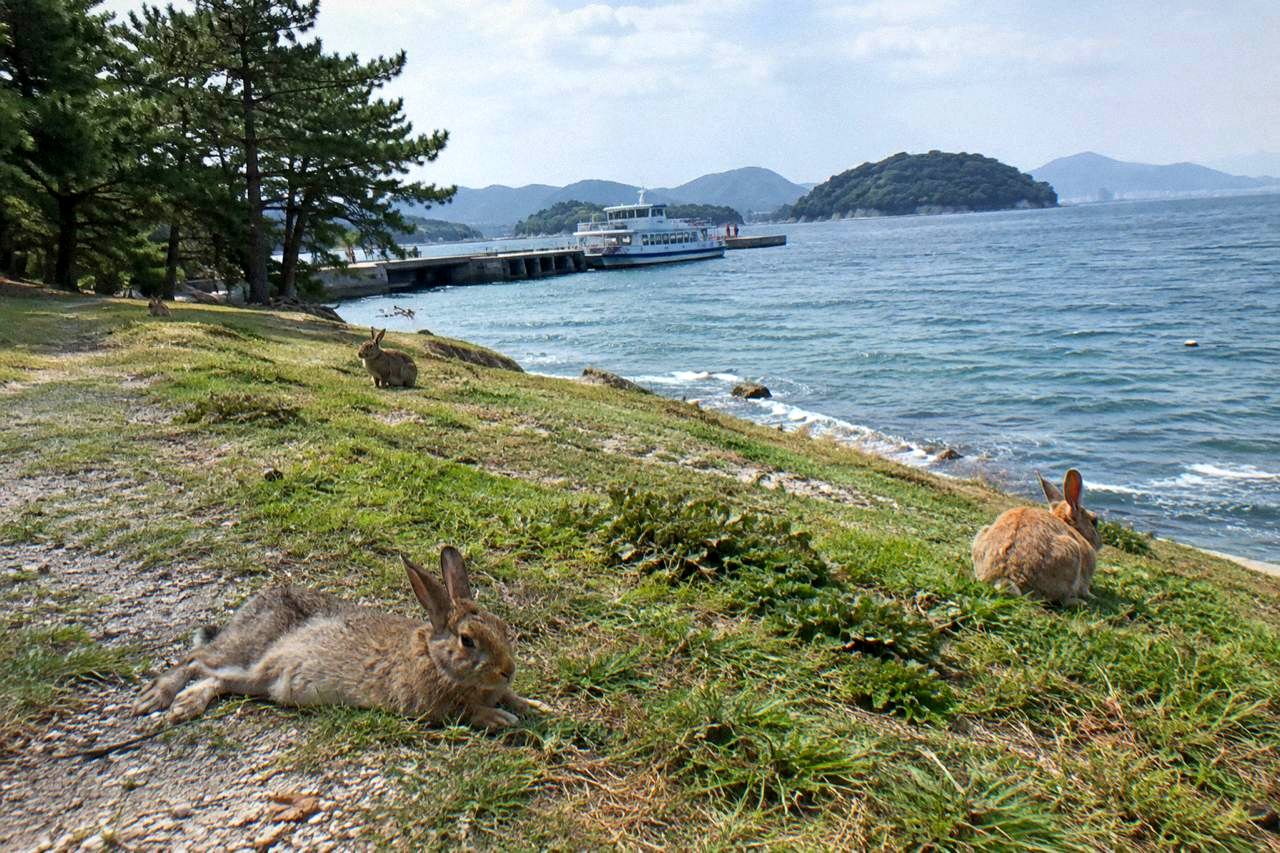
Okunoshima lies off Takehara City in Hiroshima Prefecture. From Hiroshima Station the fastest route is Shinkansen to Mihara, then the JR Kure Line to Tadanoumi and a 15-minute ferry (adult fare 360 yen one way).
Okunoshima, better known as Rabbit Island, sits in the Seto Inland Sea off the coast of Takehara City in Hiroshima Prefecture, and it combines two very different reasons to visit: several hundred semi-wild rabbits that depend on visitor feeding, and the well-documented ruins of a secret Imperial Japanese Army poison gas plant that operated on the island from 1929 to 1945. The island is small, about 4 km around, has no permanent residents beyond hotel staff, and allows no private cars at all. This guide lays out how to get there from Hiroshima, what the ferry and museum cost, the rules for meeting the rabbits, and how a day trip fits alongside the other islands of the Seto Inland Sea.
What Is Okunoshima And Where Is It?
Okunoshima is a small island of about 4 km circumference in the Seto Inland Sea, administered by Takehara City in Hiroshima Prefecture, and part of Setonaikai National Park. It has several hundred wild rabbits, no civilian vehicles, and no permanent residents beyond the staff of the island's national-park lodge, and it is reached only by ferry from Tadanoumi Port on the mainland.
The rabbits are European rabbits, introduced after the war, and they are semi-wild rather than pets: recent surveys put the population at several hundred, earlier counts ran above 900, and the colony depends heavily on tourist feeding. The island is designated part of Seto Inland Sea National Park. Beyond the rabbits, Okunoshima carries a heavy history: between 1929 and 1945 it hosted a secret Imperial Japanese Army poison gas manufacturing facility, producing about 6,600 tonnes of agents including mustard gas, and the island was erased from official maps during the war to protect that secret. The full history, including the factory's workforce and output figures, is covered in What Was Okunoshima Used For?.
| Fact | Detail |
|---|---|
| Location | Seto Inland Sea, off Tadanoumi-cho, Takehara City, Hiroshima Prefecture |
| Circumference | About 4 km |
| Designation | Part of Setonaikai National Park |
| Rabbit population | Several hundred (recent surveys); earlier counts over 900 |
| Vehicles | No private cars on the island |
| Pets | Dogs and cats not allowed |
| Access | 15-minute ferry from Tadanoumi Port |
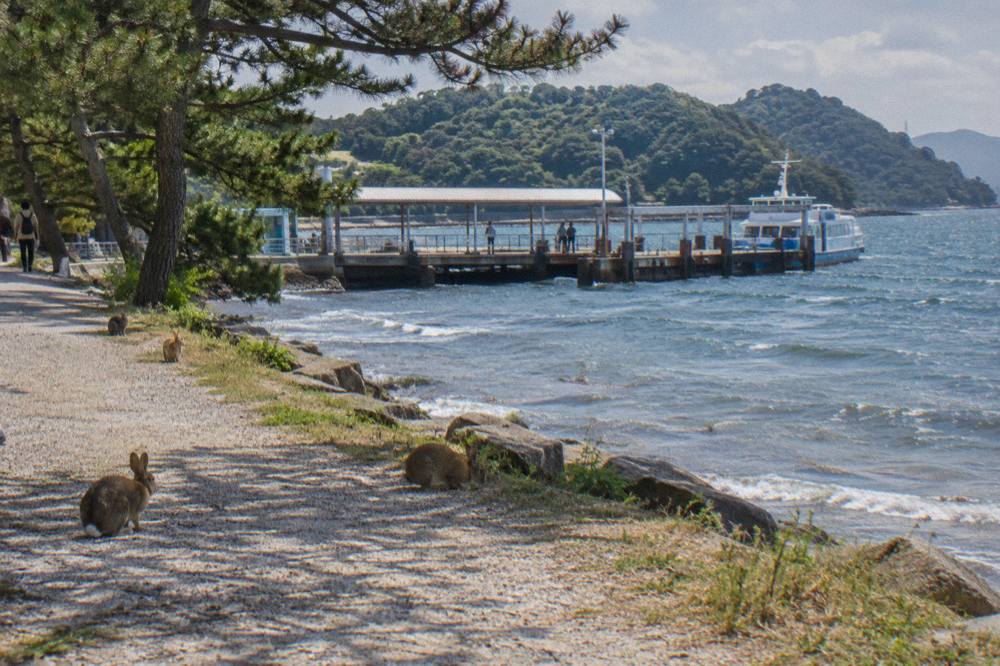
Getting to this corner of Hiroshima Prefecture usually starts at one of the region's main transport hubs. Shinkansen trains link Hiroshima with Shin-Osaka in roughly 80 minutes and with Tokyo in about four hours. From Hiroshima Airport, limousine buses reach the Shinkansen exit of Hiroshima Station in about 50 minutes, at 1,500 yen for adults and 730 yen for children, with IC cards accepted; a second route serves the Hiroshima Bus Center in about 55 minutes at the same fare, departing from Stop 1 at the airport while the station service uses Stop 2. Within the city, Hiroden streetcars charge a flat 240 yen for adults and 120 yen for children on every line, including the Miyajima line, a fare set in February 2025, and the trams now run directly into the station building, which simplifies early transfers on a day trip out of town.
The Japan Meteorological Agency's 1991 to 2020 climate normals for Hiroshima sketch the seasons. January brings a mean temperature of 5.4 degrees Celsius, highs near 10 degrees, lows around 2.0 and just 46.2 mm of rain. February is similar, with a mean of 6.2 degrees and 64.0 mm of rain. Spring warms steadily, from a March mean of 9.5 degrees to 14.8 in April and 19.6 in May, with April highs around 19.8 degrees and May highs near 24.4, though rainfall rises too, from 118.3 mm in March to 141.0 mm in April and 169.8 mm in May. May is a notably sunny month, averaging 210.8 hours of sunshine. Early summer is wet: June averages 226.5 mm of rain on a mean of 23.2 degrees, and July 279.8 mm on a mean of 27.2 degrees with highs around 30.9. Since a day on the island is spent outdoors, the rainfall totals deserve as much attention as the temperatures.
How Do You Get From Hiroshima To Okunoshima?
From Hiroshima Station the fastest route is the Shinkansen to Mihara Station, about 30 minutes and 2,290 yen non-reserved, then the JR Kure Line local to Tadanoumi Station, about 22 minutes and 320 yen, then a flat 5- to 7-minute walk to Tadanoumi Port and the 15-minute ferry. A direct JR Kure Line local train from Hiroshima to Tadanoumi takes about 2 hours and costs 1,320 yen one way.
The ferry is operated year-round by Daisan Omishima ferry and the Kyukamura passenger boat, with roughly 1 to 2 sailings per hour. Adult fare is 360 yen one way or 720 yen round trip; school-age children pay 180 yen one way or 360 yen round trip; preschoolers ride free. Tadanoumi Station to the port is a flat 5- to 7-minute walk, so the transfer is simple with luggage or a stroller.
Two practical points shape the day. First, rabbit food (pellets, cabbage, carrots) must be bought at Tadanoumi Port before boarding; nothing is sold on the island itself. Second, the last ferry back from Okunoshima to Tadanoumi is typically around 18:30, which sets the latest possible return time for the whole trip. The Rabbit Line high-speed boat from Mihara Port, a 30-minute crossing that ran on weekends and holidays, has been suspended for the time being, so Tadanoumi is the working route.
| Route step | Line | Time | Fare |
|---|---|---|---|
| Hiroshima Station to Mihara | Shinkansen, non-reserved | About 30 minutes | 2,290 yen |
| Mihara to Tadanoumi | JR Kure Line local | About 22 minutes | 320 yen |
| Hiroshima Station to Tadanoumi direct | JR Kure Line local | About 2 hours | 1,320 yen |
| Tadanoumi Station to Tadanoumi Port | Flat walk | 5 to 7 minutes | Free |
| Tadanoumi Port to Okunoshima | Ferry, 1-2 per hour | About 15 minutes | 360 yen one way, 720 yen return |
Other island days are covered in the Miyajima day trip guide and the Seto Inland Sea islands overview.
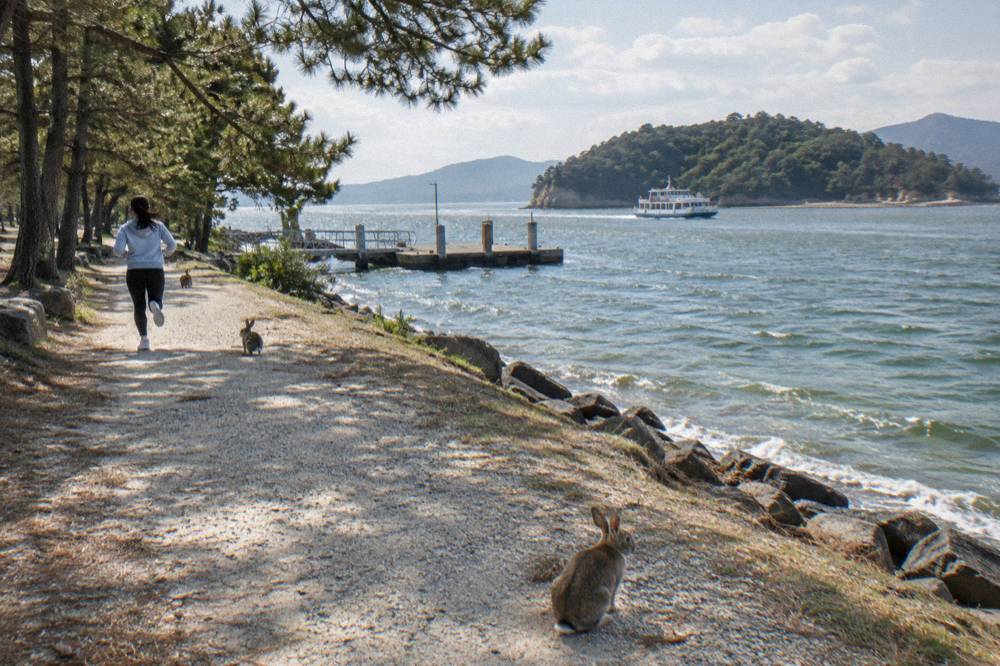
Can You Pet The Rabbits On Rabbit Island?
No. Visitors must not chase, hug, pick up or hold the rabbits on Okunoshima, because the animals are semi-wild, not pets, and can become stressed or injured if handled. Interaction is by feeding only: place suitable food on the ground, stay and watch them eat, and take any leftovers home with you.
The feeding rules are specific and worth following exactly. Buy pellets, cabbage or carrots at Tadanoumi Port before boarding, since no food is sold on the island. Never feed sweets, bread, snacks, green onions or any allium vegetables. Do not feed the rabbits on roads, roadsides or in front of building entrances, because bicycle and vehicle traffic uses those surfaces. The Kyukamura Okunoshima hotel area is one of the best spots to see large numbers of rabbits gathered, and rabbits are most active at dawn and dusk, which matters when planning ferry times.
The full etiquette rundown, including every banned food, is in Can You Pet The Rabbits On Rabbit Island?.
What Was Okunoshima Used For Before The Rabbits?
From 1929 to 1945 Okunoshima hosted a secret Imperial Japanese Army poison gas manufacturing facility that produced an estimated 6,600 tons of agents, including mustard gas and lewisite, and the island was erased from official Japanese maps during the war to protect the secret. At its peak about 6,000 people worked daily in production, recruited mainly from the Takehara area.
The scale of the plant is startling for an island this size: production there accounted for about 90 percent of Japan's total toxic chemical output from 1929 to 1944, according to a 2026 report citing the island's history.
Physical remains are still visible. The poison gas plant structures survive on the island, alongside older military ruins: the Geiyo Fortress gun batteries of the late 1890s and early 1900s, including the North Battery, where 22 cannons were installed as coastal defenses between 1897 and 1902.
| Period | What stood on Okunoshima |
|---|---|
| 1897 to 1902 | North Battery built, 22 cannons installed |
| 1929 to 1945 | Secret poison gas plant, about 6,600 tons produced |
| During the war | Island erased from official Japanese maps |
| Post-war | Rabbits introduced; island becomes part of the national park |
What Does The Poison Gas Museum Cover And What Does It Cost?
The Okunoshima Poison Gas Museum charges 150 yen for adults aged 19 and over, 120 yen for groups, and admits visitors under 19 free. It is open 9:00 to 16:00 with last entry at 15:40, and it closes from December 29 to January 3 and on occasional days through the year.
Its address is 5491 Tadanoumi-cho, Takehara City, with phone 0846-26-3036 for anyone checking the occasional closure days before travelling. The wider set of guides lives on Hiroshima Travel Guide.
Can You Stay On Rabbit Island?
Yes. Kyukamura Okunoshima, the national-park lodge on the island, is the place to stay, and it also offers day-use onsen and meals to visitors who are not staying overnight. The island has no permanent residents beyond the hotel staff, so overnight guests have the paths and the rabbits largely to themselves once the day-trippers leave on the last ferry.
Staying overnight also matches the rabbits' own schedule, since they are most active at dawn and dusk, outside the midday window that day visitors get. A free shuttle bus runs from the Okunoshima pier to the hotel, which helps with the walk from the ferry to the lodge.
The port town of Tadanoumi belongs to Takehara, and the Takehara day trip guide covers the preserved old town on the mainland side, reachable without another ferry.
What Else Is There To Do On Okunoshima?
Beyond the rabbits and the ruins, Okunoshima has a private beach open in summer with facilities, a campground, walking paths around the whole 4 km circumference, and a viewpoint reachable by a short hike that offers 360-degree views over the Seto Inland Sea. There is also a free shuttle bus from the pier to the Kyukamura Okunoshima hotel.
The viewpoint hike rewards the climb with a panoramic look at the sea lanes between Hiroshima Prefecture's islands.
Practical logistics are simple. No private cars are allowed, and visitors who drive park for free at Tadanoumi Port, which has about 200 spaces; the drive from Kawachi IC takes about 40 minutes and from Hiroshima Airport about 45 minutes. Luggage storage is available at Tadanoumi Port for 500 yen per item per day, useful for travellers passing through between Hiroshima and elsewhere.
| Item | Detail |
|---|---|
| Beach | Private beach, open summer, with facilities |
| Campground | On the island |
| Walking paths | Around the full about-4 km circumference |
| Viewpoint | Short hike, 360-degree Seto Inland Sea views |
| Shuttle | Free, pier to Kyukamura Okunoshima hotel |
| Parking | Free at Tadanoumi Port, about 200 spaces |
| Luggage storage | 500 yen per item per day at Tadanoumi Port |
How Much Does A Day Trip To Okunoshima Cost?
The transport-and-entry core of an independent Okunoshima day trip from Hiroshima is made of three pieces: the train to Tadanoumi (1,320 yen one way on the direct JR Kure Line local, or 2,290 yen plus 320 yen via the Shinkansen and the Kure Line from Mihara), the round-trip ferry at 720 yen per adult, and the Poison Gas Museum at 150 yen, plus whatever you spend on rabbit food bought at Tadanoumi Port.
To bundle the region's train travel into a pass, book a Kansai Hiroshima Area Pass here.
The table breaks this down piece by piece. The faster Shinkansen routing via Mihara costs more on the rail leg but cuts about an hour off each direction compared with the direct local, so the choice is between money and time. Either way, buy the rabbit food at the port; it is the one purchase the island itself cannot supply.
| Cost item | Adult price |
|---|---|
| JR Kure Line, Hiroshima to Tadanoumi, one way | 1,320 yen |
| Shinkansen to Mihara, non-reserved, one way | 2,290 yen |
| JR Kure Line, Mihara to Tadanoumi | 320 yen |
| Ferry, one way | 360 yen |
| Ferry, round trip | 720 yen |
| Poison Gas Museum, adult | 150 yen |
For travellers building a wider Hiroshima itinerary around the Seto Inland Sea, the overview at things to do in Hiroshima places Okunoshima among the city's day-trip options, and the Hiroshima Travel Guide's regional pages cover the coast either side of it.
When Should You Plan An Okunoshima Trip?
The Japan Meteorological Agency (JMA) 1991-2020 station normals for Hiroshima show January averaging 46.2 mm of rain and July averaging 279.8 mm, with August averaging a daily high of about 32.8 °C and January averaging a daily low of about 2.0 C. The beach season is summer, and rabbits are most active at dawn and dusk year-round.
Summer brings the beach into use and the highest rainfall; winter is mild by Japanese standards but the ferry and the flat island paths are the whole of the day's activity. No single month is licensed as the one to pick, and
| Month | Average high °C | Average low °C | Average rain mm |
|---|---|---|---|
| Jan | 9.9 | 2.0 | 46.2 |
| Feb | 10.9 | 2.4 | 64.0 |
| Mar | 14.5 | 5.1 | 118.3 |
| Apr | 19.8 | 10.1 | 141.0 |
| May | 24.4 | 15.1 | 169.8 |
| Jun | 27.2 | 19.8 | 226.5 |
| Jul | 30.9 | 24.1 | 279.8 |
| Aug | 32.8 | 25.1 | 131.4 |
| Sep | 29.1 | 21.1 | 162.7 |
| Oct | 23.7 | 14.9 | 109.2 |
| Nov | 17.7 | 8.9 | 69.3 |
| Dec | 12.1 | 4.0 | 54.0 |
Which Other Day Trips Pair With Okunoshima?
Two strong companions follow Okunoshima. East of Tadanoumi, the Onomichi day trip guide and the Shimanami Kaido guide pick up the island-hopping route toward Shikoku, a natural second day for anyone who enjoyed Okunoshima's sea crossings. Visitors who would rather hand the planning to a guided day on the water and the islands can choose the bike-and-boat combination pairing Hiroshima with Miyajima, whose tour page explains what the day covers.
East of Tadanoumi, the Onomichi day trip guide and the Shimanami Kaido guide pick up the island-hopping route toward Shikoku, a natural second day for anyone who enjoyed Okunoshima's sea crossings. Visitors who prefer a guided day can instead choose the bike-and-boat combination pairing Hiroshima with Miyajima, whose tour page explains what the day covers.
Visitors who would rather hand the planning to a guided day on the water and the islands can look at the bike-and-boat combination that pairs Hiroshima with Miyajima: Check availability. The tour page at Hiroshima and Miyajima by Bike and Boat explains what the day covers.
Common Questions About Okunoshima
Can You Stay On Rabbit Island?
Yes. Kyukamura Okunoshima, the national-park lodge on the island, takes overnight guests and also offers day-use onsen and meals. A free shuttle bus runs from the pier to the hotel, and the last ferry back to Tadanoumi is typically around 18:30, so overnight guests keep the island after the day crowd leaves.
How Long Is The Ferry To Okunoshima?
The crossing from Tadanoumi Port to Okunoshima takes about 15 minutes, with roughly 1 to 2 sailings per hour year-round. The adult fare is 360 yen one way or 720 yen round trip, and preschool children ride free.
Do You Need To Buy Rabbit Food Before Boarding?
Yes. Rabbit food such as pellets, cabbage and carrots is sold at Tadanoumi Port and must be bought before boarding, because none is sold on the island. Sweets, bread, snacks, green onions and other allium vegetables must not be fed to the rabbits.
Are Dogs Or Cats Allowed On Okunoshima?
No. Visitors also must not chase, hug, pick up or hold the rabbits.
Is There Anything To Eat On The Island?
Kyukamura Okunoshima, the island's hotel, serves meals to both staying guests and day visitors, and a seasonal beach shop operates in summer. Plan around the hotel or bring what you need.
Can You Drive To Okunoshima?
No. Drivers park for free at Tadanoumi Port, which has about 200 spaces, and take the 15-minute ferry like everyone else.