How Long Was Hiroshima Radioactive?
How long was Hiroshima radioactive? The City of Hiroshima's own figures on residual radiation, its rapid decline after 6 August 1945, and what the levels are today.
The numbers behind that statement are precise, and they come from the City of Hiroshima and from the Peace Memorial Museum's own educational materials.
Hiroshima was dangerously radioactive for a matter of days rather than years: the City of Hiroshima states that a person standing at the hypocenter one day later would have received one thousandth of the immediate dose, and that a week after the bombing the figure was one millionth. Today the city's radiation matches natural background levels anywhere on Earth and has no effect on human bodies.
Those sentences compress three separate figures, each published by the City of Hiroshima on its English pages about the bombing's effects. The first is the energy split: of the bomb's emitted energy, 5 percent was initial radiation, released in the instant of the explosion, and 10 percent was residual radiation, emitted afterwards. The second is the pace of decay: residual radiation was emitted later than the initial radiation, but roughly 80 percent of the total had been emitted within a very short time. The third is today's reading: the radiation in Hiroshima is on a par with the extremely low levels of natural background radiation present anywhere on Earth, and it has no effect on human bodies.
It is worth being careful with the word "long" in the question. Initial radiation, the burst released at the moment of detonation, lasted an instant; the City of Hiroshima notes that most of those exposed to direct radiation within a one-kilometer radius died. Residual radiation, the lingering kind people usually mean by the question, came from radioactive by-products of fission, from uranium that did not undergo fission, and from atomic nuclei in soil and rubble that became radioactive after being struck by initial radiation. That is the part that declined rapidly.
| Time After The Bombing | Residual Radiation At The Hypocenter | Source |
|---|---|---|
| Immediately after the explosion | Full reference level | City of Hiroshima |
| 24 hours later | 1/1,000th of the immediate level | City of Hiroshima |
| One week later | 1/1,000,000th of the immediate level | City of Hiroshima |
| Roughly 80 percent of all residual radiation | Emitted within the first 24 hours | City of Hiroshima |
| Today | On a par with natural background radiation anywhere on Earth | City of Hiroshima |
The table's last row is the one that matters to a traveller. The Peace Memorial Museum's own materials for children and students state the same conclusion in plain language: the background radiation in Hiroshima today is the same as the average amount of natural radiation present anywhere on Earth, and it is not enough to affect human health.
What Caused The Radiation In Hiroshima?
The radiation in Hiroshima came from the atomic bomb detonated over the city on 6 August 1945, and the City of Hiroshima splits it into two kinds: initial radiation, about 5 percent of the bomb's emitted energy, released the instant the bomb exploded, and residual radiation, about 10 percent of the emitted energy, released afterwards. Most of those exposed to direct radiation within one kilometer of the hypocenter died.
The distinction between the two kinds is not academic; it is the reason the answer to "how long" is so short. Initial radiation refers to the radiation released at the instant of explosion. It inflicted severe damage to human bodies, but it was over in that instant. The museum's question-box page for students puts the shares plainly: about 5 percent of the energy released by the bomb was in the form of initial radiation, and about 10 percent was in the form of residual radiation.
Residual radiation is the slower part, and it had three sources according to the same materials: radioactive by-products of fission produced after the bomb exploded, radiation from the uranium that did not undergo fission, and induced radioactivity, meaning atomic nuclei in soil, rubble and other materials that became radioactive after being struck by initial radiation. Calculations of residual radiation levels are based on the gamma radiation released due to that induced radioactivity.
The scale of the initial exposure is documented with restraint. The City of Hiroshima states that most of those exposed to direct radiation within a one-kilometer radius died, and the museum's materials say nearly everyone directly exposed within one kilometer of the hypocenter received a lethal dose. A fuller treatment of the target decision itself sits on the page why Hiroshima was chosen as a target.
How Quickly Did Radiation Levels Fall?
Radiation levels in Hiroshima fell extremely fast: the City of Hiroshima reports that roughly 80 percent of all residual radiation was emitted within 24 hours, that the dose at the hypocenter 24 hours after the bombing was one thousandth of the immediate dose, and that a week after the bombing it was one millionth. Residual radiation declined rapidly, and today's background level matches natural radiation anywhere on Earth.
Two figures do most of the work here. Research cited by the City of Hiroshima indicates that 24 hours after the bombing, the quantity of residual radiation a person would receive at the hypocenter was one thousandth of the quantity received immediately following the explosion. A week after the bombing, the quantity was one millionth. Those are ratios rather than absolute doses, but they describe a curve that dropped away almost vertically in the first hours and days.
A natural event then finished the job. Reported levels of residual radiation declined quickly as a result of radioactive decay and of the Makurazaki Typhoon, which struck the region on 17 September 1945, killing hundreds of bombing survivors. The extensive flooding it caused also washed away the fallout-contaminated layer of topsoil. Subsequent measurements reflected a significant drop after that typhoon and a second typhoon in October 1945, suggesting the two storms had effectively functioned as a large-scale decontaminator.
| Source Of Radiation | Share Of The Bomb's Emitted Energy | When It Was Released |
|---|---|---|
| Initial radiation | About 5 percent | The instant of the explosion |
| Residual radiation | About 10 percent | After the explosion, about 80 percent of it within 24 hours |
| Residual radiation at 24 hours | One thousandth of the immediate hypocenter dose | Per City of Hiroshima research |
| Residual radiation at one week | One millionth of the immediate hypocenter dose | Per City of Hiroshima research |
Scientific study of the survivors began soon afterwards: the Atomic Bomb Casualty Commission began medical and biological research on the effects of radiation in Hiroshima in 1947, according to Encyclopaedia Britannica. That research programme is part of why the dose figures above are known with such precision.
Is Hiroshima Still Radioactive Today?
No, not in any sense that matters to a visitor: the City of Hiroshima states that radiation in Hiroshima today is on a par with the extremely low levels of background radiation present anywhere on Earth and has no effect on human bodies. Encyclopaedia Britannica's summary agrees, reporting that radiation levels in Hiroshima today are comparable to those in any other city.
The city's own FAQ page answers a version of this question directly, and its answer is unambiguous: current radiation levels match natural background radiation anywhere on Earth. Natural background radiation exists everywhere, from granite-rich countryside to high-altitude cities, and Hiroshima's reading sits within that ordinary band. The Peace Memorial Museum's student materials reach the same conclusion in simpler words: the background radiation in Hiroshima today is the same as the average amount of natural radiation present anywhere on Earth. The wider set of guides lives on Hiroshima Travel Guide.
The longer companion piece on this site, is Hiroshima still radioactive, takes today's levels in more depth.
The health story that does continue is a human one rather than an environmental one. As of 31 March 2026, 91,105 hibakusha, the recognised atomic bomb survivors, were still alive, mostly in Japan, according to Japanese government recognition. Their care and registration are ongoing; radiation in the city's soil and air is not the live issue it is sometimes assumed to be.
Why Is Hiroshima Not Radioactive But Chernobyl Is?
A reactor accident such as Chernobyl released long-lived radioactive material continuously, so its decay curve is not comparable to that of the Hiroshima bomb. The City of Hiroshima states that Hiroshima's residual radiation declined rapidly and that today it matches natural background levels anywhere.
A bomb and a reactor core are not the same machine. The atomic bomb detonated over Hiroshima was an explosion that finished releasing its energy in an instant, and its residual radiation, from fission by-products, unfissioned uranium and induced radioactivity in soil and rubble, decayed and dispersed on the timescale described above. The two typhoons of September and October 1945, which washed away contaminated topsoil, shortened Hiroshima's timeline further.
The dedicated comparison page, why Hiroshima is not radioactive but Chernobyl is, works through the physics side by side. What this page adds from the City of Hiroshima is that radiation in the city today is on a par with natural background levels, a statement the city itself makes on its public FAQ page.
What Can Visitors See And Learn In Hiroshima Today?
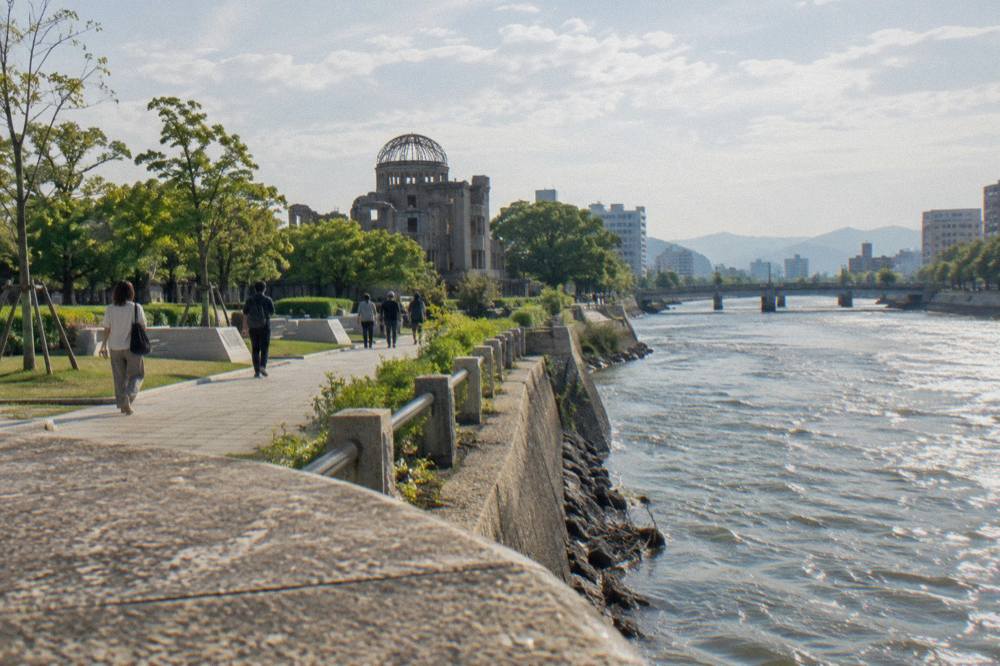
Visitors to Hiroshima can see the Peace Memorial Park, the Peace Memorial Museum, which admitted a record 2,580,926 visitors in FY2025 as reported, and the A-Bomb Dome, viewable from outside its fence with no fee. They can learn at the museum, where the figures are taught, with adult admission at 200 yen and hours from 7:30 in the morning.
The museum is where the figures on this page are taught. Admission is 200 yen for adults, college age and up, 100 yen for high school students, free for junior high and younger, and 100 yen for visitors 65 and over with a passport. Hours run from 7:30 in the morning, with seasonal closing times between 18:00 and 20:00.
For visitors arriving from Kansai, the Osaka or Kyoto to Hiroshima and Miyajima bus tour is the site's featured option for covering the Peace Memorial Park and the island in a single guided day, and it can be checked at Check availability. Travellers planning a longer stay in the region can read how many days in Hiroshima is enough before fixing an itinerary, or start from the site's own overview of things to do in Hiroshima.
Questions about whether a visit is appropriate, especially for American travellers, are common and are answered separately on whether it is okay for Americans to visit Hiroshima. The short version relevant here: the city's own pages present the history factually and welcome visitors, and the radiation question that worries some first-time visitors is answered by the city in a single sentence.
Common Questions About Hiroshima Radioactivity
How Long Was Hiroshima Radioactive?
The dangerous phase lasted days, not decades. The City of Hiroshima states that roughly 80 percent of all residual radiation was emitted within 24 hours of the bombing, that the hypocenter dose 24 hours later was one thousandth of the immediate dose, and that a week later it was one millionth. Today the city's radiation matches natural background levels anywhere on Earth.
Is Hiroshima Safe From Radiation Today?
Yes, by the city's own statement. The City of Hiroshima says radiation in Hiroshima today is on a par with the extremely low levels of background radiation present anywhere on Earth and has no effect on human bodies. Radiation levels in Hiroshima today are comparable to those in any other city.
What Caused The Radiation In Hiroshima?
The atomic bomb detonated over the city on 6 August 1945. About 5 percent of its emitted energy was initial radiation, released the instant it exploded, and about 10 percent was residual radiation, from fission by-products, uranium that did not undergo fission, and soil and rubble made radioactive by the initial radiation.
Why Did Radiation In Hiroshima Fall So Quickly?
Radioactive decay did most of it, and weather finished the job. Roughly 80 percent of residual radiation was emitted within 24 hours, and the Makurazaki Typhoon of 17 September 1945 flooded the city and washed away the fallout-contaminated layer of topsoil, with measurements dropping further after a second typhoon in October 1945.
Can Visitors Go To The Peace Memorial Park And Museum?
Yes. The museum reported a record 2,580,926 visitors in FY2025.
The figures on this page all trace back to two institutions: the City of Hiroshima's English-language pages on the bombing and its FAQ, and the Hiroshima Peace Memorial Museum's own educational materials.