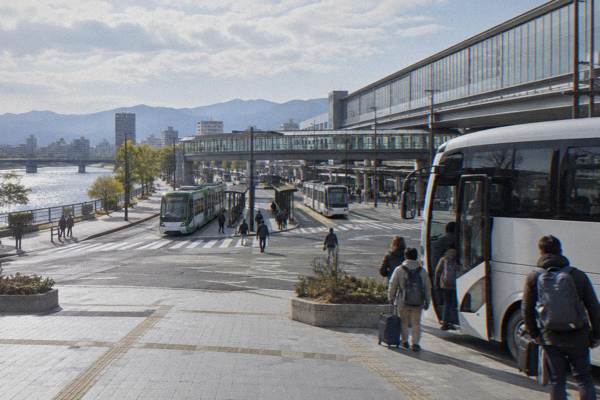
Renting A Car In Hiroshima: When It Helps
For most of the city itself the trams and trains do the work. A rental car earns its keep at the edges: the airport in Mihara, the Shimanami Kaido islands, and the small Seto Inland Sea towns the railways skip.
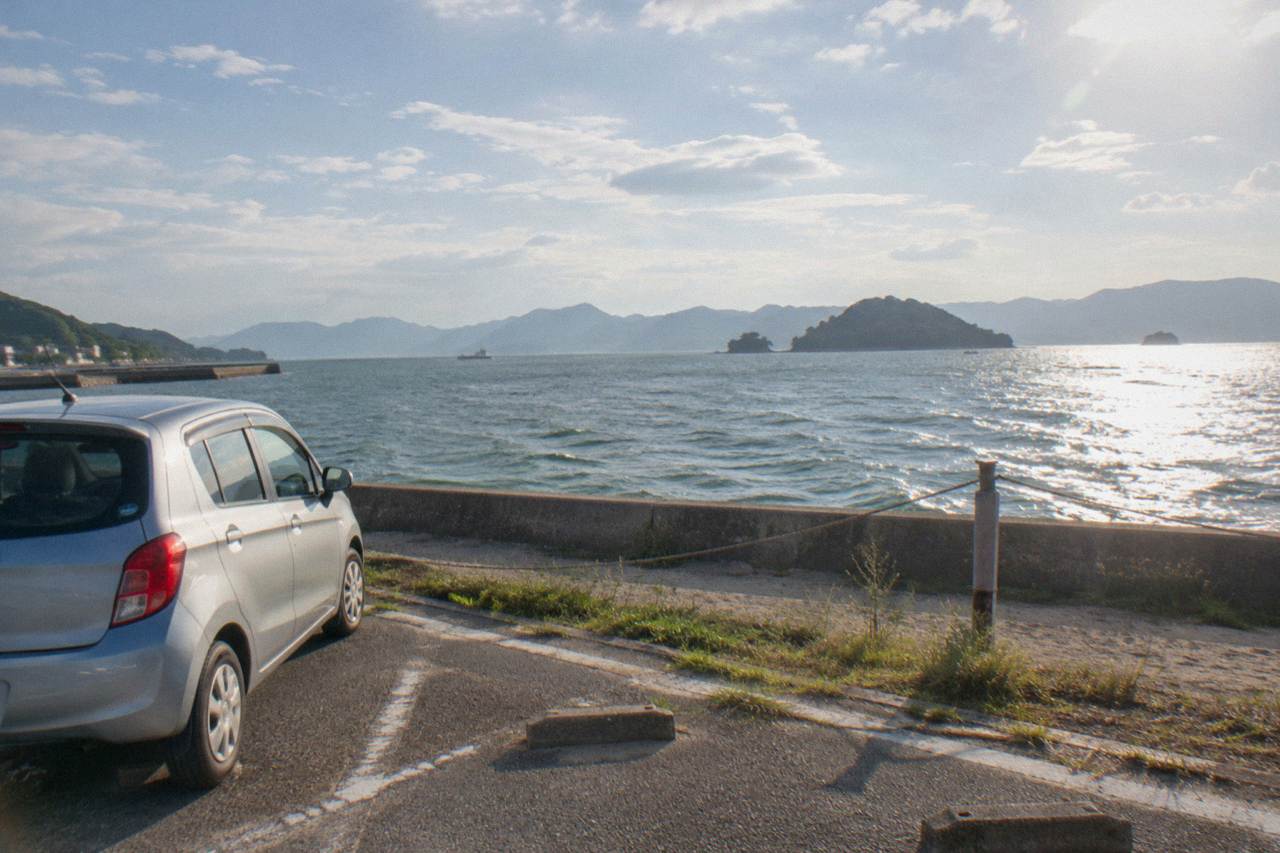
Rent a car in Hiroshima mainly for the airport, the Shimanami Kaido and scattered coastal towns; inside the city the Hiroden tram at 240 yen a ride, the JR lines and the Miyajima ferry cover nearly everything a visitor needs.
The Hiroden streetcar network runs on a flat fare of 240 yen for adults and 120 yen for children, every line including the Miyajima line, and the JR Sanyo Line carries passengers out to Miyajimaguchi for the ten-minute ferry crossing to Miyajima. The practical questions are where the rental counters are, what Japan requires from a foreign driver, roughly what a compact car costs, and the moments when the tram and the train simply win.
The case for and against splits neatly by geography. If the itinerary is the Peace Memorial Museum at 200 yen adult admission, Shukkeien at 350 yen, the castle grounds and a Miyajima day trip, the total spent on local transport can stay under a single day of parking and fuel. The car-rental question in Hiroshima is therefore a question about the second and third days of the trip, not the first.
Where Are The Car Rental Counters In Hiroshima?
The two main rental points in the Hiroshima area are Hiroshima Airport, whose six agencies share a counter complex called RENT-A-Car.Port a three-minute walk from the terminal on a pedestrian bridge, and the cluster around Hiroshima Station, including a Nippon Rent-a-Car branch three minutes east of the South Exit and a JR Eki Rent-a-Car desk in the GRANODE building by the North Exit. The airport counters keep long hours: Orix opens 8:00 to 20:00 and Nippon Rent-a-Car the same, while Times Car Rental runs 8:00 to 19:00. The station branches stretch later, with the Nippon South Exit location open until 21:00.
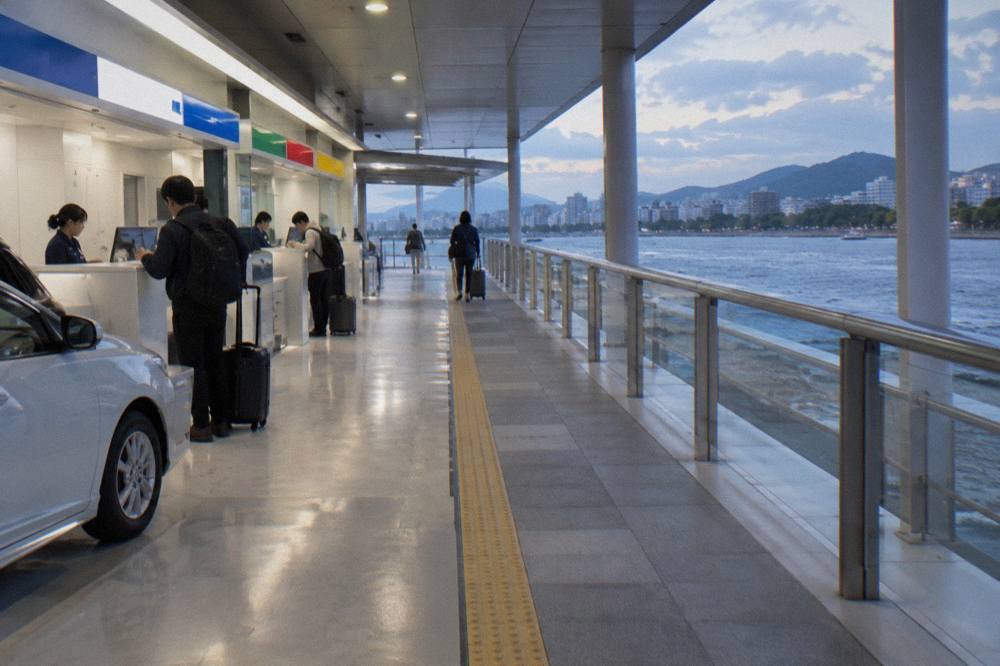
Six agencies operate counters at the airport's RENT-A-Car.Port, which sits on the far side of a pedestrian connecting bridge from the second floor of the passenger terminal, so there is no shuttle bus to factor into an arrival plan. Car-sharing stations, a separate category from the rental counters, sit on the fourth floor of the airport parking garage for drivers already registered with a sharing service.
| Counter | Location | Hours |
|---|---|---|
| Orix Rent-a-Car | Hiroshima Airport RENT-A-Car.Port | 8:00 to 20:00 |
| Nippon Rent-a-Car | Hiroshima Airport RENT-A-Car.Port | 8:00 to 20:00 daily |
| Times Car Rental | Hiroshima Airport RENT-A-Car.Port | 8:00 to 19:00 |
| Toyota Rent a Car | Hiroshima Airport, three-minute walk from terminal | see operator |
| Nippon Rent-a-Car | Hiroshima Station South Exit, three minutes east | 8:00 to 21:00 |
| JR Eki Rent-a-Car | GRANODE building, Station North Exit | see operator |
The airport placement matters because Hiroshima Airport is in Mihara, roughly 50 km east of central Hiroshima, and no rail line serves the terminal at all. A driver landing there can be on the road within minutes of the counter; a non-driver takes the limousine bus, covered below. Arriving by Shinkansen instead, the station cluster is the practical pickup point, and the Hiroshima Station area guide walks through which exits serve which transport.
To have navigation working from touchdown, book a travel eSIM here.
What Does A Hiroshima Car Rental Cost?
A compact car at Hiroshima Airport starts from roughly 7,700 to 10,340 yen per day according to late-October 2026 search results on a Japanese booking site, and that daily figure is the reference point from which everything else is added: fuel, expressway tolls, parking, and any extra-driver fees. The range is a reported market reference rather than a quoted counter rate, and the usual levers of Japanese rental pricing, season, lead time and duration, move the number well off that floor in peak weeks.
The tolls deserve their own line of arithmetic. The reported drive from Osaka to Hiroshima covers 327.1 km of expressway in about four hours and two minutes, with tolls around 8,380 yen one way for an ordinary car; wider estimates for the Osaka-area-to-Hiroshima-IC run 8,000 to 10,000 yen depending on route and discounts. A one-way intercity drive therefore carries a toll bill close to a second day of the car itself, before a drop-off fee if the rental is not returned to its origin branch.
Parking in central Hiroshima is a real cost the train traveller never sees, and it is the quiet argument of the whole page. Two adults riding the Hiroden all day, or pairing a 420 yen JR ride to Miyajimaguchi with the ferry and the 100 yen Miyajima visitor tax, spend a fraction of what a day of city parking plus fuel plus tolls adds to. The Hiroshima trip cost guide does the full budget arithmetic for both styles of travel.
What Documents Does A Foreign Driver Need To Rent In Hiroshima?
Drivers from most countries need the 1949 Geneva Convention International Driving Permit obtained at home before travel, since it cannot be issued inside Japan, and it stays valid for up to one year from the date of entry or until the permit or home licence expires, whichever comes first; licences from Switzerland, Germany, France, Belgium, Monaco and Taiwan instead require an official Japanese translation, and the counter will also want a passport. The Geneva IDP is the standard route for British, American, Australian and many other licences, and it must be arranged before departure because no Japanese office can print one for a visitor already in the country.
The six translation-required countries are a consistent trap at Japanese counters, including Hiroshima's. A Swiss or French licence holder arriving with only a Geneva IDP issued elsewhere, or with no translation at all, will be turned away, and the translation must be the official Japanese one rather than a private document. The rental counter checks the paperwork before the keys move.
| Licence origin | What the Hiroshima counter needs |
|---|---|
| Most Geneva Convention countries | 1949 Geneva IDP issued at home, plus passport and home licence |
| Switzerland, Germany, France, Belgium, Monaco, Taiwan | Official Japanese translation of the national licence, plus passport |
| Any country | Passport presented at the counter |
| Payment | A major credit card in the renter's own name at National Car Rental; debit cards and cash not accepted |
The payment rule is worth underlining: at the National Car Rental Hiroshima Airport location the renter must present a passport and a major credit card in the renter's own name, with debit cards and cash refused. The minimum rental age there is 18, and any additional driver must appear in person at the counter and sign the agreement, so a shared-driving couple should budget a few extra minutes rather than assume the second name rides free and unseen.
Miyajima itself is the place the car stays behind. Travellers who want the island covered for them can look at the Miyajima rickshaw experience, or Check availability for the operator's live listing, while the getting around Hiroshima guide covers the tram-and-ferry mechanics in full.
When Does A Car Actually Help In Hiroshima?
A rental car helps in the Hiroshima region with a region-wide itinerary, driving the Shimanami Kaido toll road that links the Hiroshima-area islands to Shikoku, and reaching small Seto Inland Sea towns and gorges that sit away from convenient rail lines; for the Peace Memorial Park, the museum, Shukkeien and Miyajima it helps far less than the tram and ferry do. The honest split is city versus coastline.
The Shimanami Kaido is the clearest car case of all. The toll road connects the islands between the Hiroshima area and Shikoku, and a car turns the crossing from a cycling project into a driving day with stops.
Inside the city the ledger flips. The Peace Memorial Museum charges 200 yen for adults and nothing for junior-high age and under; Shukkeien charges 350 yen; Itsukushima Shrine on Miyajima charges 300 yen; and every one of those destinations sits on a tram, a train or a ferry at a fraction of a parking spot's daily cost. The car in central Hiroshima buys flexibility it rarely gets to use.
| Destination from central Hiroshima | Without a car | With a car |
|---|---|---|
| Peace Memorial Park and museum | Hiroden tram, flat 240 yen | city parking at daily rates |
| Miyajima | JR line to Miyajimaguchi, ferry 200 yen plus 100 yen visitor tax | car stays at Miyajimaguchi; island is ferry-only |
| Shukkeien garden | tram or short ride, entry 350 yen | parking near the garden |
| Hiroshima Airport, Mihara | limousine bus 1,500 yen, 45 to 60 minutes | pickup at RENT-A-Car.Port, no rail to terminal |
| Shimanami Kaido islands | cycle the crossing or bus links | toll road built for this drive |
| Tomonoura, Takehara | slow by rail and bus | the reason to have wheels |
How Do You Get From Hiroshima Airport Without A Car?
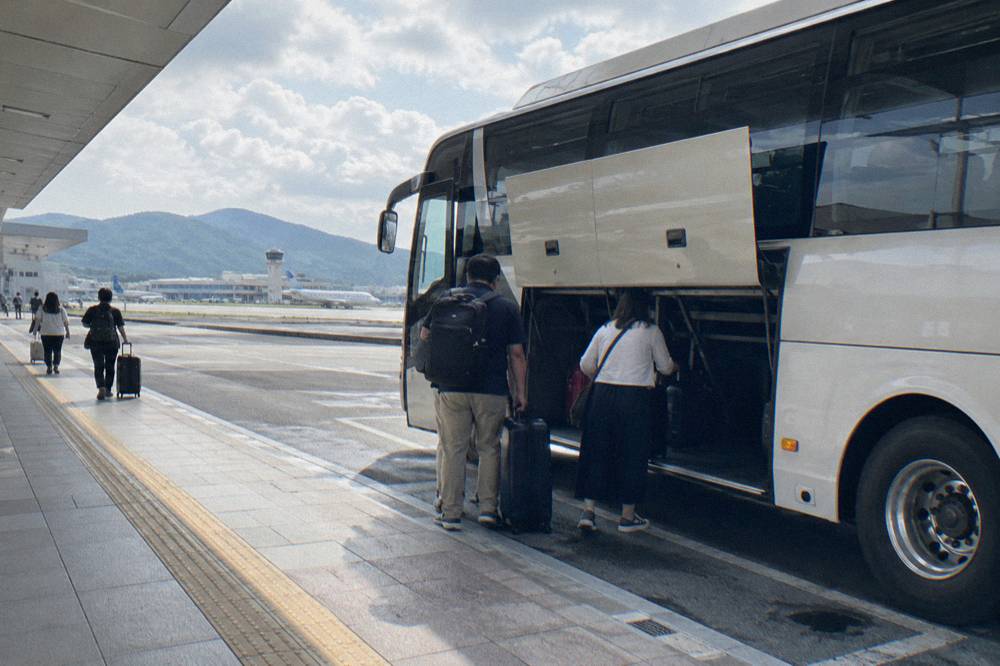
The limousine bus from Hiroshima Airport to Hiroshima Station's Shinkansen exit takes about 50 minutes and costs 1,500 yen for adults and 750 yen for children from Bus Stop 2, while the run to the Hiroshima Bus Center takes about 55 minutes at the same fare from Stop 1, IC cards are accepted, and both stand in for the rail link the terminal has never had. The airport lies in Mihara some 50 km east of the city, and the bus is the scheduled spine of that corridor.
For a visitor whose Hiroshima plan is the standard one, museum, castle grounds, Miyajima, the bus plus tram combination costs less than a single day of car hire and removes the parking question entirely. The Hiroshima Airport guide tracks the full arrival picture. Only when the itinerary fans out across the prefecture does the three-minute walk to RENT-A-Car.Port become the better first move of the trip.
Is Driving In Hiroshima Difficult For Visitors?
Driving in and around Hiroshima is left-side, sign-posted and toll-gated rather than technically hard, and the reported Osaka-to-Hiroshima run of 327.1 km in about four hours and two minutes over the Hanshin, Chugoku and Sanyo expressways to Hiroshima IC shows what the long legs feel like: motorway driving with tolls around 8,380 yen one way, followed by narrow, tram-shared city streets where the car is least useful. The dual character is the thing to plan around.
The expressway half is straightforward. The typical route from the Kansai side uses the Hanshin Expressway, the Chugoku Expressway and the Sanyo Expressway into Hiroshima IC, and the toll estimates cluster between 8,000 and 10,000 yen one way for an ordinary car depending on route and discounts. Fuel, tolls and time all argue for the Shinkansen on that corridor, which is why the Osaka to Hiroshima guide and the JR pass for Hiroshima guide treat the train as the default and the road as the exception.
The city half is where patience pays. Hiroshima's central streets carry the Hiroden trams, and since 3 August 2025, as reported, the tram now enters the Hiroshima Station building itself on the second floor. A driver dropping off or picking up near the station meets tram lanes, one-way grids and paid parking rather than open road, which is one more argument for collecting the car only on the morning the regional driving begins.
How Does Weather Affect A Hiroshima Road Trip?
The Japan Meteorological Agency's 1991-2020 station normals for Hiroshima put July as the wettest month at 279.8 mm of rain and August as the warmest with an average daily high of 32.8 °C, while January is the driest at 46.2 mm with an average low of 2.0 °C, so summer driving mixes heat with the rainy-season downpours and winter remains mild enough that snow is rarely the deciding factor at sea level. The numbers say plan around rain, not ice.
The wet half of the year builds steadily: 141.0 mm in April, 169.8 mm in May, 226.5 mm in June and the 279.8 mm July peak, before August drops back to 131.4 mm on average. For the Shimanami Kaido and the coastal drives, that curve matters more than temperature, since the crossing's appeal is its viewpoints. Autumn settles toward 109.2 mm in October and 69.3 mm in November, and the best time to visit Hiroshima guide and the Hiroshima weather guide carry the month-by-month detail.
| Month | Average high °C | Average low °C | Rain mm |
|---|---|---|---|
| January | 9.9 | 2.0 | 46.2 |
| April | 19.8 | 10.1 | 141.0 |
| July | 30.9 | 24.1 | 279.8 |
| August | 32.8 | 25.1 | 131.4 |
| October | 23.7 | 14.9 | 109.2 |
| November | 17.7 | 8.9 | 69.3 |
Car Or Train For The Miyajima Day Trip?
The car loses the Miyajima comparison: the JR Sanyo Line covers Hiroshima Station to Miyajimaguchi in about 25 to 30 minutes for a reported 420 yen one way, the ferry crossing takes about ten minutes at 200 yen plus the 100 yen visitor tax, and the island's sights from Itsukushima Shrine at 300 yen to the Mount Misen ropeway at 2,000 yen return are all reached on foot once ashore, so a car can only wait at the mainland pier. The Hiroden offers a slower, cheaper-flavoured alternative on its Line 2 streetcar, about 66 minutes to Hiroden-Miyajimaguchi on the flat 240 yen fare.
The two ferry operators, JR West Miyajima Ferry and Matsudai Kisen, each run about every 15 minutes through the daytime, with JR's first Miyajimaguchi departure at 6:25 and the last at 22:42, so the return is never a cliff-edge for a driver-turned-passenger. The Japan Rail Pass covers both the JR train to Miyajimaguchi and the JR ferry, though not the visitor tax, and Hiroden's own 1,000 yen one-day streetcar-and-ferry pass bundles the tram with the Matsudai crossing. The Hiroshima to Miyajima guide compares every combination.
What Are The Alternatives To Renting A Car In Hiroshima?
The workable car-free stack in Hiroshima is the 240 yen flat-fare Hiroden streetcar network across the city, the JR lines for Miyajimaguchi and the wider region, the ten-minute ferry for Miyajima, and a regional rail pass such as the Kansai-Hiroshima Area Pass at 17,000 yen for five days covering reserved Sanyo Shinkansen seats between Shin-Osaka and Hiroshima, which together beat the car on every corridor the rails actually serve. The pass point matters for anyone flying into Kansai and finishing in Hiroshima.
The one-way Shinkansen benchmark for the same corridor is 7,900 yen in basic fare for an adult from Osaka City to Hiroshima City before the express supplement, with children at 3,950 yen, so a five-day pass repays itself on a round trip plus regional use. Even luggage has a rail answer: same-day delivery from Osaka Station to Hiroshima Station or a city hotel runs 11,000 yen per bag with a noon hand-in deadline and pickup until 7 PM, sparing a driver the boot-space calculation entirely.
| Option | Coverage | Cost as verified |
|---|---|---|
| Hiroden streetcar | all city lines including the Miyajima line | flat 240 yen adult, 120 yen child |
| Hiroden 1-Day Streetcar and Ferry Pass | streetcars plus Matsudai Kisen ferry, not the JR ferry | 1,000 yen adult |
| JR Sanyo Line | Hiroshima Station to Miyajimaguchi | reported 420 yen one way |
| JR Miyajima Ferry | Miyajimaguchi to Miyajima | 200 yen plus 100 yen visitor tax |
| Sanyo Shinkansen | Osaka City to Hiroshima City | 7,900 yen basic adult fare plus express ticket |
| Kansai-Hiroshima Area Pass | 5 days, reserved Sanyo Shinkansen seats Shin-Osaka to Hiroshima | 17,000 yen adult |
| Airport limousine bus | Hiroshima Airport to Station or Bus Center | 1,500 yen adult, 750 yen child |
What Should You Check Before Signing The Rental Agreement In Hiroshima?
Before signing at a Hiroshima counter, confirm four things against the terms: the fuel-return rule and the nearest station to the drop-off point, the toll-card arrangement for the expressways, the treatment of any additional driver, who must appear in person and sign at National's counter, and the after-hours return procedure if the flight or the drive lands outside the counter's hours, which at the airport run to 19:00 or 20:00 depending on the agency. The paperwork stage is also where the translation and IDP checks bite.
The document set should be assembled before departure from home, since the Geneva IDP cannot be issued in Japan and the official Japanese translation for the six named licence countries takes time. The credit card must be in the renter's own name at National's Hiroshima Airport location, debit and cash refused, and the minimum age there is 18. None of this is exotic; all of it is easier fixed in a living room than at a counter at 9 PM after a long flight.
Where Can You Drive From Hiroshima On A Day Or Two?
The drive to Osaka covers 327.1 km of expressway taking about four hours and two minutes with tolls near 8,380 yen one way, while within the prefecture a car opens the Shimanami Kaido island road toward Shikoku and the coastal and gorge towns around Kure, Tomonoura, Takehara and Sandankyo that rail and bus serve slowly or not at all. Those two circles, regional and intercity, are what the rental is for.
The intercity drive is the one worth questioning every time. The Shinkansen covers Shin-Osaka to Hiroshima in about 80 to 85 minutes on a Nozomi, a reported figure from timetable services, against four hours at the wheel plus a toll bill approaching a day's hire rate. The regional drives face no such competitor. The Hiroshima car-free alternatives and the prefecture's day-trip pages carry the detail for each direction.
The closing arithmetic is simple enough to run on one hand. If the trip is Hiroshima city plus Miyajima, the tram, the JR line and the ferry total a few hundred yen a ride and the car is a cost without a job. If the trip fans out to the airport, the islands or the inland-sea towns, the counters at RENT-A-Car.Port and Hiroshima Station are ready for it, at a reported compact-class floor of roughly 7,700 to 10,340 yen a day, with the IDP or translation already in the passport holder. The rest of the planning lives in the Hiroshima Travel Guide pages on transport, seasons and the day trips themselves.
Common Questions About Renting A Car In Hiroshima
Where Are The Car Rental Counters At Hiroshima Airport?
Six agencies share the RENT-A-Car.Port counter complex, a three-minute walk from the second floor of the passenger terminal via a pedestrian connecting bridge, with no shuttle involved. Orix and Nippon Rent-a-Car open 8:00 to 20:00 and Times Car Rental 8:00 to 19:00.
Do I Need An International Driving Permit To Rent A Car In Hiroshima?
Drivers from most countries need the 1949 Geneva Convention IDP, issued at home before travel because it cannot be issued in Japan, valid for up to one year from entry. Licences from Switzerland, Germany, France, Belgium, Monaco and Taiwan need an official Japanese translation instead.
How Much Does It Cost To Rent A Car In Hiroshima?
Reported searches from late October 2026 put compact-car daily rates at Hiroshima Airport from around 7,700 to 10,340 yen, before fuel, expressway tolls and parking. The reported Osaka-to-Hiroshima drive alone carries roughly 8,380 yen in one-way tolls.
Is A Car Needed For Miyajima?
No. The JR Sanyo Line reaches Miyajimaguchi in about 25 to 30 minutes for a reported 420 yen, the ferry crossing takes ten minutes at 200 yen plus the 100 yen visitor tax, and the island's sights are reached on foot from the pier.
Can You Drive From Osaka To Hiroshima?
The reported route runs 327.1 km via the Hanshin, Chugoku and Sanyo expressways to Hiroshima IC in about four hours and two minutes, with tolls around 8,380 yen one way. The Sanyo Shinkansen covers the corridor in about 80 to 85 minutes from Shin-Osaka on a Nozomi.
What Payment Does A Hiroshima Rental Counter Accept?
At the National Car Rental Hiroshima Airport location the renter must present a passport and a major credit card in the renter's own name; debit cards and cash are not accepted, and the minimum age is 18. Additional drivers must appear in person and sign the agreement.