What To Eat In Hiroshima: Oysters, Tsukemen, Momiji Manju
Hiroshima food runs from layered okonomiyaki cooked on iron griddles to winter oysters off Miyajima grills, cold spicy tsukemen and maple-leaf-shaped cakes from island bakeries. Here is what to eat, where, and what it costs.
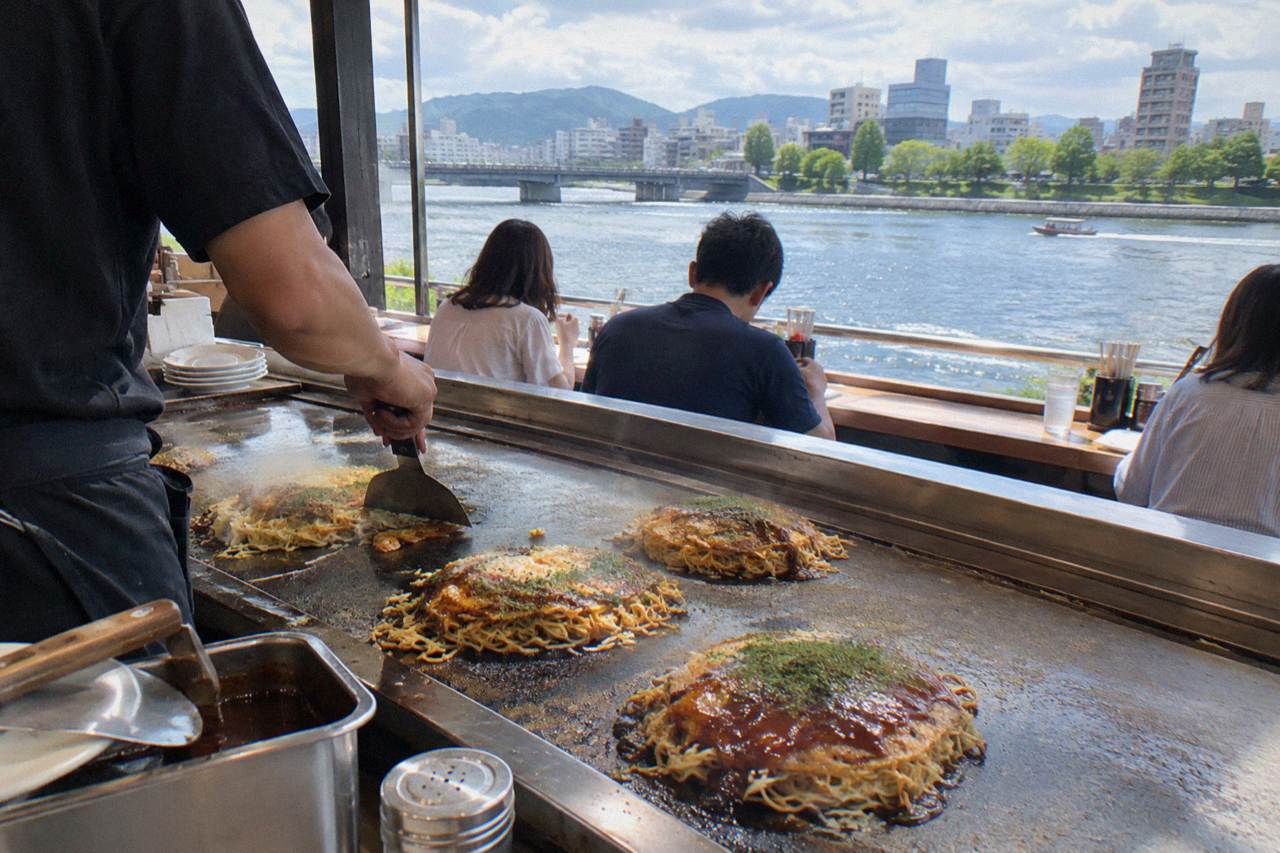
Hiroshima is known for okonomiyaki layered with cabbage and noodles, Seto Inland Sea oysters (November to March is the plump season), spicy cold tsukemen dipping noodles, anago-meshi eel rice and momiji manju souvenir cakes.
The Hiroshima city brand pages, the shrine island's shop signs and the ramen shops' own menus give a rare thing for a food destination: printed prices. For the wider picture of the city, start with things to do in Hiroshima.
What Food Is Hiroshima Famous For?
Hiroshima is famous above all for its own style of okonomiyaki, a layered savoury pancake built on a flour crepe with cabbage, noodles, pork and egg, plus Seto Inland Sea oysters, anago-meshi conger eel rice, cold spicy tsukemen dipping noodles and momiji manju, the maple-leaf-shaped filled cakes that have been baked on Miyajima since 1906. Together these dishes define eating in Hiroshima city and on the shrine island.
The layering is what separates Hiroshima okonomiyaki from the Osaka style: nothing is folded together. A thin crepe goes down first, a heap of cabbage on top, then soba or udon noodles, then egg, then a generous brush of the dark local sauce. Around Hiroshima Station the dish gets a dedicated dining floor too, covered further down this page.
The oyster is the other pillar. The season runs long, the grills on Miyajima work through the winter, and there is a whole Hiroshima oysters guide devoted to it. Anago-meshi, conger eel over rice, is the island's other classic, sold as a station ekiben as well as in restaurants.
Where To Eat Okonomiyaki In Hiroshima?
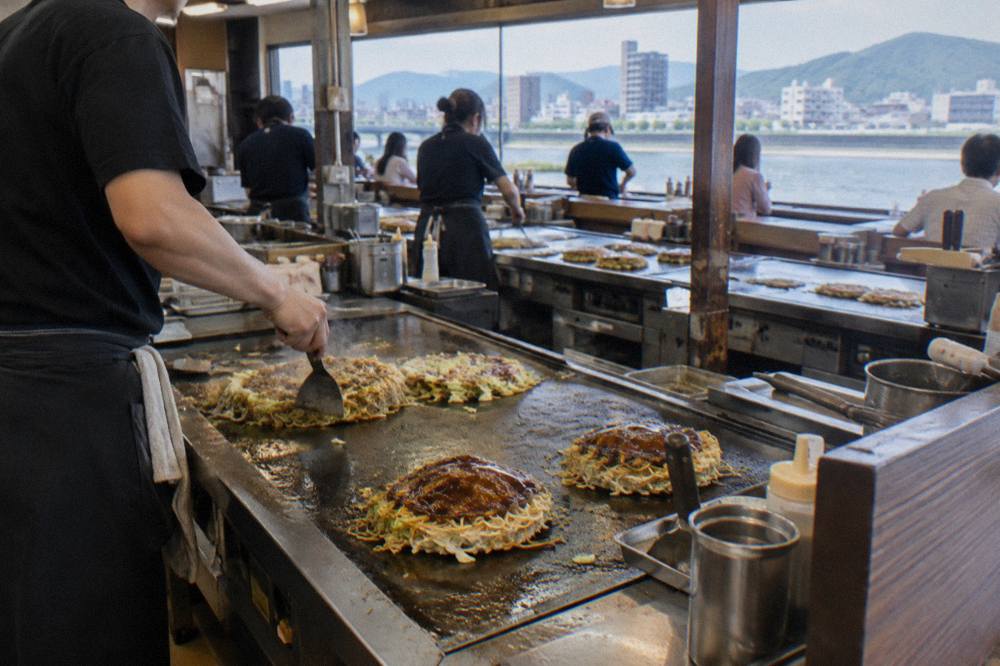
The ekie dining complex on the first floor of Hiroshima Station holds named okonomiyaki restaurants including Mitchan Sohonten and Rei-chan, and the Full Focus Building by the station holds Hiroshima Okonomi Story with fifteen okonomiyaki shops on its sixth floor.
Rei-chan, opened around 1955, sits on ekie 1F at 1-2 Matsubaracho, Minami-ku. A third name, Denko Sekka, runs both an ekie store and a Denkou Sekka Ekimae Hiroba branch on the sixth floor of the Hiroshima Full Focus Building at 10-1 Matsubara-cho. These are the printed addresses and hours from the shops' own listings.
| Okonomiyaki shop | Location | Hours |
|---|---|---|
| Mitchan Sohonten ekie branch | ekie, 1F, Hiroshima Station | 11:00 to 22:00 |
| Rei-chan | ekie 1F, 1-2 Matsubaracho, Minami-ku | 11:00 to 21:30 |
| Denko Sekka ekie store | ekie, 1-2 Matsubaracho | 11:00 to 23:00 |
| Denkou Sekka Ekimae Hiroba | 6F Full Focus Bldg, 10-1 Matsubara-cho | 10:00 to 23:00 (L.O. 22:30) |
| Mitchan Souhonten Hacchobori main store | 5-minute walk from Hacchobori tram stop, 47 seats | - |
Mitchan Souhonten's Hacchobori main store sits a five-minute walk from the Hacchobori tram stop, which the Hiroden flat fare of 240 yen covers from the station side of the centre. The Hacchobori and Kamiyacho guide and the Nagarekawa and Yagenbori guide cover the evenings around these districts, where okonomiyaki is one dinner among izakaya alleys and bars.
When Is Hiroshima Oyster Season?
Hiroshima Prefecture defines the oyster harvest season as running from October to June, and the plumpest oysters and the busiest shop-front grills come from November to March, when producers such as Yoneda Kaisan and Yano Suisan list their shucked oysters for supply, and Miyajima's grill counters serve them two at a time straight off the coals.
The raw-eating season opens later: the raw edible oyster ban in Hiroshima Prefecture is lifted on 20 October, per a prefectural season report, so raw oysters follow the grilled ones by a few weeks. Heated oyster supply runs longer still, October to April in Yano Suisan's listing. What this means for a visitor is simple: grilled oysters are a safe order almost any time the grills are lit, raw ones are a winter-and-spring pleasure, and February is the month the island throws its oyster parties.
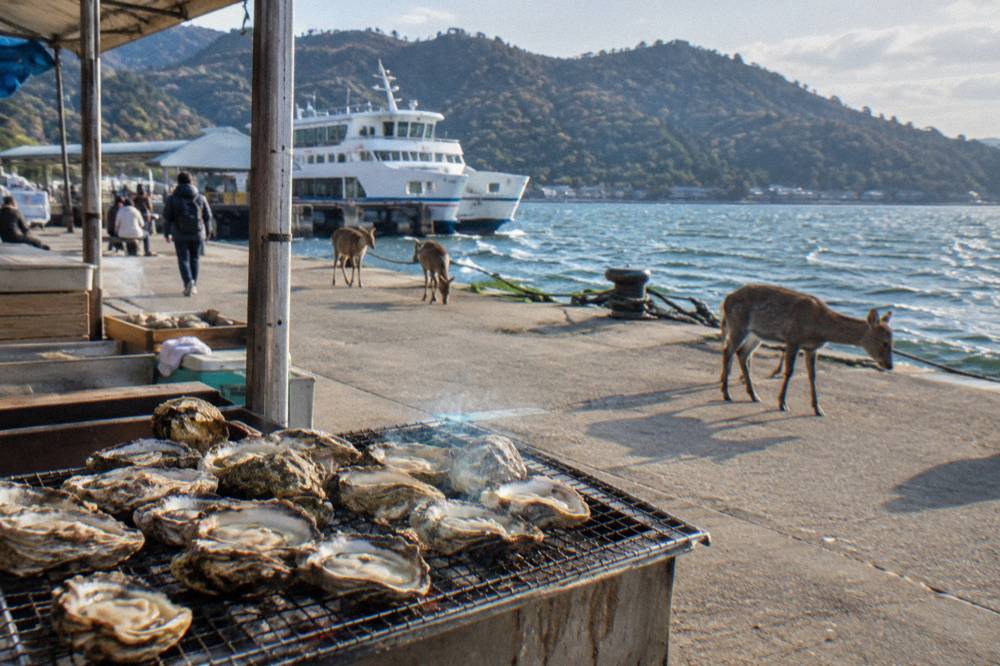
The Miyajima Oyster Festival is traditionally held on the second weekend of February from 10:00 to 15:00 in front of the ferry pier. The 42nd edition, scheduled for February 2026, was cancelled due to insufficient oysters, and no 2027 date had been announced. The Hiroshima Spring Oyster Festival 2026 ran 6 March to 19 April with 179 participating restaurants, and a Hiroshima Castle Oyster Fes was reported for 14 to 15 February on the castle grounds.
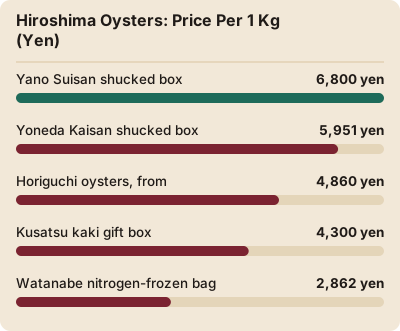
| Producer / product | Supply period | Price (tax included) |
|---|---|---|
| Yoneda Kaisan shucked oysters, 1 kg box | November to March | 5,951 yen |
| Yano Suisan shucked oysters, 1 kg box | November to March (heated: October to April) | 6,800 yen |
| Horiguchi oysters | November to March | from 4,860 yen |
| Kusatsu kaki oysters, 1 kg gift box | December to March | 4,300 yen |
| Watanabe Reishoku nitrogen-frozen oysters, 1 kg bag | year-round | 2,862 yen |
On the island itself, Kakiya on Miyajima's Omotesando opens at 10:00, takes no reservations and often closes around 16:00 or earlier when sold out, serving grilled oysters from two for 750 yen. Yakigaki no Hayashi grills from 10:30 to 17:00, closed Wednesdays, two oysters for 1,500 yen; its printed October 2026 menu also lists oyster rice at 1,600 yen and a special oyster fry at 2,100 yen. Single grilled oyster stall prices change seasonally and are posted at each shop.
What Is Momiji Manju?
Momiji manju is a small maple-leaf-shaped cake filled most traditionally with sweet bean paste, invented on Miyajima in 1906 by the confectioner Takatsu Tsunesuke and now sold across Hiroshima as the city's signature souvenir, at printed prices from 140 yen for a single cake to 1,820 yen for a twelve-piece box.
Two Miyajima makers are Yamadaya, at 140 yen a piece or 1,450 yen for ten, and Nishikido, a Hiroshima Station maker, in twelve-piece boxes at 1,820 yen, sold at Hiroshima Station and department stores. Nishikido's fresh nama-momiji version, at 152 yen a piece, keeps only one to two days against the baked cake's weeks.
The island variation is age momiji, the cake battered and deep-fried on a skewer. Kouyoudou on Miyajima sells it at 250 yen a skewer in five flavours: bean paste, cream, cheese, lemon and rare cheesecake. Momijido, nearby, sells baked momiji manju at 140 yen each and age momiji from 9:00 to about 17:30 seasonally. Shops along the Omotesando shopping street tend to close around 17:00, and several bake fresh in front of customers. The maple season itself, and the park behind all this confectionery, is covered in the Miyajima autumn leaves guide.
| Maker / product | Format | Price (tax included) | Shelf life |
|---|---|---|---|
| Yamadaya momiji manju | single / 10-piece box | 140 yen / 1,450 yen | 45 days |
| Nishikido momiji manju | 12-piece box | 1,820 yen | 20 days |
| Nishikido nama-momiji | single / 12 | 152 yen / 1,820 yen | 1 to 2 days |
| Kouyoudou age momiji | 1 skewer, 5 flavours | 250 yen | eaten on the spot |
What Is Hiroshima-Style Tsukemen?
Hiroshima-style tsukemen is a local version of dipping noodles in which cold or warm noodles come with a concentrated dipping sauce that diners spice themselves, most famously at Bakudanya, the main Hiroshima chain, whose chili scale runs from 1 to 20, and at Ramen Momiji, whose regular Hiroshima tsukemen is printed at 1,130 yen.
The dish is a Hiroshima native: it originated around 1954 at a restaurant called Shinkaen and spread through chains such as Bakudanya and Hiroshima Tsukemen Hompo. Bakudanya's Hacchobori branch keeps the night going until midnight. At Ramen Momiji, the tsukemen menu runs April to September, which matches the dish's cold-noodle logic: a regular Hiroshima tsukemen is 1,130 yen and a large 1,280 yen, with spice selectable as slightly, medium, very or none. A lemon tsukemen is 1,380 yen regular and 1,530 yen large. The wider set of guides lives on Hiroshima Travel Guide.
The chili scale deserves respect and a plan. The numbers are not decorative: a first-time order at the low end with the sauce on the side lets a diner build up, and the lemon version is the milder-flavoured route. Either way, tsukemen is the dish that surprises visitors who came for pancakes, and it belongs to the same late-night district as the okonomiyaki counters.
What To Eat Around Hiroshima Station?
Around Hiroshima Station, the Minamoa building by the Shinkansen exit holds okonomiyaki restaurants and shops, an anago-meshi ekiben is printed at 1,580 yen, a Shamoji Oyster Rice bento costs 1,600 yen from mid-September to the end of March, and an all-you-can-eat restaurant near the station runs from 4 to 11 PM from 3,000 yen.
The station's two food buildings divide the work. ekie sits on the first floor, directly connected to the station, holding Rei-chan, Mitchan Sohonten and Denko Sekka among its restaurants. Minamoa stands on the right side after exiting the Shinkansen Exit or the central ticket gate. The full station rundown, including the tram connection into the Hiroden network, is in the Hiroshima Station guide, and the eating question in full is answered at what to eat around Hiroshima Station.
The ekiben, the boxed meal sold for the train, is a Hiroshima genre of its own. The anago-meshi ekiben, conger eel over rice, is the island dish in box form at 1,580 yen including tax. The Shamoji Oyster Rice bento, at 1,600 yen including tax, is sold from mid-September to the end of March at lunch box shops inside the station, which aligns it neatly with oyster season. Kuishinbou, the all-you-can-eat spot near the station, operates 4 to 11 PM daily from 3,000 yen for diners who want volume.
What Food Souvenirs Can You Carry Home From Hiroshima?
Edible souvenirs from Hiroshima with printed prices include momiji manju boxes from 1,450 yen for ten, oyster senbei rice crackers using whole Hiroshima oysters at 540 yen for five pieces, a 140 g bottle of Hiroshima Oyster Concentrate at 1,620 yen, and kaki meshi no moto, an oyster-rice seasoning at 1,512 yen for two servings.
Shelf life decides what travels. A baked momiji manju box keeps 45 days and crosses an ocean without argument. The nama-momiji fresh cake keeps one to two days and is a this-week souvenir. Oyster products in the processed aisle are built for distance: the Oyster Concentrate has a two-year unopened shelf life, the nitrogen-frozen oysters keep three months frozen, and raw shucked oysters with their four- to five-day windows are for kitchens within reach of Hiroshima, not suitcases.
| Souvenir | Price (tax included) | Availability |
|---|---|---|
| Oyster senbei, 5-piece box (Maruichi) | 540 yen | year-round |
| Oyster senbei, 12-piece box (Maruichi) | 1,080 yen | year-round |
| Hiroshima Oyster Concentrate, 140 g | 1,620 yen | year-round |
| Kaki meshi no moto, 2 servings (Nakamura) | 1,512 yen | year-round |
| Kaki meshi no moto, 3 servings (Nakamura) | 1,998 yen | year-round |
Yoneda Kaisan's shucked oysters are retailed at Fukuya Hacchobori and Hiroshima Station stores, which makes the station the last practical stop for cold goods before a train. The wider shopping picture is in the Hiroshima shopping and souvenirs guide.
For travelers who want their cakes as fresh as possible, Miyajima is an easy day trip. The JR ferry crosses from Miyajimaguchi in about ten minutes, with departures roughly every fifteen minutes from 8:00 into the early evening; the first boat of the day leaves about 6:25 and the last about 22:00. Sailings that pass in front of the Great Torii run from 9:10 to 16:10, and a second operator, Matsudai Kisen, runs boats about every fifteen minutes on a service that starts at 7:00. Note the Miyajima Visitor Tax of 100 yen, charged separately on entering the island, with preschool children exempt. Groups of eight or more pay a 160 yen one-way fare on the JR ferry, and Japan Rail Pass and JR-West Rail Pass holders can ride it on their passes.
Reaching the pier is inexpensive and simple to budget. Since February 2025, every Hiroden tram line has charged a flat 240 yen for adults and 120 yen for children, including the Miyajima line that runs out to Miyajimaguchi. At the city end, the trams now enter the Hiroshima Station building itself, so the station shops stocked with packed oyster goods sit directly on the tram network.
Cold purchases also travel well to the airport. The limousine bus links Hiroshima Airport with the Shinkansen exit of Hiroshima Station in about 50 minutes, at 1,500 yen per adult and 750 yen per child, and it also serves Hiroshima Bus Center, about 55 minutes, at the same fares. IC cards are accepted on board, a handy detail when both hands are carrying souvenir boxes.
What And Where To Drink In Hiroshima?
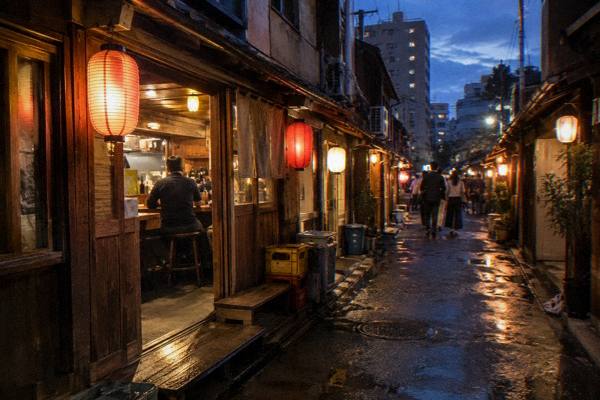
Drink in Hiroshima in the izakaya alleys of Nagarekawa and Yagenbori: Nagarekawa for bars and noise, Yagenbori for the older lantern-lit lanes, and an okonomiyaki counter whenever the night needs feeding. The guided Hiroshima izakaya food and drink night tour, which moves through the drinking districts over three hours, is an alternative to finding the alleys independently.
The Hiroshima at night guide maps the districts.
Guided food walks cover the same ground with a menu attached. The Hiroshima izakaya food and drink night tour moves through the drinking districts over three hours, and the food and culture walking tour with dinner pairs the city's food with its story. For a day built around both the Peace Park and a local guide's food picks, Check availability for the Hiroshima & Miyajima Private Custom Tour with Local Guide, whose route bends to what its guests want to eat.
Should You Take A Food Tour In Hiroshima?
A food tour in Hiroshima makes sense for the izakaya alleys and the island grills, where the printed options range from a three-hour izakaya night tour to an all-inclusive nighttime food walk and a private custom day that can be steered toward food districts, and a first-time visitor with limited evenings gets more from one guided night than from guesswork among unmarked counters.
The choice is between depth and breadth. The izakaya night tour stays in the city and drinks with the locals. The all-inclusive nighttime walk adds cultural stops between courses. A private custom tour, like the Hiroshima & Miyajima Private Custom Tour with Local Guide, can build a whole day that ends on Miyajima with grilled oysters, which pairs the city's two food pillars in one itinerary. The cooking class guide covers the other direction: learning to make the pancake rather than being served one.
Timing matters as much as the tour. Oyster dishes peak from November through March, the Spring Oyster Festival stretches the season into April, and the summer months lean toward tsukemen, whose April-to-September menu window at Ramen Momiji matches the heat. The best time to visit Hiroshima guide and the Hiroshima weather guide put the food calendar against the climate: the Japan Meteorological Agency station normals for 1991-2020 show July bringing 279.8 mm of rain and August as the warmest at an average daily high of 32.8 °C, while January's average daily low sits at 2.0 °C, mild enough that oyster grills stay busy.
Common Questions About Eating In Hiroshima
What Food Is Hiroshima Famous For?
Hiroshima is famous for its layered okonomiyaki, Seto Inland Sea oysters, anago-meshi eel rice, cold spicy tsukemen and momiji manju cakes. The momiji manju has been made on Miyajima since 1906, and tsukemen dates to around 1954 in the city.
What Is Momiji Manju?
Momiji manju is a maple-leaf-shaped cake, traditionally filled with sweet bean paste, invented on Miyajima in 1906 by confectioner Takatsu Tsunesuke. Single cakes cost from 140 yen, and a fried version called age momiji is sold on the island at 250 yen a skewer in five flavours.
When Can You Eat Raw Oysters In Hiroshima?
The raw edible oyster ban in Hiroshima Prefecture is lifted on 20 October, per a prefectural season report, and producers list raw supply from November to March. Grilled oysters start earlier, with heated supply running October to April, and nitrogen-frozen oysters are sold year-round.
Is Hiroshima Okonomiyaki Different From Osaka Style?
Yes. Hiroshima okonomiyaki is cooked in layers, with a crepe, cabbage, noodles, pork and egg stacked rather than mixed together, and it is finished with a dark local sauce. Osaka style folds the ingredients into one batter.
Where Can You Buy Momiji Manju Outside Miyajima?
Nishikido sells momiji manju in 12-piece boxes at 1,820 yen at Hiroshima Station and department stores, and Yamadaya's cakes are sold widely as souvenirs. The baked cakes keep up to 45 days, so they travel well.
What Food Souvenir Keeps Longest From Hiroshima?
The Hiroshima Oyster Concentrate, a 140 g bottle at 1,620 yen, has a two-year unopened shelf life. Baked momiji manju keep 45 days and oyster senbei are dry crackers, while fresh nama-momiji cakes last only one to two days.
Eating in Hiroshima is a two-place affair: the griddles and dipping noodles of the city, and the oyster smoke of the island, tied together by a 10-minute ferry and a century-old maple cake. Bring an appetite for layers, a tolerance for chili measured on a scale of one to twenty, and an empty corner of the suitcase for the senbei.